
Skip to content
The Encyclopedia of Horology

Clock · Mantel clock

Meissen Porcelain Mantel Clock, Model 1047

Partially verified

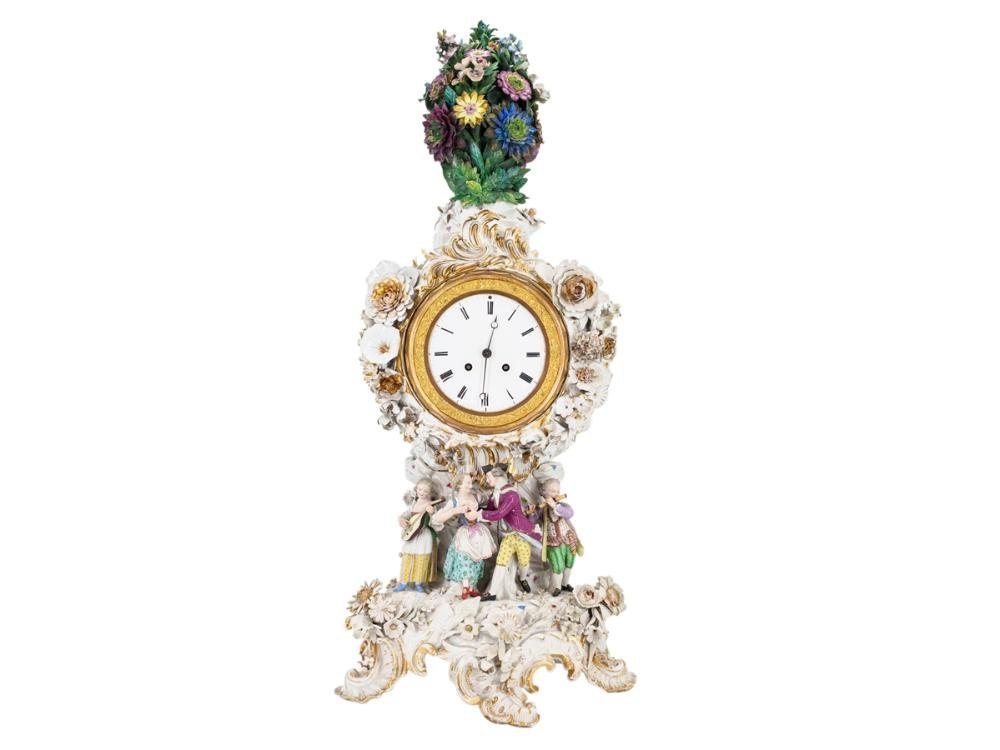
This large mantel clock is a product of the Meissen porcelain manufactory, based on a design originated around 1770 by Johann Joachim Kaendler, specifically identified by the model number 1047. The timepiece features an extensive porcelain case decorated with rocaille motifs and filigree floral elements. The upper section is crowned with a large bouquet of sculpted, vividly colored flowers. Beneath the central enameled clock dial, the base integrates a fully sculpted figure group consisting of two musicians flanking a dancing couple. Standing approximately 68 centimeters tall, the clock is described as having a first-quality classification. The piece is marked with the underglaze blue crossed swords mark, which, according to the provided documentation, places the production of this specific specimen within the timeframe of 1815 to 1924. The clock combines complex sculptural porcelain components with functional timekeeping elements, adhering to the design specifications attributed to the Kaendler model.

Meissen porcelain mantel clock, model 1047.
Meissen porcelain mantel clock, model 1047. — Pari Auktionen, via Invaluable. Rights pending — permission not yet requested. Original source

Catalogue identity

Source
orbiscollectibles.com
Category
Clock · Mantel clock
Maker / attribution
Meissen porcelain manufactory
Reference
1047
Catalogue / lot identifier
Source URL identifies the listing
Source-reported date
1815-1924
Source-reported place
Germany

Source-reported attribution and specifications are not independent authentication. A listing does not establish present ownership, current display, availability or permission to reproduce.

Object description

Case Design and Decoration

The mantel clock is constructed from porcelain, featuring an ornate design categorized within the Rococo style. The case is characterized by complex rocaille motifs and filigree floral elements integrated into the structure. A notable decorative feature is the crowning bouquet of vividly colored, sculpted flowers that sits at the apex of the clock.

The lower portion of the object serves as a base for a sculpted porcelain figure group. This group consists of a dancing couple positioned centrally, flanked on either side by a musician. The overall aesthetic balances sculptural detail with painted surfaces, consistent with the identified model 1047 design.

Evidence for this section
  • “porcelain case decorated in the ornate Rococo style with elaborate rocaille motifs and filigree floral elements”
  • “crowning bouquet of vividly colored, sculpted flowers serves as the focal point of the upper section”
  • “base displays a fully sculpted figure group consisting of a dancing couple flanked by two musicians”
  • “indicated by the first-quality classification”

Signatures and Dating

The clock is identified by its underglaze blue crossed swords mark. This mark serves as the primary indicator for the dating of the object, as the provided source documentation attributes this specific mark to production occurring between 1815 and 1924.

While the model design originates from a 1770 concept by Johann Joachim Kaendler, the physical specimen described belongs to the 19th- or early 20th-century production era.

Evidence for this section
  • “marked with the underglaze blue crossed swords, which dates the production of this specific piece to the period between 1815 and 1924”
  • “based on a design from around 1770 by Johann Joachim Kaendler”

Timekeeping Components

The clock features an enameled dial set within the porcelain case. The dial serves as the primary functional component of the mantel clock, framed by the surrounding porcelain rocaille work.

The functional mechanics of the clock are secondary to the porcelain sculptural assembly, which occupies the majority of the object's height and visual focus.

Evidence for this section
  • “Beneath the enameled clock dial”

Open research questions

  • What is the condition of the internal clock movement mechanism?
  • Does the porcelain case exhibit any firing cracks or restorations?

Source evidence

Recorded claims and source quotations for Meissen Porcelain Mantel Clock, Model 1047
FieldSource-reported valueSource quotation
MakerMeissen porcelain manufactory“masterwork produced by the Meissen porcelain manufactory”
DesignerJohann Joachim Kaendler“based on a design from around 1770 by Johann Joachim Kaendler”
Model Number1047“model number 1047”
Height68 cm“stands approximately 68 centimeters tall”
Production Date1815-1924“dates the production of this specific piece to the period between 1815 and 1924”
MarkUnderglaze blue crossed swords“marked with the underglaze blue crossed swords”

Visible details

  • Enameled circular clock dial
  • Sculpted floral bouquet cresting
  • Figure group of musicians and dancers at base
  • Gilt metal bezel surround

Research qualifications

  • Attribution to Kaendler is based on a later model design.
  • Precise manufacture year within the 1815-1924 range is not specified.

Photograph identity and source facts were screened before import; rights clearance remains pending.

Consulted source

Meissen porcelain mantel clock, model 1047 after Johann Joachim Kaendler

Reviewed 2026-11-02 · Record 917118f475

Terms in this record

Glossary explanations for terms named in this object’s record.