
Skip to content
The Encyclopedia of Horology

Clock · Mantel clock

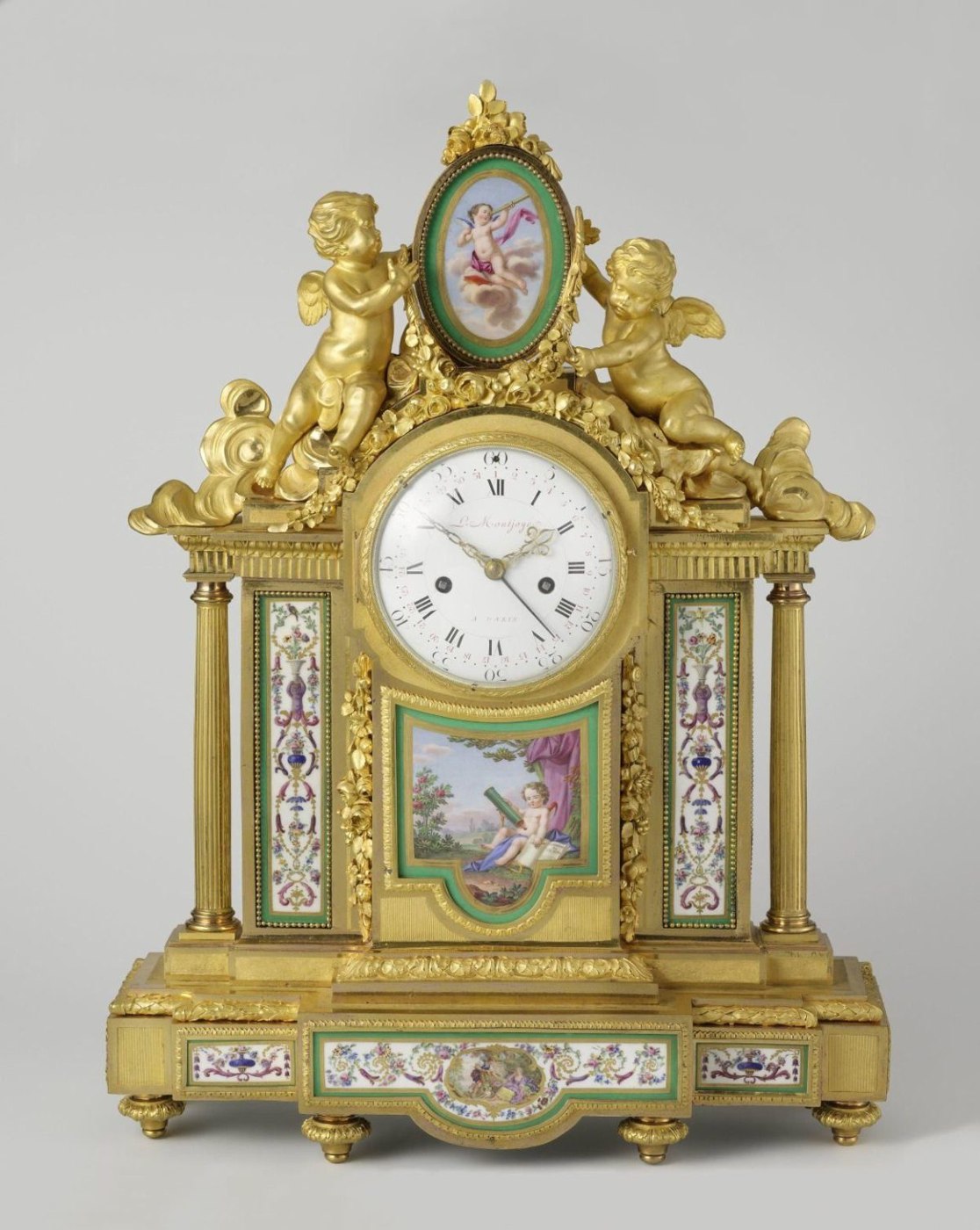
Mantel clock with Sèvres porcelain plaques

Partially verified

This mantel clock (pendule) is a collaboration between horologist Louis Montjoye and the Sèvres porcelain manufactory, dating to circa 1781-1782. The clock features an architectural case constructed of gilt bronze, incorporating free-standing Tuscan columns and intricate decorative elements. It is distinguished by its integration of Sèvres porcelain plaques, which include floral motifs and figurative scenes, as well as an oval medallion held by putti atop the case. The enamel dial is signed by Montjoye, who also engraved his signature on the rear movement plate. Purchased in 1782 by Grand Duke Paul of Russia and his wife Maria Feodorovna from the Parisian marchand-mercier Dominique Daguerre, the object reflects the materials and artistic partnerships of its time.

Mantel clock in gilt bronze and Sèvres porcelain, signed by Louis Montjoye.
Mantel clock in gilt bronze and Sèvres porcelain, signed by Louis Montjoye. — Rijksmuseum. Rights pending — permission not yet requested. Original source

Catalogue identity

Source
www.rijksmuseum.nl
Category
Clock · Mantel clock
Maker / attribution
Louis Montjoye
Reference
BK-16672
Catalogue / lot identifier
BK-16672
Source-reported date
c. 1781 - c. 1782
Source-reported place
France

Source-reported attribution and specifications are not independent authentication. A listing does not establish present ownership, current display, availability or permission to reproduce.

Object description

Construction and Design

The mantel clock is an architectural composition realized in gilt bronze and Sèvres porcelain. The base features a prominent central plaque depicting pastoral figures and floral motifs, flanked by panels decorated with floral patterns. The main body incorporates free-standing Tuscan columns which flank a central section housing the clock face. Above the dial, two bronze putti support an oval medallion containing a porcelain plaque of a putto set against a sky background.

Below the circular dial, which features Roman numerals, sits a bronze putto equipped with instruments including a telescope, compass, and an open book. The book displays the title "CONNAISSANCE des TEMPS" in painted script.

Evidence for this section
  • “Het voetstuk komt twee keer naar voren en dit wordt gevolgd door het centrale veld erboven, geflankeerd door plaques met groteske-motieven en vrijstaande Toscaanse zuilen.”
  • “Onder de ronde wijzerplaat een putto met kijker, passer, boek en motto.”

Signatures and Technical Marks

The clock bears several inscriptions identifying the various craftsmen involved in its creation. Louis Montjoye, the horologist, signed the enamel dial in red paint and engraved his name on the rear movement plate. An additional signature, "montjoye a Cantième," is present on the dial mount.

Further internal and hidden markings indicate the involvement of specialists. The enamelist Georges-Adrien Merlet signed the reverse of the dial. Springs within the movement are inscribed with "Richard x 1781," indicating the involvement of a spring-maker. These marks provide evidence of the collaborative process between the various workshops engaged in the production of the timepiece.

Evidence for this section
  • “signatuur, op de achterplaat, gegraveerd: ‘Louis Montjoye AParis’”
  • “signatuur, op de achterzijde van de wijzerplaat, geschilderd in zwart email: ‘G Merlet’”
  • “inscriptie, op de veer van het gaand werk, ingegrift: ‘Richard x 1781’”

Provenance

The object was acquired in 1782 by Grand Duke Paul of Russia and Maria Feodorovna through the marchand-mercier Dominique Daguerre. The clock later formed part of the collection of Dr. Fritz Mannheimer in Amsterdam and Paris by 1933.

Following the displacement of objects during the Second World War, the clock was purchased for the Führermuseum in Linz in 1940. It was recovered by the Stichting Nederlands Kunstbezit (SNK) in 1945 and subsequently entered the collection of the Rijksmuseum, where it was placed on loan in 1952 and formally transferred in 1960.

Evidence for this section
  • “In 1782 kochten groothertog Paul van Rusland, de latere tsaar Paul I, en zijn echtgenote Maria Feodorovna dit kostbare pronkstuk bij de Parijse handelaar (marchand-mercier) Dominique Daguerre.”

Open research questions

  • What is the significance of the 'Richard x 1781' signature on the movement springs in relation to the primary clockmaker?
  • Does the 'montjoye a Cantième' signature on the dial mount imply a specific workshop location or secondary collaborator?

Source evidence

Recorded claims and source quotations for Mantel clock with Sèvres porcelain plaques
FieldSource-reported valueSource quotation
EnamelistGeorges-Adrien Merlet“signatuur, op de achterzijde van de wijzerplaat, geschilderd in zwart email: ‘G Merlet’”
Dimensions65 cm x 48 cm x 17 cm“hoogte 65 cm x breedte 48 cm x diepte 17 cm”
Object NumberBK-16672“Objectnummer BK-16672”
AcquisitionPurchased by Paul I of Russia in 1782“In 1782 kochten groothertog Paul van Rusland, de latere tsaar Paul I, en zijn echtgenote Maria Feodorovna dit kostbare pronkstuk”
MaterialsGilt bronze, enamel, soft-paste porcelain“Fysieke kenmerken verguld brons, email, beschilderd en verguld porselein (pâte tendre)”

Visible details

  • Putto beneath the dial holds a book inscribed with 'CONNAISSANCE des TEMPS'
  • Gilt bronze case features free-standing Tuscan columns
  • Enamel dial signed by Louis Montjoye in red
  • Oval medallion featuring a painted putto set above the dial

Research qualifications

  • Historical provenance during the 1933-1945 period is noted by the museum as potentially incomplete
  • Specific functions of internal components like the 'Richard x 1781' springs are not detailed beyond their marking

Photograph identity and source facts were screened before import; rights clearance remains pending.

Consulted source

Mantel clock (pendule), c. 1781 - c. 1782

Reviewed 2026-11-02 · Record 6c92fce724

Terms in this record

Glossary explanations for terms named in this object’s record.