
Skip to content
The Encyclopedia of Horology

Clock · Mantel clock

Mantel Clock with Madonna and Child

Partially verified

This mantel clock, held in the collection of The Metropolitan Museum of Art (accession number 1999.253), dates to the period of 1840–50. It is attributed to the maker Honoré Pons, who was active between 1807 and 1850. The clock features an elaborate construction combining several materials; the case is composed of gilded and patinated bronze, wood, glass, and marble. The dial is crafted from gilt brass and enamel, while the movement is made of brass and steel. The overall dimensions are 21 1/4 by 15 1/2 by 7 1/4 inches. The object is catalogued by the museum’s European Sculpture and Decorative Arts department and remains part of the museum's permanent collection records.

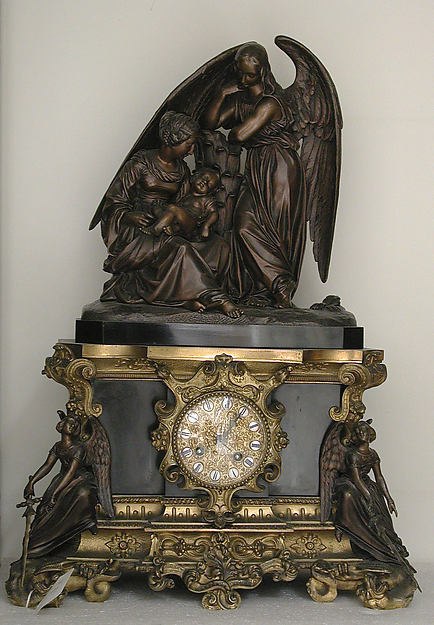
The mantel clock is shown with its central sculptural group of the Madonna and Child and the flanking winged figures at the base.
The mantel clock is shown with its central sculptural group of the Madonna and Child and the flanking winged figures at the base. — The Metropolitan Museum of Art, New York. Rights pending — permission not yet requested. Original source

Catalogue identity

Source
orbiscollectibles.com
Category
Clock · Mantel clock
Maker / attribution
Honoré Pons
Reference
Not recorded
Catalogue / lot identifier
1999.253
Source-reported date
1840–50
Source-reported place
Not established

Source-reported attribution and specifications are not independent authentication. A listing does not establish present ownership, current display, availability or permission to reproduce.

Object description

Construction and Materials

The primary structure integrates gilded and patinated bronze, which is used for both the complex sculptural elements and the decorative mounts applied to the body. This bronze is set against a dark marble foundation, which provides a weighted base for the internal mechanical movement. Wood and glass components are also noted in the structural makeup of the housing.

The timepiece component is set into a central panel. The dial itself is composed of gilt brass and enamel, which contrasts with the darker patinated bronze of the figural groups. The total measurements of the assembly are recorded as 54 centimeters in height, 39.4 centimeters in width, and 18.4 centimeters in depth.

Evidence for this section
  • “Case: bronze, gilded and patinated; marble; wood; glass; Dial: gilt brass and enamel; Movement: brass and steel”
  • “Overall: 21 1/4 × 15 1/2 × 7 1/4 in. (54 × 39.4 × 18.4 cm).”

Iconography and Design

The visual design of the clock is defined by its elaborate sculptural top section and flanking figures. The central iconographic theme is the Madonna and Child, a sculptural group rendered in patinated bronze. This group is mounted on a plinth above the clock face. The base of the clock incorporates further sculptural figures, specifically winged angels positioned to the left and right, who are depicted alongside representations of swords.

The arrangement of these elements reflects a specific thematic programme catalogued by the museum.

Evidence for this section
  • “Subject tags assigned by the museum: Swords, Angels, Madonna and Child.”
  • “Mantel clock, 1840–50”

Attribution and Documentation

This object is currently attributed to Honoré Pons, a maker recorded as active between 1807 and 1850. The documentation provided by The Metropolitan Museum of Art serves as the primary record for this clock. The object has been assigned the accession number 1999.253 and is catalogued within the museum's European Sculpture and Decorative Arts department.

The attribution to Pons is listed in the museum records, though the status of this identification remains subject to ongoing verification. As the record serves as an entry in the museum's open-access collection, it provides the fundamental data regarding the clock's materials, dimensions, and subject matter without providing further contextual history or specific technical analysis of the movement's escapement.

Evidence for this section
  • “It is attributed to Honoré Pons (recorded 1807–50).”
  • “Mantel clock in The Metropolitan Museum of Art, New York (accession 1999.253), catalogued by the museum's European Sculpture and Decorative Arts department.”

Open research questions

  • Does the clock movement bear an explicit maker's mark or signature to confirm the attribution to Honoré Pons?
  • Are there similar extant models by Honoré Pons that confirm the intended grouping of these specific bronze sculptural subjects?

Source evidence

Recorded claims and source quotations for Mantel Clock with Madonna and Child
FieldSource-reported valueSource quotation
MakerHonoré Pons“It is attributed to Honoré Pons (recorded 1807–50).”
Accession Number1999.253“Mantel clock in The Metropolitan Museum of Art, New York (accession 1999.253)”
Date1840–50“The museum dates it 1840–50.”
Case MaterialsBronze, marble, wood, glass“Case: bronze, gilded and patinated; marble; wood; glass”
Dial MaterialsGilt brass and enamel“Dial: gilt brass and enamel”
Dimensions21 1/4 x 15 1/2 x 7 1/4 inches“Overall: 21 1/4 × 15 1/2 × 7 1/4 in. (54 × 39.4 × 18.4 cm).”
Subject MatterMadonna and Child, swords, angels“Subject tags assigned by the museum: Swords, Angels, Madonna and Child.”

Visible details

  • The clock dial is surrounded by ornate gilded bronze scrollwork
  • The base features seated winged figures positioned on either side of the dial
  • A large sculptural group depicting the Madonna and Child stands atop the clock base
  • The clock movement is housed within a dark marble-faced case with gilt bronze mounts

Research qualifications

  • The attribution to Honoré Pons is not explicitly confirmed by a signature visible on the object
  • The wider horological context and typology of this clock require further specialist verification beyond the museum record

Photograph identity and source facts were screened before import; rights clearance remains pending.

Consulted source

Mantel clock, 1840–50

Reviewed 2026-11-02 · Record c2b3336fac

Terms in this record

Glossary explanations for terms named in this object’s record.