
Skip to content
The Encyclopedia of Horology

Clock · Mantel clock

Mantel clock with Arachne and Athena

Partially verified

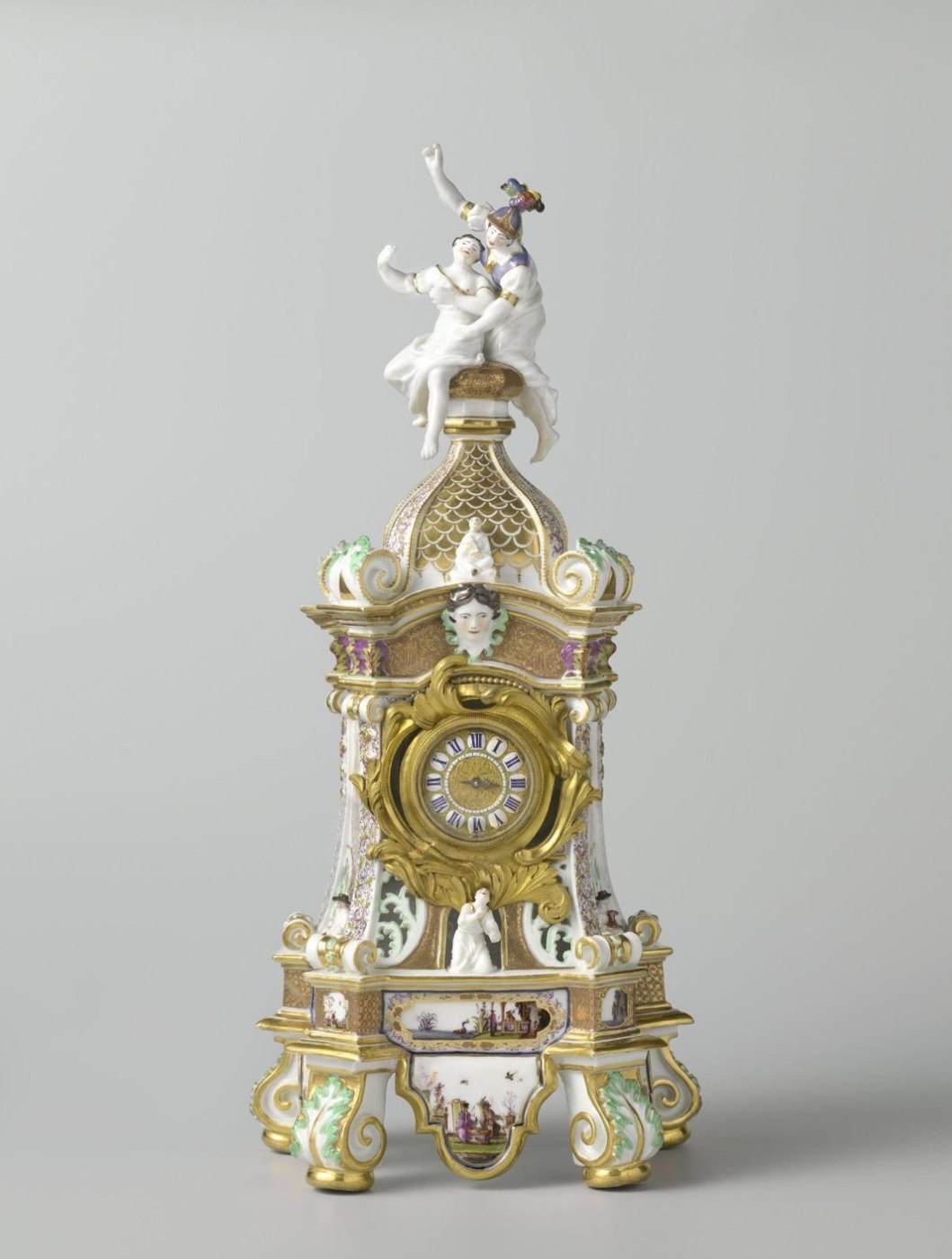
This mantel clock features a case of painted porcelain produced by the Meissener Porzellan Manufaktur in 1727, with movement by the Parisian maker Barrey. The case is constructed as a small architectural structure with a trapezoidal base supported on four overhanging feet decorated in relief with acanthus leaves. A domed top crowns the body and supports porcelain figures representing Arachne and Athena. The lower sections of the case walls are pierced on three sides, incorporating arched openings where Chinese-style figures are seated or kneeling. The rear wall is decorated with Indianische Blumen, while other surfaces feature Höroldt-chinoiseries. The clock dial is framed by gilt metal mounts. The piece is attributed to porcelain modellers Johann Gottlieb Kirchner and George Fritzsche. This object holds a detailed provenance including the Oppenheimer collection, wartime confiscation for the Führermuseum, and eventual acquisition by the Rijksmuseum in 2021 following restitution.

Front view of the Meissen porcelain mantel clock featuring Arachne and Athena figures.
Front view of the Meissen porcelain mantel clock featuring Arachne and Athena figures. — Rijksmuseum. Rights pending — permission not yet requested. Original source

Catalogue identity

Source
www.rijksmuseum.nl
Category
Clock · Mantel clock
Maker / attribution
Meissener Porzellan Manufaktur / Barrey
Reference
BK-17437
Catalogue / lot identifier
BK-17437
Source-reported date
1727
Source-reported place
Germany

Source-reported attribution and specifications are not independent authentication. A listing does not establish present ownership, current display, availability or permission to reproduce.

Object description

Case Design and Construction

The clock is housed in an ambitious porcelain case designed as a small architectural construct with a distinctively trapezoidal base. The structure stands on four overhanging feet, each detailed with relief-molded acanthus leaves highlighted with gilding. A vaulted dome surmounts the main body, serving as a plinth for two narrative porcelain figures representing the myth of Arachne and Athena.

The lower body of the clock is structurally complex, featuring pierced wall sections on three sides that frame arched openings. These openings contain modeled figures of seated or kneeling Chinese characters. The surface is decorated with a combination of painted motifs, including Indianische Blumen on the rear and intricate Höroldt-chinoiseries on the remaining surfaces.

Evidence for this section
  • “De vier overhoeks geplaatste poten staan op vergulde ringen en zijn in reliëf versierd met een acanthusblad.”
  • “De achterwand is versierd met Indianische Blumen, de wanden met Höroldt-chinoiserieën.”

Signatures and Mechanical Attribution

The timepiece is the result of a collaboration between the Meissen porcelain factory and the Parisian horological workshop of Barrey. The signature of the movement maker is recorded directly on the clock's mechanical assembly. The porcelain itself carries a factory mark on the reverse of the dome, consisting of the Meissen crossed swords and the date 1727 in underglaze blue.

Additional identification includes a number '135' painted in black on the underside of the base, which aligns with records from historical inventories of the object.

Evidence for this section
  • “signatuur, op het uurwerk: ‘Barrey à Paris’”
  • “fabrieksmerk, achterzijde koepel, geschilderd in onderglazuurblauw: Meißen // gekruiste zwaarden // 1727”
  • “nummer, onderzijde klok, in zwart: ‘135’”

Provenance and History

The object has an extensive and documented ownership history. It was part of the collection of Franz and Margarethe Oppenheimer in Berlin by 1927. During the 1930s, it moved into the collection of Dr. Fritz Mannheimer before being confiscated by the Dienststelle Mühlmann in 1940 for the intended Führermuseum in Linz.

Following the war, the object was recovered in 1945 and held by the SNK. It was subsequently loaned to the museum in 1952 and transferred in 1960. In 2019, the piece was restituted to the heirs of the Oppenheimer family and subsequently sold at auction in 2021, where it was acquired by the Rijksmuseum with the support of several funding institutions.

Evidence for this section
  • “collection Franz (1871-1950) and Margarethe Oppenheimer (1878-1949), Berlin 1927”
  • “restituted to the Oppenheimer family, 14 October 2019”

Open research questions

  • What is the specific type of escapement used in the Barrey movement?
  • Are there remaining internal records confirming the attribution to Kirchner versus Fritzsche?

Source evidence

Recorded claims and source quotations for Mantel clock with Arachne and Athena
FieldSource-reported valueSource quotation
Maker (porcelain)Meissener Porzellan Manufaktur“Meissener Porzellan Manufaktur, 1727”
Maker (movement)Barrey“uurwerkmaker: Barrey, Parijs”
Object numberBK-17437“Objectnummer BK-17437”
Decoration detailsIndianische Blumen and Höroldt-chinoiseries“De achterwand is versierd met Indianische Blumen, de wanden met Höroldt-chinoiserieën.”
MarkingsMeissen crossed swords and date 1727“fabrieksmerk, achterzijde koepel, geschilderd in onderglazuurblauw: Meißen // gekruiste zwaarden // 1727”

Visible details

  • Gilt metal dial bezel with Roman numerals
  • Two female porcelain figures seated on a domed top
  • Pierced porcelain sections at the base
  • Four feet with relief acanthus leaf decoration

Research qualifications

  • Porcelain modellers are attributed rather than confirmed
  • Exact date of acquisition by Dr Fritz Mannheimer is stated as possibly 1936 or 1937

Photograph identity and source facts were screened before import; rights clearance remains pending.

Consulted source

Clock Case with Arachne and Athena

Reviewed 2026-11-02 · Record 0a562986f4

Terms in this record

Glossary explanations for terms named in this object’s record.