
Skip to content
The Encyclopedia of Horology

Clock · Mantel clock

Mantel clock with alarm

Partially verified

This mantel clock with an integrated alarm is part of the collection of The Metropolitan Museum of Art (accession 46.162). The object is a composite work featuring a case dated to approximately 1710 and a movement attributed to the German maker Franz Xavier Gegenreiner, active between 1760 and 1770. The construction of the case involves multiple materials, including tortoiseshell backed with brass leaf, pearwood veneered with rosewood, and partly gilded silver. The movement is fabricated from gilded brass and steel. The overall dimensions of the clock are 31 3/4 by 17 by 11 1/4 inches, with a total weight of approximately 31 pounds. Decorative elements incorporated into the clock face and case include depictions of Men, Women, Cupid, Diana, Mars, and Venus. The museum manages this piece within its European Sculpture and Decorative Arts department.

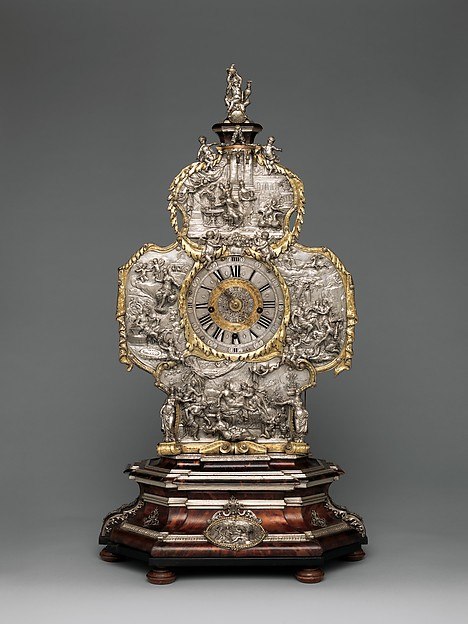
Frontal view of the mantel clock showing the silver-relief dial, mythological ornamentation, and wooden base.
Frontal view of the mantel clock showing the silver-relief dial, mythological ornamentation, and wooden base. — The Metropolitan Museum of Art, New York. Rights pending — permission not yet requested. Original source

Catalogue identity

Source
orbiscollectibles.com
Category
Clock · Mantel clock
Maker / attribution
Franz Xavier Gegenreiner
Reference
Not recorded
Catalogue / lot identifier
46.162
Source-reported date
case ca. 1710, movement ca. 1760–70
Source-reported place
Not established

Source-reported attribution and specifications are not independent authentication. A listing does not establish present ownership, current display, availability or permission to reproduce.

Object description

Construction and Materials

The mantel clock is composed of a complex case structure that integrates several distinct materials. The primary body utilizes pearwood veneered with rosewood, further enhanced by the use of tortoiseshell that is backed with brass leaf. These wooden and organic elements are combined with metal components, specifically partly gilded silver, which provides structural and decorative detailing.

The movement, which is dated to a different period than the case, consists of gilded brass and steel components. The overall structure reaches a height of 31 3/4 inches and a width of 17 inches, supported by a significant base that accommodates the weight of the assembly. The object requires a surface capable of supporting its mass of approximately 31 pounds.

Evidence for this section
  • “Case: tortoiseshell backed with brass leaf, pearwood veneered with rosewood; and partly gilded silver”
  • “Movement: gilded brass and steel”
  • “wt. confirmed: 31 3/4 × 17 × 11 1/4 in., 31 lb.”

Temporal Attribution

The dating of the clock is bifurcated due to the differing origins of its components. The museum classifies the case as having been produced circa 1710. In contrast, the internal movement is dated to a later period, specifically 1760 to 1770.

The maker associated with the movement is Franz Xavier Gegenreiner, a German craftsman recorded as active during the mid-eighteenth century. The distinction between the manufacture of the case and the movement is clearly noted in the museum documentation, reflecting the history of the object's assembly.

Evidence for this section
  • “case ca. 1710, movement ca. 1760–70”
  • “attributed to Franz Xavier Gegenreiner (German, active 1760–70)”

Iconography and Presentation

The visual presentation of the clock is characterized by elaborate metalwork, particularly on the dial surroundings and the clock body. The design incorporates a series of mythological figures and human subjects. According to the museum's documentation, these figures include representations of Men, Women, Cupid, Diana, Mars, and Venus.

The clock is designed to serve as a mantelpiece object, featuring a balanced aesthetic that integrates the silver relief work with the dark wood veneer of the base. The presence of the alarm function is noted in the title assigned by the museum, although the specific mechanical operation of the alarm is not further described in the record.

Evidence for this section
  • “Subject tags assigned by the museum: Men, Women, Cupid, Diana, Mars, Venus”
  • “Mantel clock with alarm”

Open research questions

  • What was the original source or manufacture of the 1710 case before the later movement was installed?
  • How does the alarm mechanism interface with the 18th-century movement added by Gegenreiner?

Source evidence

Recorded claims and source quotations for Mantel clock with alarm
FieldSource-reported valueSource quotation
MakerFranz Xavier Gegenreiner“attributed to Franz Xavier Gegenreiner”
Case materialsTortoiseshell, brass leaf, pearwood, rosewood, and silver“Case: tortoiseshell backed with brass leaf, pearwood veneered with rosewood; and partly gilded silver”
Movement materialsGilded brass and steel“Movement: gilded brass and steel”
Dimensions31 3/4 x 17 x 11 1/4 in“31 3/4 × 17 × 11 1/4 in.”
Accession Number46.162“46.162”
Subject tagsMen, Women, Cupid, Diana, Mars, Venus“Men, Women, Cupid, Diana, Mars, Venus”

Visible details

  • Decorative silver relief panels on the dial surround featuring mythological figures
  • Prominent finial depicting a figure holding a vessel atop the clock body
  • Multi-tiered base construction utilizing veneered wood and metal mounts
  • Clock dial features Roman numerals and a central gilded ornamental disc

Research qualifications

  • The discrepancy between the case and movement dates indicates it is a marriage of parts rather than a single-period creation
  • The specific nature of the alarm mechanism is not detailed beyond the museum's assigned title

Photograph identity and source facts were screened before import; rights clearance remains pending.

Consulted source

Mantel clock with alarm, case ca. 1710, movement ca. 1760–70

Reviewed 2026-11-02 · Record 27d973548b

Terms in this record

Glossary explanations for terms named in this object’s record.