
Skip to content
The Encyclopedia of Horology

Clock · Mantel clock

Mantel clock, circa 1765

Partially verified

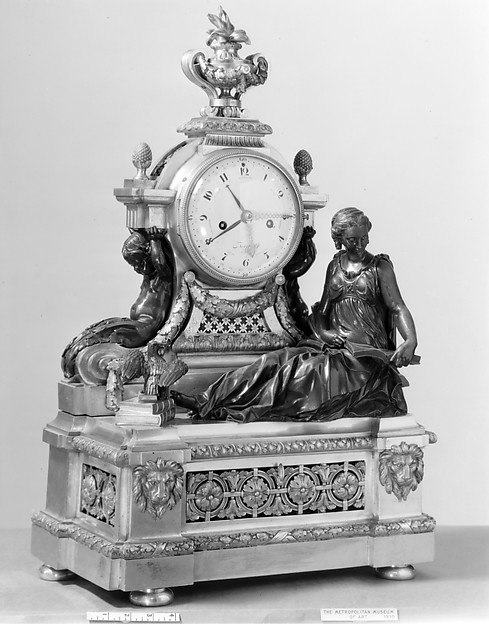
This mantel clock, held by The Metropolitan Museum of Art (accession number 29.180.3), is a decorative horological object dating to approximately 1765. Attributed to the maker Joseph Charles Paul Bertrand, who was active as a master between 1772 and 1789, the clock incorporates intricate bronze and gilt bronze elements. The design features figurative and ornamental motifs, including birds, lions, and a woman engaged in reading. The overall physical structure measures 29 1/4 inches in height by 17 1/2 inches in width and 9 3/4 inches in depth. As a piece within the museum's European Sculpture and Decorative Arts department, it represents a specific style of 18th-century decorative clockwork. Its physical assembly combines these sculptural elements with a timekeeping dial and internal mechanism housed within the gilt metal framework.

A gilt bronze mantel clock featuring a seated female reader and a top-mounted bird finial, dated circa 1765, held by The Metropolitan Museum of Art.
A gilt bronze mantel clock featuring a seated female reader and a top-mounted bird finial, dated circa 1765, held by The Metropolitan Museum of Art. — The Metropolitan Museum of Art, New York. Rights pending — permission not yet requested. Original source

Catalogue identity

Source
orbiscollectibles.com
Category
Clock · Mantel clock
Maker / attribution
Joseph Charles Paul Bertrand
Reference
29.180.3
Catalogue / lot identifier
196532
Source-reported date
ca. 1765
Source-reported place
Not established

Source-reported attribution and specifications are not independent authentication. A listing does not establish present ownership, current display, availability or permission to reproduce.

Object description

Construction and Design

The clock is constructed from bronze and gilt bronze, utilizing both materials to create a complex, multi-part assembly. The overall design incorporates a central timekeeping dial elevated on a rectangular base. The aesthetic program is heavily sculptural, featuring a seated female figure engrossed in a book situated on the right side of the base, balanced by lateral figurative elements supporting the dial case.

Ornamental details are integrated throughout the object, including lion heads applied to the corners of the pedestal and a bird motif serving as a top-mounted finial. The inclusion of these elements follows a thematic focus on narrative subjects, which the museum classifies under tags including reading, women, and lions.

Evidence for this section
  • “Bronze and gilt bronze”
  • “Overall: 29 1/4 × 17 1/2 × 9 3/4 in. (74.3 × 44.5 × 24.8 cm)”
  • “Subject tags assigned by the museum: Birds, Women, Reading, Lions”

Attribution and Chronology

The Metropolitan Museum of Art dates the object to approximately 1765. The piece is attributed to the maker Joseph Charles Paul Bertrand. Historical records indicate that Bertrand's master status lasted from 1772 until 1789.

The discrepancy between the manufacturing date and the maker's active master years is noted in the institutional records. The object is catalogued within the museum's European Sculpture and Decorative Arts department under the accession number 29.180.3.

Evidence for this section
  • “The museum dates it ca. 1765.”
  • “It is attributed to Joseph Charles Paul Bertrand (master 1772–89).”

Provenance and Documentation

This clock is part of the collection held at The Metropolitan Museum of Art in New York. The information regarding its physical properties and origin has been transcribed from the museum's official open-access digital record. The object serves as a documented example of the horological collection within the institution.

The museum maintains the record under ID 196532. No further provenance or catalogue numbers have been identified in the provided sources. The current record is subject to ongoing editorial review.

Evidence for this section
  • “Clock in The Metropolitan Museum of Art, New York (accession 29.180.3)”
  • “These details are transcribed from the museum's open-access record”

Open research questions

  • How is the attribution to Joseph Charles Paul Bertrand reconciled with the clock's dated production of 1765 given his active master years of 1772–1789?
  • Are there other clocks with this exact sculptural design currently held in private or public collections?

Source evidence

Recorded claims and source quotations for Mantel clock, circa 1765
FieldSource-reported valueSource quotation
Accession number29.180.3“29.180.3”
MakerJoseph Charles Paul Bertrand“Joseph Charles Paul Bertrand”
Dateca. 1765“ca. 1765”
MaterialsBronze and gilt bronze“Bronze and gilt bronze”
Dimensions74.3 x 44.5 x 24.8 cm“74.3 × 44.5 × 24.8 cm”
DepartmentEuropean Sculpture and Decorative Arts“European Sculpture and Decorative Arts department”

Visible details

  • A female figure is depicted in a seated, reading posture to the right of the dial.
  • The base of the clock features lion-head motifs on the side corners.
  • The clock face is surmounted by a decorative finial featuring a bird motif.
  • The dial is integrated into the central structure supported by two lateral figurative mounts.

Research qualifications

  • The attribution to Joseph Charles Paul Bertrand remains subject to research as his master period (1772-1789) post-dates the assigned production date of the clock (ca. 1765).
  • The degree to which this object represents a wider series of collectible clocks has not been independently verified.

Photograph identity and source facts were screened before import; rights clearance remains pending.

Consulted source

Clock, ca. 1765

Reviewed 2026-11-02 · Record 4c3f6c57f5

Terms in this record

Glossary explanations for terms named in this object’s record.