
Skip to content
The Encyclopedia of Horology

Clock · Mantel clock

Mantel clock

Partially verified

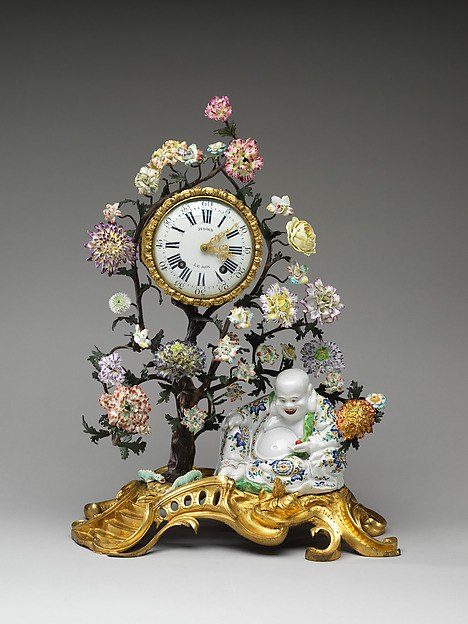
This mantel clock, created circa 1745–1749, is the work of Parisian clockmaker Julien Le Roy. The object consists of a clock movement housed within a drum-shaped case, which is integral to a larger decorative structure. The case and surrounding elements are constructed from Chantilly soft-paste porcelain mounted on a gilt bronze base. The aesthetic design incorporates numerous flowers rendered in both soft- and hard-paste porcelain, interspersed throughout the bronze branches that support the clock housing. The assembly rests on a stylized gilt bronze base and features a porcelain figure of a seated deity. The integration of Parisian horological mechanics with Chantilly decorative ceramics reflects the production environment of mid-eighteenth-century France. The clock measures 21 1/2 inches in height. The museum attribution identifies the movement as the work of Julien Le Roy.

Full view of the mantel clock featuring the porcelain figure and floral arrangement.
Full view of the mantel clock featuring the porcelain figure and floral arrangement. — The Metropolitan Museum of Art — The Jack and Belle Linsky Collection, 1982. Rights pending — permission not yet requested. Original source

Catalogue identity

Source
orbiscollectibles.com
Category
Clock · Mantel clock
Maker / attribution
Julien Le Roy
Reference
Not recorded
Catalogue / lot identifier
1982.60.68
Source-reported date
ca. 1745–49
Source-reported place
France

Source-reported attribution and specifications are not independent authentication. A listing does not establish present ownership, current display, availability or permission to reproduce.

Object description

Horological and Ceramic Construction

The clock is built upon a gilt bronze base that provides the foundation for both the clock housing and the ornamental ceramic elements. The movement is contained within a cylindrical housing that is decorated with painted porcelain patterns. The entire assembly integrates horological components with a sculptural porcelain program.

The structure features numerous applied flowers of varying paste compositions, supported by bronze branches that extend from the base. A seated porcelain figure is positioned prominently at the base, creating a balanced, asymmetrical arrangement that supports the weight of the central clock housing.

Evidence for this section
  • “Chantilly soft-paste porcelain mounted on gilt bronze, flowers of soft- and hard-paste porcelain; clock face of white enameled metal.”
  • “The movement was paired with a case originating from Chantilly, uniting Parisian horology with the production of French decorative ceramics during the reign of Louis XV.”

Signature and Dial Details

The white enameled dial is mounted centrally within the porcelain and bronze frame. It is marked with the maker's name.

The hands are positioned centrally on the dial. The dial itself is secured within a gilded bezel, which coordinates with the bronze elements of the surrounding decorative tree and the base, maintaining a consistent material palette throughout the design.

Evidence for this section
  • “clock face of white enameled metal.”
  • “Julien Le Roy (French, Tours 1686–1759 Paris)”

Provenance and Documentation

The object is held by the Metropolitan Museum of Art as part of the Jack and Belle Linsky Collection. The institutional records provide the dimensions and material composition of the clock. The maker is identified as Julien Le Roy, who was a prominent clockmaker in Paris during the eighteenth century.

The museum record establishes the object's presence in the collection as of 1982. The documentation characterizes the object as a product of French horology and decorative ceramic production, specifically utilizing the Chantilly facility for its porcelain components.

Evidence for this section
  • “The Metropolitan Museum of Art holds this object as 1982.60.68”
  • “The Metropolitan Museum of Art — The Jack and Belle Linsky Collection, 1982”

Open research questions

  • What is the specific mechanical type of the movement contained within the drum case?
  • Are there similar Chantilly porcelain-mounted timepieces that utilize movements by Julien Le Roy?

Source evidence

Recorded claims and source quotations for Mantel clock
FieldSource-reported valueSource quotation
MakerJulien Le Roy“Julien Le Roy”
Museum Number1982.60.68“1982.60.68”
Dateca. 1745–49“ca. 1745–49”
Height21 1/2 in. (54.6 cm)“Height: 21 1/2 in. (54.6 cm)”
MaterialsChantilly soft-paste porcelain, gilt bronze, hard-paste porcelain, enameled metal“Chantilly soft-paste porcelain mounted on gilt bronze, flowers of soft- and hard-paste porcelain; clock face of white enameled metal.”
Clockmaker roleHorloger Ordinaire du Roi“appointed Horloger Ordinaire du Roi to King Louis XV”
OriginFrench, Paris with French, Chantilly case“French, Paris with French, Chantilly case”

Visible details

  • Clock dial features black Roman numerals and individual minute markers in five-minute increments.
  • The porcelain figure depicted is a seated, smiling individual.
  • The clock case features an elaborate pierced gilt metal back panel.

Research qualifications

  • The wider type of this clock has not been independently verified against a specialist reference.
  • The specific distribution of soft- versus hard-paste porcelain flowers is based on museum cataloguing.

Photograph identity and source facts were screened before import; rights clearance remains pending.

Consulted source

Mantel clock, Julien Le Roy, ca. 1745–49

Reviewed 2026-11-02 · Record 3e5f620e70

Terms in this record

Glossary explanations for terms named in this object’s record.