
Skip to content
The Encyclopedia of Horology

Clock · Porcelain mantle clock

Large porcelain clock with matching pedestal

Partially verified

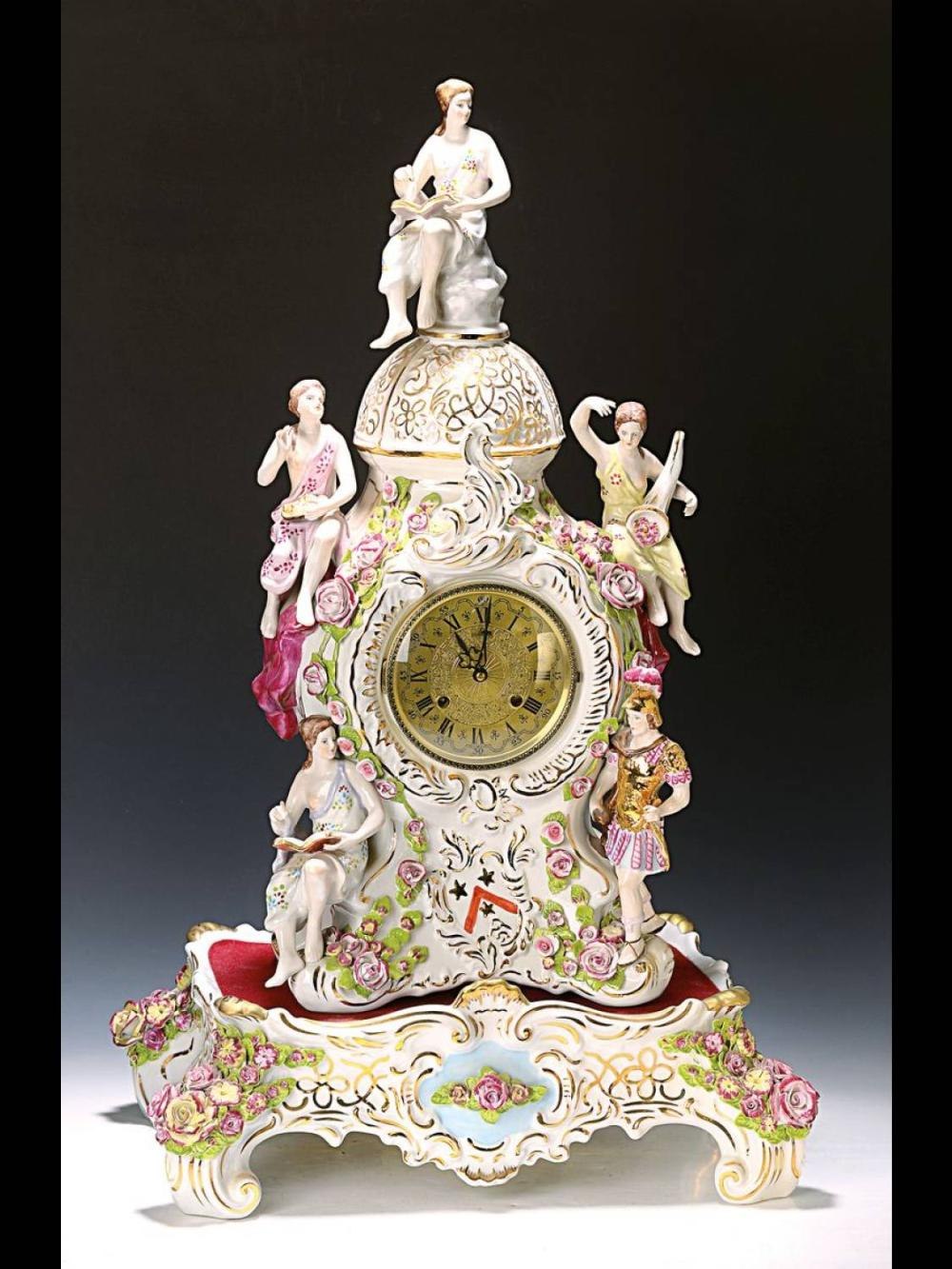
This large porcelain mantle clock from Thuringia, dated to the 20th century, features an elaborate porcelain housing supported by volute feet. The case is decorated with floral motifs and gold painting, with a crown depicting a seated writing woman and additional sculptural figures flanking the dial. The piece includes a matching pedestal base. The front of the clock features a protective glass lid, while the rear access is provided by a Bakelite slider. A brass dial, signed with the name "Dugena," displays the time. The movement consists of a round brass plate assembly utilizing a floating anchor escapement, designed with a half-hour double strike mechanism on two bells and a running duration of approximately one week. The auction description notes the piece requires service due to resinified oil within the movement and reports a single missing porcelain flower on the decorative exterior housing.

Front view of the Thuringian porcelain mantle clock showing the writing woman finial, sculptural figures, and floral decoration.
Front view of the Thuringian porcelain mantle clock showing the writing woman finial, sculptural figures, and floral decoration. — Henry's Auktionshaus (via Invaluable). Rights pending — permission not yet requested. Original source

Catalogue identity

Source
www.invaluable.com
Category
Clock · Porcelain mantle clock
Maker / attribution
Dugena
Reference
Not recorded
Catalogue / lot identifier
5152
Source-reported date
20th c.
Source-reported place
Germany

Source-reported attribution and specifications are not independent authentication. A listing does not establish present ownership, current display, availability or permission to reproduce.

Object description

Case and Aesthetic Features

The structure is supported by four volute-shaped feet and includes a matching pedestal base. The surface is heavily ornamented with floral appliqués and gold-colored painted detailing.

The case composition incorporates multiple sculptural elements, including four figures flanking the central dial area and a distinct figure of a seated woman writing, which serves as the clock's crown. The front dial is protected by a glass lid, and the movement is accessed from the rear via a Bakelite slider.

Evidence for this section
  • “rear side marked: crown inter alia D”
  • “on volute feet, opulent with flowers and gold painting”
  • “Uhrgehäuse flankiert von vollplastischen Figuren, Bekrönung einer Schreibenden”
  • “Glasdeckel vorne, hinten Bakelitschieber”

Movement and Functionality

The clock is powered by a round brass plate movement featuring a floating anchor escapement. It is designed to provide a half-hour double strike on two internal bells, with a stated operational duration of approximately one week on a single winding.

The movement is signed on the brass dial by Dugena. The auction description suggests that the movement is in need of maintenance, as the lubricating oil has become resinified over time, affecting the current functionality.

Evidence for this section
  • “rundes Messingplatinenwerk mit Schwebeanker”
  • “half hour double strike on 2 bells”
  • “running period approx. 1 week”
  • “oil resinified - to revise”

Condition and Attribution

The auction description provides a specific condition report, assigning the movement a status of 3 and the housing a status between 2 and 3. While the porcelain is largely intact, it is noted that one of the decorative flowers is currently missing from the housing.

Attribution to Thuringia in the 20th century is based on the provided sale details, which also reference the specific backstamp located on the rear of the clock case.

Evidence for this section
  • “(1 flower missing)”
  • “condition of movement 3, housing 2-3”
  • “Thuringia, 20th c.”
  • “rear side marked: crown inter alia D”

Open research questions

  • What is the specific manufacturer associated with the 'crown over D' porcelain mark?
  • To what extent is the Dugena signature original to the clock movement versus a later addition or retailer mark?

Source evidence

Recorded claims and source quotations for Large porcelain clock with matching pedestal
FieldSource-reported valueSource quotation
MakerDugena“inscribed: Dugena”
OriginThuringia“Thuringia, 20th c.”
Movement typeRound brass plate with floating anchor“rundes Messingplatinenwerk mit Schwebeanker”
HeightApprox. 76cm“H. approx. 76cm”
Striking mechanismHalf hour double strike on 2 bells“half hour double strike on 2 bells”
EscapementFloating anchor“floating anchor”
MarkingCrown with letter D“rear side marked: crown inter alia D”

Visible details

  • Volute-shaped feet supporting the base
  • Dial with Roman numerals and central ornamentation
  • Four distinct sculptural figures decorating the case
  • Top finial representing a writing woman

Research qualifications

  • Condition of oil within the movement is reported as resinified
  • Single flower element described as missing

Photograph identity and source facts were screened before import; rights clearance remains pending.

Consulted source

Large porcelain clock, Thuringia, 20th c., matching

Reviewed 2026-10-26 · Record a67dadba0c

Terms in this record

Glossary explanations for terms named in this object’s record.