
Skip to content
The Encyclopedia of Horology

Clock · Shelf cuckoo clock

Johann Baptist Beha Model 519 B Shelf Cuckoo Clock

Partially verified

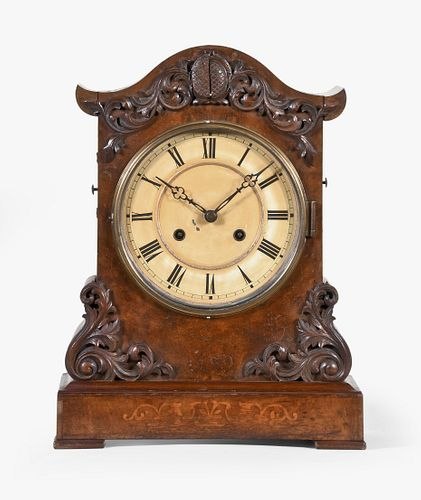
This shelf cuckoo clock, catalogued as model 519 B, is attributed to Johann Baptist Beha of Eisenbach, Germany, made for the English market circa 1880. The burl veneered oak case features floral marquetry inlay on the base and applied carved foliate moldings along the arched crest and sides. The circular two-piece painted metal dial presents Roman numerals, decorative steel hands, and two winding arbors. Schmitt Horan & Co. describes the movement as an eight-day fusee wood-plate time and strike mechanism, and notes retailer labels from Camerer, Kuss & Co. on the interior backboard and side door.

Front view of the Johann Baptist Beha Model 519 B shelf cuckoo clock showing the carved case and painted dial.
Front view of the Johann Baptist Beha Model 519 B shelf cuckoo clock showing the carved case and painted dial. — Schmitt Horan & Co.. Rights pending — permission not yet requested. Original source

Catalogue identity

Source
www.bidsquare.com
Category
Clock · Shelf cuckoo clock
Maker / attribution
Johann Baptist Beha
Reference
Model 519 B
Catalogue / lot identifier
385
Source-reported date
circa 1880
Country
Germany

Source-reported attribution and specifications are not independent authentication. A listing does not establish present ownership, current display, availability or permission to reproduce.

Object description

Case Architecture and Decorative Treatment

The clock is styled as a shelf or mantel bracket cuckoo clock, cataloged as a burl veneered oak case with floral marquetry inlay along the base plinth and applied carved foliate moldings. Observation of the front shows an arched silhouette with carved foliate cresting, cyma-curved side carvings, and an inlaid floral band running across the stepped base.

The auction catalog reports the case finish as original, while noting specific structural wear: a small loss of veneer on the front left base, a horizontal shrinkage crack on the curved top, separation gaps along the cyma-curved side moldings due to wood shrinkage, and broken hinges on the left side door.

Evidence for this section
  • “burl veneered oak case with floral marquetry inlay and applied carved foliate molding”
  • “Arched bracket-style wooden case with applied foliate carvings and a central carved crest motif.”
  • “Horizontal marquetry inlay band centered on the base plinth.”
  • “case in original finish, small veneer loss on front left of base, curved top with horizontal shrinkage crack, left side door with broken hinges, cyma curved side moldings with separation gaps due to age shrinkage of case”

Dial and Hands

The time display features a circular two-piece painted metal dial with black Roman numerals and pierced steel hands. Visual inspection confirms two winding apertures positioned in the lower section of the center dial disk.

Schmitt Horan & Co. describes both the painted two-piece metal dial and the steel hands as original to the clock.

Evidence for this section
  • “painted two piece metal dial, steel hands”
  • “original painted metal dial, original hands”
  • “Circular two-piece painted dial showing black Roman hour numerals and pierced steel hands.”
  • “Two winding apertures situated in the lower portion of the central dial section.”

Movement, Automaton, and Provenance Labels

The movement is not visible in the provided primary exterior photograph. According to the auction description, it is an eight-day fusee wood-plate time and strike movement that strikes and remains in complete condition, though noted as eventually needing service. The bellow tops are reported as replaced.

The catalog notes several alterations and condition issues with the automaton and accessories: the cuckoo doors are mismatched, the cuckoo bird is cataloged as a possible period replacement because it is not of the typical Beha type, and the included pendulum is period and appropriate but too long to swing freely in the case. Labels from English market retailer Camerer, Kuss & Co. are reported on the inside backboard and inside right side door.

Evidence for this section
  • “time and strike 8 day fusee wood plate movement”
  • “wood plate movement in complete condition with replaced bellow tops”
  • “cuckoo doors are mismatched”
  • “cuckoo bird a possible period replacement as is not of the typical Beha type”
  • “pendulum is period and appropriate but is too long to hang freely in the case”
  • “inside backboard and inside right side door with original labels from retailer Camerer, Kuss & Co”
  • “movement strikes but will eventually need service”

Open research questions

  • What specific text, addresses, or serial references appear on the retailer labels of Camerer, Kuss & Co. inside the case?
  • Does the wood-plate movement have any stamped maker marks, numerals, or characteristic Beha construction stamps on the plates or arbors?
  • What specific carving or construction attributes distinguish the present cuckoo bird from standard Beha factory production?

Source evidence

Recorded claims and source quotations for Johann Baptist Beha Model 519 B Shelf Cuckoo Clock
FieldSource-reported valueSource quotation
Maker and OriginJohann Baptist Beha, Eisenbach, Germany“Johann Baptist Beha, Eisenbach, Germany, for the English market”
ModelModel 519 B“model 519 B shelf cuckoo clock”
CaseBurl veneered oak case with floral marquetry inlay and applied carved foliate molding“burl veneered oak case with floral marquetry inlay and applied carved foliate molding”
MovementTime and strike 8 day fusee wood plate movement“time and strike 8 day fusee wood plate movement”
Retailer LabelsCamerer, Kuss & Co.“inside backboard and inside right side door with original labels from retailer Camerer, Kuss & Co”
Dimensions18in x 13in x 7in“Dimensions: 18in x 13in x 7in”
Included AccessoriesPendulum and winding key“ACCESSORIES: Pendulum, Winding Key”
Reported DateCirca 1880“circa 1880”

Visible details

  • Arched bracket-style wooden case with applied foliate carvings and a central carved crest motif.
  • Circular two-piece painted dial showing black Roman hour numerals and pierced steel hands.
  • Horizontal marquetry inlay band centered on the base plinth.
  • Two winding apertures situated in the lower portion of the central dial section.

Research qualifications

  • Internal wood plate fusee movement, retailer labels, and cuckoo mechanism are not visible in the primary front photograph.
  • The auction catalog notes replaced bellow tops, mismatched cuckoo doors, a pendulum that is too long to hang freely in the case, and a possible period replacement cuckoo bird.

Photograph identity and source facts were screened before import; rights clearance remains pending.

Terms in this record

Glossary explanations for terms named in this object’s record.