
Skip to content
The Encyclopedia of Horology

Clock · Cartel wall clock

Japy Freres French Cartel Wall Clock

Partially verified

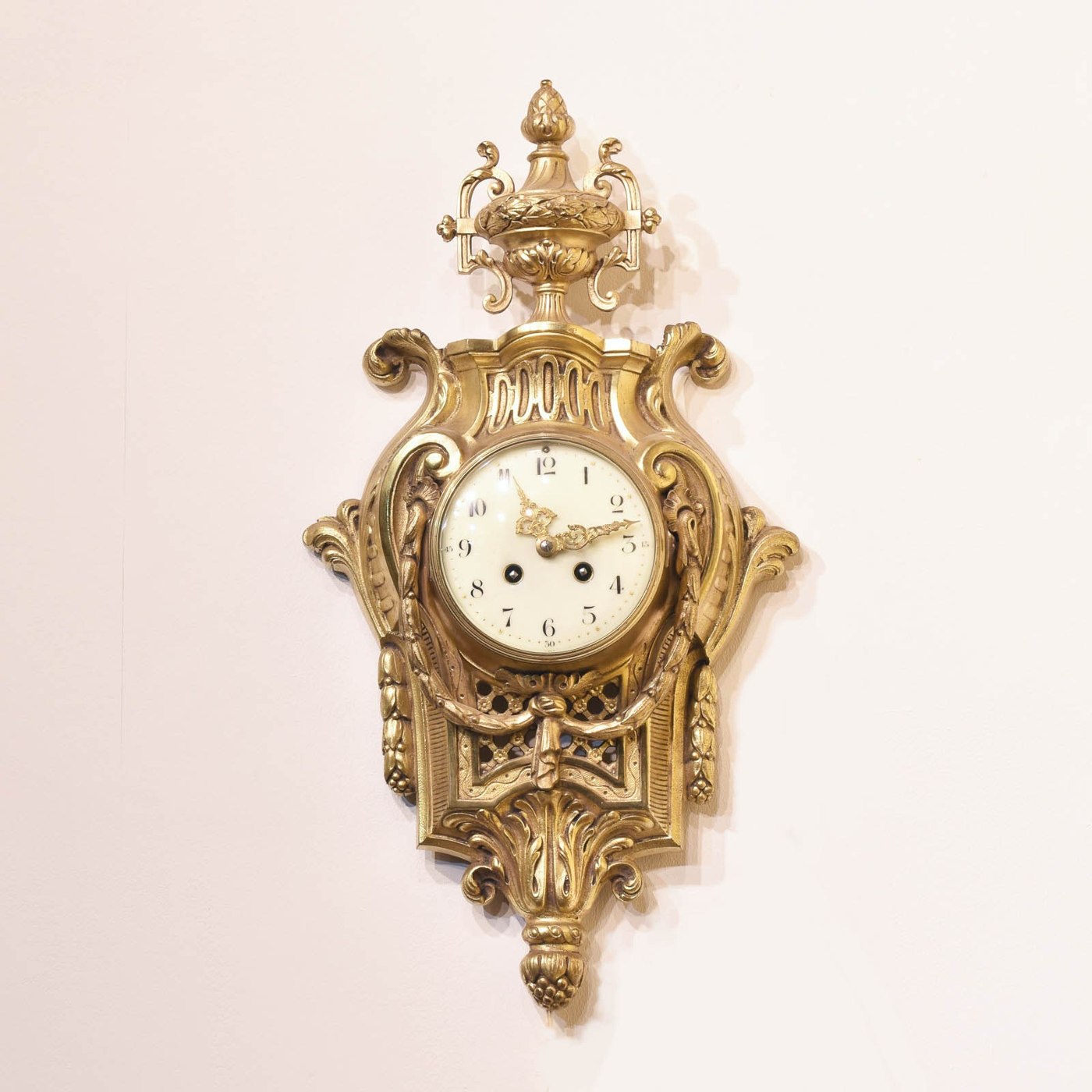
This object is a French cartel-style wall clock, attributed to the Japy Freres workshop in Paris, dated between approximately 1890 and 1900. The clock features a vertically oriented decorative frame, which is reported by the seller as gilt bronze, although internal documentation also indicates wood, leaving the primary material construction unverified. The clock includes a convex white enamel dial displaying Arabic numerals, paired with pierced decorative hands. Movement features include two winding apertures for the timekeeping and striking mechanisms. The audible system strikes the hour and provides a single strike on the half-hour, utilizing an internal bell. The total dimensions are recorded as 540 by 250 by 150 millimeters. The assembly is designed for single wall mounting, consistent with the tradition of French cartel timepieces.

A frontal view of the Japy Freres French cartel wall clock, showing the gilt case, the convex enamel dial with Arabic numerals, and the pierced hands.
A frontal view of the Japy Freres French cartel wall clock, showing the gilt case, the convex enamel dial with Arabic numerals, and the pierced hands. — The Clock & Watch Shop. Rights pending — permission not yet requested. Original source

Catalogue identity

Source
zamanito.com
Category
Clock · Cartel wall clock
Maker / attribution
Japy Freres
Reference
CL-WL-824
Catalogue / lot identifier
Source URL identifies the listing
Source-reported date
circa 1890–1900
Source-reported place
France

Source-reported attribution and specifications are not independent authentication. A listing does not establish present ownership, current display, availability or permission to reproduce.

Object description

Case and Dial

The object is a wall-mounted cartel clock with a highly detailed, cast-metal frame. The case exhibits a golden surface, though documentation from the source presents conflicting claims regarding the base material, citing both gilt bronze and wood.

The dial is a convex, circular enamel piece featuring black Arabic numerals for the hours. It is centered by a pair of pierced, decorative hands. Two winding holes are visible on the dial, serving the timekeeping and the striking train, respectively.

Evidence for this section
  • “ساعت دیواری فرانسوی سبک کارتل (Cartel) با تزیینات ظریف”
  • “جنس بدنه برنز طلاکاری‌شده است”
  • “متن بدنه را gilt bronze می‌نامد، اما جدول Case Material: Wood دارد”
  • “صفحه، گرد و از نوع لعابی محدب است که اعداد عربی بر روی آن درج شده‌اند”

Movement and Striking Mechanism

The movement is housed within the decorative case, though the specific internal components are not described in detail. The clock operates with two separate winding keys visible on the dial, indicating a standard French design for a striking timepiece.

The auditory output consists of a striking mechanism that sounds on the hour and provides a single strike at the half-hour intervals. The sounds are produced by an internal bell, which remains hidden within the structure of the wall-mounted housing.

Evidence for this section
  • “روی صفحه دو روزنه برای کوک تعبیه شده که یکی مخصوص تنظیم زمان و دیگری مربوط به سازوکار زنگ است”
  • “سامانه صوتی آن ساعت‌های کامل را با ضربات مشخص بر روی کاسه زنگ (bell) و نیم‌ساعت‌ها را با یک تک‌ضربه اعلام می‌کند”

Attribution and History

The clock is attributed to the Japy Freres workshop based in Paris. The source places the production of this object within the late 19th-century window of circa 1890 to 1900. The cataloging information provided by the source identifies the item under the internal reference code CL-WL-824.

The object is classified as a cartel clock, a type of decorative wall timepiece rooted in 18th-century French watchmaking traditions. While the attribution is noted by the provider, the source indicates that the actual manufacturer's marks and the internal movement integrity have not been fully verified as of the current documentation.

Evidence for this section
  • “ساخت آن به کارگاه Japy Freres در پاریس و بازه زمانی حدود ۱۸۹۰ تا ۱۹۰۰ نسبت داده شده است”
  • “کد موجودی CL-WL-824”
  • “ساعت‌های سبک کارتل ریشه در سنت ساعت‌سازی قرن هجدهم فرانسه دارند”

Open research questions

  • Is the frame material confirmed to be gilt bronze or wood?
  • Does the movement contain a visible Japy Freres stamp, and does it match the age of the case?

Source evidence

Recorded claims and source quotations for Japy Freres French Cartel Wall Clock
FieldSource-reported valueSource quotation
MakerJapy Freres“ساخت آن به کارگاه Japy Freres در پاریس و بازه زمانی حدود ۱۸۹۰ تا ۱۹۰۰ نسبت داده شده است.”
StyleCartel“ساعت دیواری فرانسوی سبک کارتل (Cartel)”
Datecirca 1890–1900“حدود ۱۸۹۰–۱۹۰۰”
Case material conflictGilt bronze vs. Wood“متن بدنه را gilt bronze می‌نامد، اما جدول Case Material: Wood دارد.”
Dial typeConvex enamel“صفحه، گرد و از نوع لعابی محدب است”
Striking mechanismBell strike on hour and half-hour“سامانه صوتی آن ساعت‌های کامل را با ضربات مشخص بر روی کاسه زنگ (bell) و نیم‌ساعت‌ها را با یک تک‌ضربه اعلام می‌کند.”
Reference codeCL-WL-824“کد موجودی CL-WL-824”

Visible details

  • Convex white enamel dial with Arabic numerals
  • Pierced-style decorative clock hands
  • Two winding apertures located on the dial face
  • Highly decorative, cast-metal frame with floral and architectural elements

Research qualifications

  • Conflict in source documentation regarding case material: listed as gilt bronze in text but as wood in the reference table.
  • The internal movement construction and authenticity of Japy Freres markings have not been independently verified.

Photograph identity and source facts were screened before import; rights clearance remains pending.

Consulted source

French Cartel clock.

Reviewed 2026-11-02 · Record f1ce31c9df

Terms in this record

Glossary explanations for terms named in this object’s record.