
Skip to content
The Encyclopedia of Horology

Clock · Lantern clock / yagura-dokei

Japanese lantern clock on pyramidal stand

Partially verified

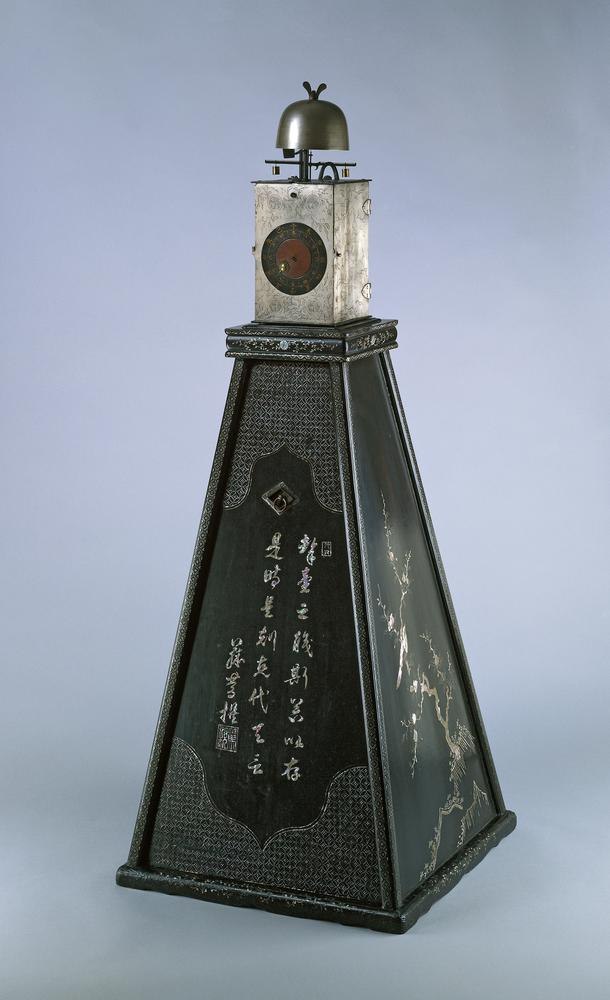
This Japanese striking lantern clock, dated to circa 1700, is mounted atop a tall black-lacquered pyramidal base. Known as a Yagura-Dokei, the timepiece features a steel movement governed by a single oscillating foliot with adjustable weights and rope drive. Its engraved silvered brass case panels house a fixed lacquer dial with a revolving hand, surmounted by an openwork foliot assembly and a bell. The accompanying lacquer base is decorated with mother-of-pearl inlays depicting birds, flowering branches, and an inscribed Chinese poem, having been married to the clock by J. Drummond Robertson in the 1930s.

Overall view of the Japanese lantern clock mounted on its mother-of-pearl inlaid pyramidal lacquer stand
Overall view of the Japanese lantern clock mounted on its mother-of-pearl inlaid pyramidal lacquer stand — British Museum. Rights pending — permission not yet requested. Original source

Catalogue identity

Source
www.britishmuseum.org
Category
Clock · Lantern clock / yagura-dokei
Maker / attribution
Not established
Reference
1958,1006.2165
Catalogue / lot identifier
Source URL identifies the listing
Source-reported date
c1700
Country
Japan

Source-reported attribution and specifications are not independent authentication. A listing does not establish present ownership, current display, availability or permission to reproduce.

Object description

Object Description and Composition

This object, categorized as a Yagura-Dokei (tower clock), dates to approximately 1700. It consists of a lantern-style clock with a steel movement, a rope-drive mechanism, and a single foliot with adjustable weights. The case is constructed of silvered brass panels featuring an engraved design, with a fixed lacquer dial and a revolving hand.

The clock is mounted on a black-lacquered pyramidal stand, which is inlaid with mother-of-pearl in patterns of birds and flowering branches. The stand also features an inscription: 'In place of an expected pot, this present instrument will give the hour & division, correctly presenting heaven's word.'

Evidence for this section
  • “Lantern clock; steel movement; single foliot; rope driven; fixed lacquer dial with revolving hand; engraved silvered brass panels to case”
  • “inlaid in mother-of-pearl with inscription and birds and flowering branches on black lacquer ground.”
  • “'In place of an expected pot, this present instrument will give the hour & division, correctly presenting heaven's word.'”

Horological Context

The clock utilizes a striking mechanism on a bell. The source notes that while these clocks were called Yagura-Dokei, they retained a 1-12 striking sequence which differed from the Japanese temporal system of the time. The system divided day and night into six 'toki' each, necessitating frequent manual adjustments to the foliot weights to account for seasonal variations in day length.

It is suggested that due to the impracticality of constant manual calibration, such clocks in feudal Japan likely functioned as expensive curiosities rather than strictly utilitarian timekeeping instruments.

Evidence for this section
  • “Called Yagura-Dokei, meaning tower clocks, they still used the standard 1-12 blows on the bell”
  • “the rate of the clock would have to be adjusted by moving the weights on the foliot, not only according to the time of year but also at sunrise and sunset on a daily basis.”
  • “it is likely that in feudal Japan in the seventeenth century clocks were simply owned as expensive curiosities rather than as instruments for measuring time.”

Provenance and Assembly

The clock and its pyramidal base were combined by J. Drummond Robertson in the 1930s. Although the base is contemporary to the period of the clock, this was a subsequent pairing. The piece was later part of the Ilbert Collection and was acquired by the British Museum in 1958 via a donation from Gilbert Edgar.

The clock front features four chrysanthemum motifs, which are noted as an indication that the clock may have originally been an imperial piece.

Evidence for this section
  • “It is known that this base, although contemporary with the clock, was married to it by J. Drummond Robertson in the 1930s.”
  • “An interesting feature is the four chrysanthemum flowers on the front which suggest that the clock was originally an imperial piece.”

Open research questions

  • What specific characteristics confirm the chrysanthemum motifs as indicative of imperial provenance?
  • Are there records detailing the specific materials or techniques used in the 1930s to secure the clock to the base?

Source evidence

Recorded claims and source quotations for Japanese lantern clock on pyramidal stand
FieldSource-reported valueSource quotation
Movement typeSteel movement with single foliot“Lantern clock; steel movement; single foliot; rope driven;”
Case materialsSilvered brass, black lacquer, and mother-of-pearl“engraved silvered brass panels to case; European strike; pyramid stand; inlaid in mother-of-pearl with inscription and birds and flowering branches on black lacquer ground.”
Stand associationMarried to the clock in the 1930s“It is known that this base, although contemporary with the clock, was married to it by J. Drummond Robertson in the 1930s.”
Overall height1.44 metres“Height: 1.44 metres (overall)”
Overall Dimensions1.44 metres height“Height: 1.44 metres (overall)”
Clock dimensions43.5 cm height, 16.5 cm width, 16.5 cm depth“Clock: height 43.5 cm, width 16.5 cm, depth 16.5 cm”
Stand dimensions97 cm height, 55.5 cm width, 55.5 cm depth“Base: height 97 cm, width 55.5 cm, depth 55.5 cm”

Visible details

  • Bell positioned at the top above the exposed foliot bar and weights
  • Silvered rectangular metal case with circular dial and single central pointer
  • Pyramidal black lacquer stand adorned with inlaid calligraphy and flowering branch motifs in mother-of-pearl

Research qualifications

  • The pyramidal stand was married to the clock in the 1930s by J. Drummond Robertson rather than originally paired
  • Internal movement gearing and rope-drive mechanism are enclosed and not visible in the exterior photos

Photograph identity and source facts were screened before import; rights clearance remains pending.

Consulted source

lantern clock; striking clock; clock-case | British Museum

Reviewed 2026-10-25 · Record c84dcd8b65

Terms in this record

Glossary explanations for terms named in this object’s record.