
Skip to content
The Encyclopedia of Horology

Tool · Inclining sundial

Inclining Dial by Johann Christoph Keller

Partially verified

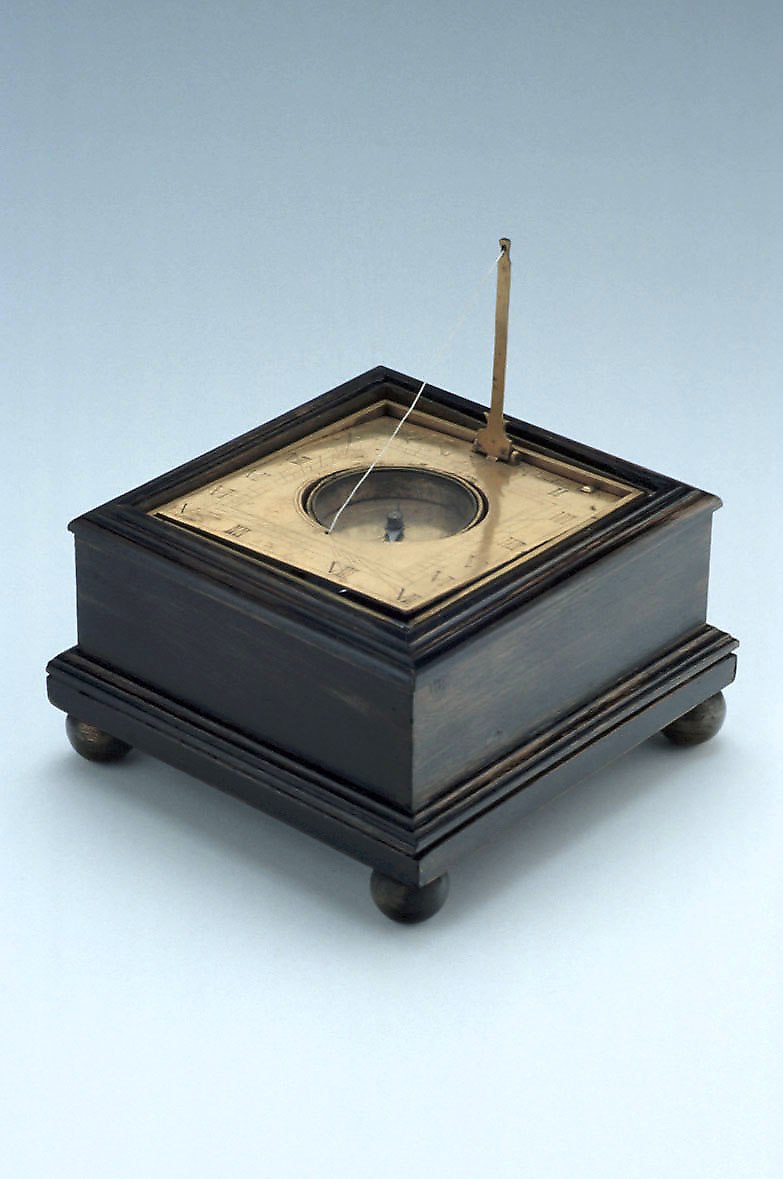
This inclining dial, held by the Museum of the History of Science, Oxford, is signed by Johann Christoph Keller and dates to approximately 1600. Manufactured in Linz, the instrument consists of a brass plate integrated into a wooden case. The brass dial is mounted on gimbals, allowing for adjustment to latitudes ranging between 45 and 55 degrees through the use of a sliding counterpoise positioned on the underside of the plate. A compass is set at the center, mounted on pivots to maintain a horizontal position regardless of the angle of the dial. Time is indicated by a string gnomon dial, with hours marked from IIII to XII to VIII, supported by a folding brass stand. The signature of the maker is inscribed at the top of the dial plate. The wooden case, which features brass round feet, is described as appearing to be modern.

Inclining dial signed by Johann Christoph Keller, featuring a brass plate on gimbals with a central compass and string gnomon.
Inclining dial signed by Johann Christoph Keller, featuring a brass plate on gimbals with a central compass and string gnomon. — Museum of the History of Science, Oxford. Rights pending — permission not yet requested. Original source

Catalogue identity

Source
www.mhs.ox.ac.uk
Category
Tool · Inclining sundial
Maker / attribution
Johann Christoph Keller
Reference
Not recorded
Catalogue / lot identifier
35317
Source-reported date
circa 1600
Source-reported place
Linz

Source-reported attribution and specifications are not independent authentication. A listing does not establish present ownership, current display, availability or permission to reproduce.

Object description

Construction and Design

The inclining dial is constructed from a brass plate housed within a wooden case. The primary function of the instrument relies on a gimbal-mounted system that allows the plate to tilt relative to the horizon. Adjustment for latitude is managed through a sliding counterpoise located on the underside of the brass plate, accommodating a range between 45 and 55 degrees. The overall dimensions are 113 by 116 by 67 millimeters, supported by round brass feet.

A central compass is integrated into the dial plate. This component is mounted on pivots to remain horizontal during operation, irrespective of the angle of the main dial. The compass dial is marked with cardinal points abbreviated as 'SE', 'OR', 'ME', and 'OC' and includes declination markings to facilitate orientation.

Evidence for this section
  • “The dial consists of a plate mounted on gimbals in a wooden case and can be adjusted for any latitude between 45 and 55? by means of a sliding counterpoise.”
  • “At the centre of the dial is a compass, mounted on pivots to remain horizontal whatever the angle of the dial, marked with the declination and the cardinal points 'SE', 'OR', 'ME', 'OC'.”

Timekeeping Mechanism

The time is indicated via a string gnomon, which creates the necessary shadow on the brass plate. The hour scale is marked with Roman numerals ranging from IIII to XII and continuing to VIII. To ensure the gnomon remains in the correct position for timekeeping, it is supported by a folding brass stand attached to the dial plate.

The signature is prominently displayed at the top of the dial plate. The inscription, 'I ? CHRIST KELLER ? LINZI', identifies the maker and the location of manufacture as Linz, providing attribution for the origin of the instrument to the period around 1600.

Evidence for this section
  • “The string gnomon dial indicates common hours numbered from IIII to XII to VIII and bears at the top the signature 'I ? CHRIST KELLER ? LINZI'.”

Condition and Attribution

The instrument is catalogued under the inventory number 35317 at the Museum of the History of Science in Oxford. Documentation provided by the museum indicates that the wooden case, which contributes to the current aesthetic of the object, is not original. It is explicitly noted in the records that the wooden case with its round brass feet appears to be modern in origin.

The attribution to Johann Christoph Keller of Linz is derived from the signature present on the dial plate itself. The dial is classified as an inclining dial, which utilizes the aforementioned gimbals and counterpoise to compensate for different latitudes,

Evidence for this section
  • “The wooden case, with brass round feet, appears to be modern.”
  • “Signed by Johann Christoph Keller”

Open research questions

  • What is the specific significance of the cardinal abbreviations SE, OR, ME, OC in the context of Keller's workshop?
  • Are there similar extant dials by Johann Christoph Keller that retain their original 17th-century cases?

Source evidence

Recorded claims and source quotations for Inclining Dial by Johann Christoph Keller
FieldSource-reported valueSource quotation
MakerJohann Christoph Keller“Signed by Johann Christoph Keller”
Datecirca 1600“circa 1600; Linz”
Dimensions113 x 116 x 67 mm“113 x 116 x 67 mm”
MaterialBrass and wood“Brass and wood”
Compass markingsSE, OR, ME, OC“marked with the declination and the cardinal points 'SE', 'OR', 'ME', 'OC'”
Inventory number35317“Inventory number: 35317”

Visible details

  • Dial plate mounted on gimbals
  • Folding brass gnomon stand
  • Cardinal points marked SE, OR, ME, OC
  • Modern wooden case with spherical feet

Research qualifications

  • The wooden case is noted as appearing to be modern
  • Latitude adjustability range specified as 45 to 55 degrees

Photograph identity and source facts were screened before import; rights clearance remains pending.

Consulted source

Inclining Dial

Reviewed 2026-10-26 · Record 63ea529526

Terms in this record

Glossary explanations for terms named in this object’s record.