
Skip to content
The Encyclopedia of Horology

Clock · Electric impulse clock

Impulse Clock by James Searle

Partially verified

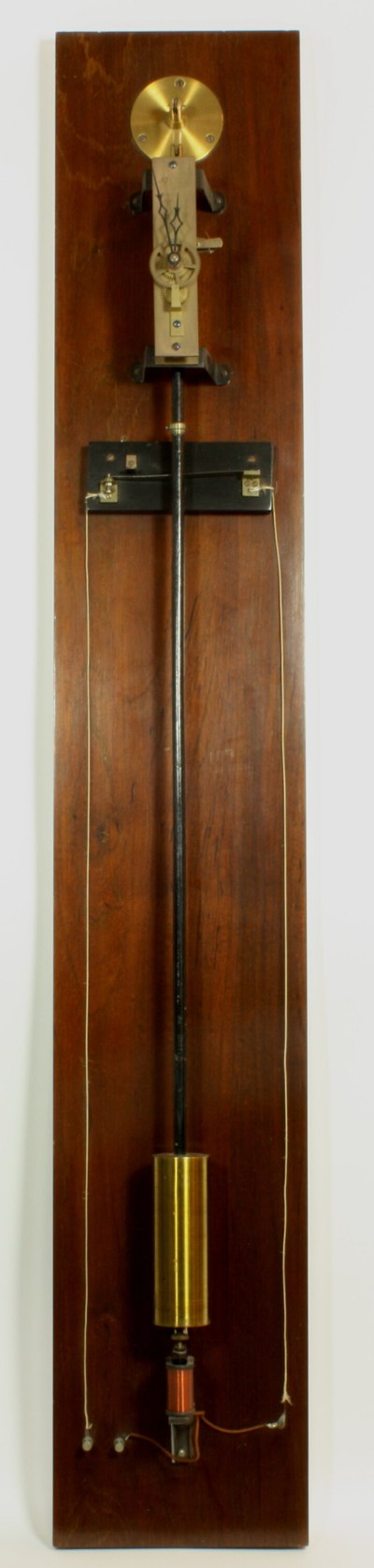
This electric impulse clock was produced in 1931 by James Searle in Melbourne, Australia. Commissioned by the Melbourne clock collector John Askew, the device serves to illustrate the mechanical and electrical principles developed by Matthias Hipp during the 1830s. The clock mechanism is mounted directly onto a vertical polished timber backboard, measuring 137 centimeters in length and 23 centimeters in width. It features an exposed pendulum configuration where the movement is driven via an electro-mechanical impulse system. This setup functions by providing a power pulse to the pendulum only when its oscillations decrease enough to activate an electromagnet, which then drives a ratchet wheel linked to the clock train. The object entered the collection of Museums Victoria following a loan and subsequent bequest from John Askew in September 1931, remaining a record of early 20th-century Australian clockmaking and technical experimentation with electric timekeeping systems.

The impulse clock mounted on its vertical wooden backboard, showing the upper movement, central pendulum rod, and the lower electromagnetic impulse assembly.
The impulse clock mounted on its vertical wooden backboard, showing the upper movement, central pendulum rod, and the lower electromagnetic impulse assembly. — Museums Victoria. Rights pending — permission not yet requested. Original source

Catalogue identity

Source
collections.museumsvictoria.com.au
Category
Clock · Electric impulse clock
Maker / attribution
James Searle
Reference
Not recorded
Catalogue / lot identifier
ST 19105
Source-reported date
1931
Source-reported place
Australia

Source-reported attribution and specifications are not independent authentication. A listing does not establish present ownership, current display, availability or permission to reproduce.

Object description

Construction and Design

The impulse clock is constructed with an exposed movement design mounted directly onto a finished, vertical timber backboard. Measuring 137 centimeters tall, the wooden board provides the structural support for the primary clock train, the pendulum assembly, and the electrical components. The components are arranged vertically, with the movement housing situated at the upper section of the board, allowing for the pendulum to hang freely beneath the driving mechanism.

The assembly utilizes a brass pendulum bob suspended from the upper movement housing. At the base of the pendulum rod, an electromagnetic coil is positioned to facilitate the impulse mechanism.

Evidence for this section
  • “Clock mechanism is suspended on a polished backboard.”
  • “137 cm (Length), 23 cm (Width)”

Mechanical Principle

The operation of the clock is based on the Hipp principle, an electrical timekeeping method developed by Matthias Hipp in the 1830s. The system operates on a selective impulse cycle rather than a continuous power feed. The pendulum remains free-swinging under standard conditions. As energy dissipation causes the pendulum's arc of oscillation to reduce, a contact point is eventually triggered.

Once the oscillation amplitude decreases sufficiently, the pendulum engages an electromagnet. This activation provides an electromagnetic pulse to the pendulum, replenishing the kinetic energy required to maintain the swing. This action simultaneously drives a ratchet wheel, which advances the clock train.

Evidence for this section
  • “in which the pendulum received an electro-mechanical impulse only when its swing had decreased sufficiently to trigger an electromagnet.”
  • “The pendulum drove a ratchet wheel which in turn drove the clock train.”

Provenance and History

The clock was produced in 1931 in Melbourne, Australia, by the maker James Searle. It was a commissioned work requested by John Askew, a local clock collector interested in the practical application and demonstration of historical horological theories.

Following its creation, the clock remained with the commissioner for a period. In 1931, it entered the institutional care of Museums Victoria, beginning as a loan before transitioning to a permanent bequest. The registration number ST 19105 marks the object within the museum's horological collection,

Evidence for this section
  • “Commissioned by Melbourne clock collector John Askew”
  • “Loan & Subsequent Bequest from Mr John Askew, 03 Sep 1931”
  • “made by James Searle, Melbourne, 1931”

Open research questions

  • What specific material is the backboard constructed from?
  • Are there any legible maker's signatures or stamps on the movement plate?

Source evidence

Recorded claims and source quotations for Impulse Clock by James Searle
FieldSource-reported valueSource quotation
MakerJames Searle“Maker, name: James Searle”
Date1931“date: 1931”
LocationMelbourne, Australia“locality: Melbourne, region: Greater Melbourne, state: Victoria, country: Australia”
Dimensions137 cm (Length), 23 cm (Width)“Overall Dimensions, dimensions: 137 cm (Length), 23 cm (Width)”
AcquisitionLoan and bequest from John Askew“Loan & Subsequent Bequest from Mr John Askew, 03 Sep 1931”
RegistrationST 19105“Registration number: ST 19105”
Mechanism principleHipp principle“demonstrate the use of the Hipp principle in timekeeping”

Visible details

  • Mechanism mounted to a polished timber backboard
  • Exposed pendulum with brass bob
  • Electromagnetic assembly at the base of the pendulum
  • Clock face featuring hands and a small ratchet wheel

Research qualifications

  • Exact operational status not specified
  • Extent of restoration or historical modifications not documented

Photograph identity and source facts were screened before import; rights clearance remains pending.

Consulted source

Impulse Clock - James Searle, Melbourne, 1931

Reviewed 2026-10-26 · Record 408dd885bd

Terms in this record

Glossary explanations for terms named in this object’s record.