
Skip to content
The Encyclopedia of Horology

Clock · Table clock

ImHof The Royal Geographical Society World Clock

Partially verified

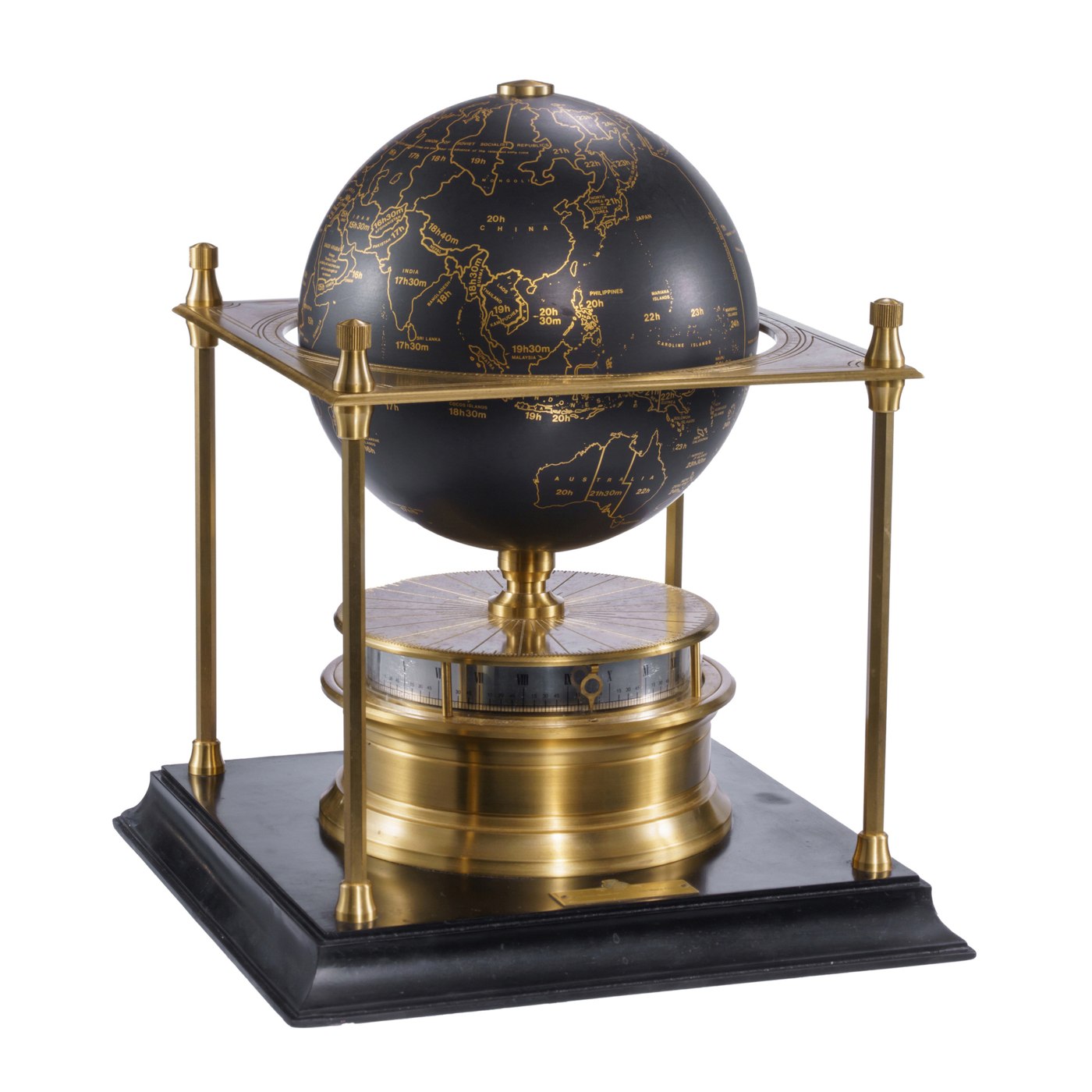
This terrestrial globe table clock, identified as The Royal Geographical Society World Clock, was produced by the Swiss manufacturer ImHof in a limited edition around 1982. The design is attributed to British watchmaker Richard Good, with the clock edited by the Franklin Mint Ltd., London. The construction features a rotating terrestrial globe mounted above a circular brass base, which is set upon a dark ebonized wood plinth. Four vertical brass columns support an upper brass frame encircling the globe. The movement, designated as Caliber 15, is wound by turning the globe knob and set by manipulating the crown to align with a viewfinder or visor. The instrument is intended to provide a view of the time globally. It measures 28 x 22 x 22 cm. The signature appears on a brass plaque affixed to the base.

The Royal Geographical Society World Clock, showing the terrestrial globe within the four-pillar frame and the signed brass plaque on the ebonized base.
The Royal Geographical Society World Clock, showing the terrestrial globe within the four-pillar frame and the signed brass plaque on the ebonized base. — Antiquorum. Rights pending — permission not yet requested. Original source

Catalogue identity

Source
catalog.antiquorum.swiss
Category
Clock · Table clock
Maker / attribution
ImHof
Reference
Not recorded
Catalogue / lot identifier
13
Source-reported date
circa 1982
Source-reported place
Switzerland

Source-reported attribution and specifications are not independent authentication. A listing does not establish present ownership, current display, availability or permission to reproduce.

Object description

Construction and Design

The Royal Geographical Society World Clock is constructed from a combination of brass and ebonized wood. The clock stands on a dark wooden base, which supports a central circular brass housing for the movement. A terrestrial globe serves as a key visual and functional element, positioned above the main housing. The structure is reinforced by four vertical brass pillars that rise from the base to support a square, horizontal brass frame, which encircles the globe.

Designed by British watchmaker Richard Good, the clock was intended to display time globally at a glance. It measures 28 by 22 by 22 centimeters. The globe itself is detailed with geographical markings in a gold tone against a dark background, indicating international zones.

Evidence for this section
  • “Fine and unusual, brass and ebonized wood, terrestrial globe table clock.”
  • “The “Royal Geographical Society World Clock” was designed by the British watchmaker Richard Good, with the goal of being able to view the time, at a glance, in all parts of the world.”
  • “Dimensions 28 x 22 x 22 cm”

Movement and Operation

The movement, designated as Caliber 15, is a mechanical system requiring manual winding. Operators are instructed to wind the movement once every seven days by turning the globe knob clockwise. The time is adjusted by pulling the crown—described as the globe knob—and rotating it to align with the provided viewfinder or visor.

The clock includes a specific methodology for synchronization. To display global time, the user must turn the globe using the brass plate until the desired time zone is positioned above the visor, allowing for a comparative reading of the time globally.

Evidence for this section
  • “Caliber 15”
  • “The clock must be wound up once every 7 days.You do this by turning the crown (globe knob) clock wise until it can’t go any further.”
  • “Turn the globe by means of the brass plate until the correct time-zone is above the viewfinder (visor).”

Provenance and Documentation

The clock was produced in a limited edition around 1982, with documentation noting its association with the Franklin Mint Ltd. of London. The maker, ImHof, signed the object on a brass plaque located on the base of the clock.

The auction description provides a grading assessment, identifying the clock as 'very good'.

Evidence for this section
  • “Made in a limited edition in 1982.”
  • “The clock was edited by the Franklin Mint Ltd., London”
  • “Signed on a brass plaque on the base”
  • “Overhaul recommended, at buyer's expense”

Open research questions

  • What is the specific connection between the Franklin Mint Ltd. and the ImHof factory regarding the manufacturing of this caliber?
  • Does the '1980' date mentioned in the source for the original price represent an earlier release date than the 1982 production date?

Source evidence

Recorded claims and source quotations for ImHof The Royal Geographical Society World Clock
FieldSource-reported valueSource quotation
MakerImHof“Brand ImHof, Switzerland”
DesignerRichard Good“The “Royal Geographical Society World Clock” was designed by the British watchmaker Richard Good”
Caliber15“Caliber 15”
Dimensions28 x 22 x 22 cm“Dimensions 28 x 22 x 22 cm”
EditionLimited edition“Made in a limited edition in 1982.”
EditorFranklin Mint Ltd.“The clock was edited by the Franklin Mint Ltd., London”
MaterialsBrass and ebonized wood“brass and ebonized wood”

Visible details

  • Terrestrial globe features gold-tone geographical markings.
  • Circular horizontal dial plate displays time zone markings.
  • Four-post brass frame supports the globe and base assembly.
  • Ebonized wood base incorporates a signed brass plaque.

Research qualifications

  • The source attributes the design to Richard Good without documenting his specific role or contractual status.
  • Condition is reported as 'very good' but requires an overhaul as per the auction description.

Photograph identity and source facts were screened before import; rights clearance remains pending.

Consulted source

IMHOF THE ROYAL GEOGRAPHICAL SOCIETY WORLD CLOCK, BRASS

Reviewed 2026-10-26 · Record c185f5df9a

Terms in this record

Glossary explanations for terms named in this object’s record.