
Skip to content
The Encyclopedia of Horology

Clock · Table hydrochronometer / water clock

Idrocronometro da tavolo di Padre Giovanni Battista Embriaco (Ceriana)

Partially verified

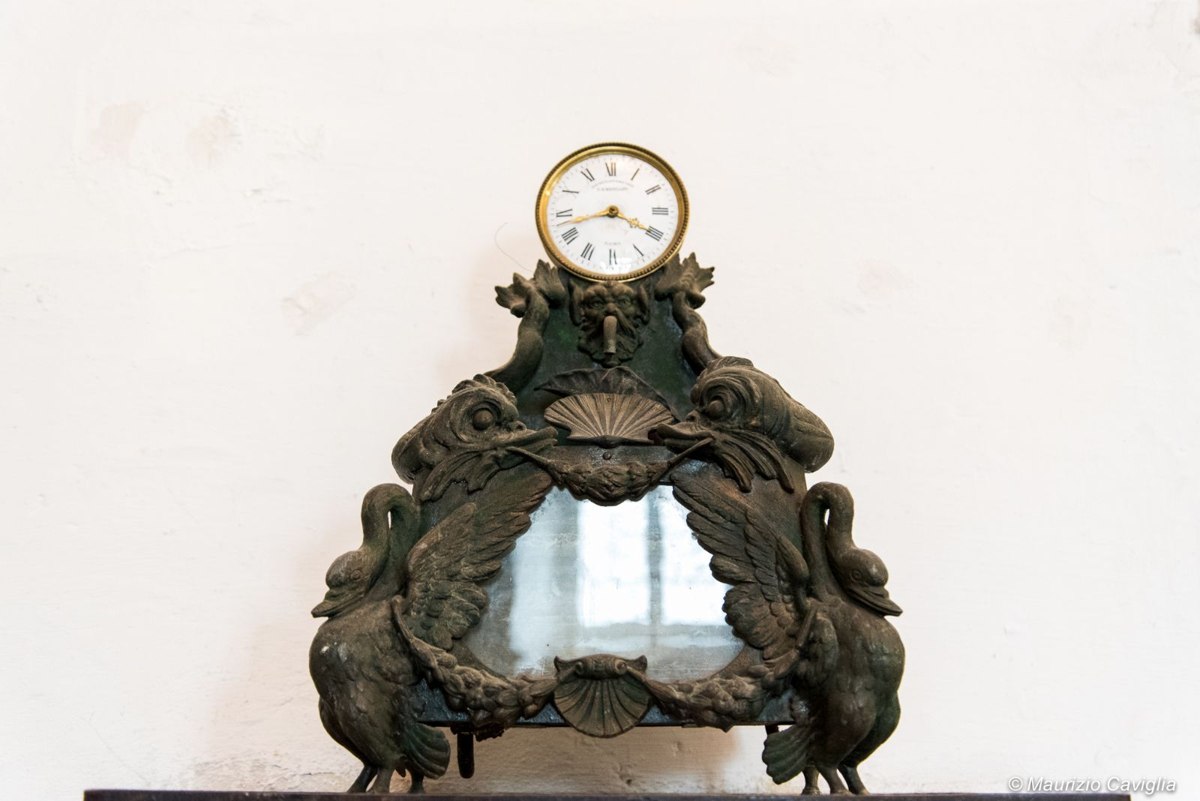
This table water clock (idrocronometro da tavolo), preserved in the sacristy of the Parrocchia dei Santi Pietro e Paolo in Ceriana, represents the horological invention of Dominican friar Giovanni Battista Embriaco (1829–1903). The source reports that Embriaco's hydrochronometer system operates by water filling two basins alternately, supplying uniform motion to drive the pendulum and striking mechanism. The object features a sculpted casing adorned with aquatic and avian motifs, including swans, dolphins, shells, and a mascaron beneath a top-mounted circular dial with Roman numerals.

Front view of the table hydrochronometer in Ceriana featuring a sculpted casing and top-mounted round dial
Front view of the table hydrochronometer in Ceriana featuring a sculpted casing and top-mounted round dial — Maurizio Caviglia. Rights pending — permission not yet requested. Original source

Catalogue identity

Source
www.comune.ceriana.im.it
Category
Clock · Table hydrochronometer / water clock
Maker / attribution
Padre Giovanni Battista Embriaco
Reference
Not recorded
Catalogue / lot identifier
Source URL identifies the listing
Source-reported date
19th century
Country
Italy

Source-reported attribution and specifications are not independent authentication. A listing does not establish present ownership, current display, availability or permission to reproduce.

Object description

Object Identity and Location

This table water clock (idrocronometro da tavolo or orologio ad acqua) is preserved in the sacristy of the Parrocchia dei Santi Pietro e Paolo in Ceriana. The source identifies it with Dominican friar Giovanni Battista Embriaco (born in Ceriana on December 31, 1829; died in Rome on March 6, 1903), who developed both monumental and table versions of his hydrochronometer.

According to the municipal source, table hydrochronometers like the one in Ceriana are also found in Florence at the Museo di Storia della Scienza, in two German museums in Stuttgart and Mindelheim, and in approximately ten private collections.

Evidence for this section
  • “si trova a Ceriana nella sagrestia della Parrocchia dei Santi Pietro e Paolo”
  • “Giovanni Battista Embriaco (Ceriana, 31 dicembre 1829 – Roma, 6 marzo1903)”
  • “Idrocronometri da tavolo, come quello di Ceriana si trovano a Firenze al Museo di Storia della Scienza, in due importanti musei tedeschi di Stoccarda e Mindelheim. e in una decina in collezioni private”

Visible Case and Dial Architecture

Visual observation indicates a circular white dial marked with black Roman numerals and enclosed in a gold-toned bezel positioned at the apex of the structure. Below, the front of the housing contains a glazed aperture revealing interior space.

The surrounding patinated sculpted metal case incorporates aquatic and avian ornamental motifs. Two sculpted swans with raised wings flank the glazed upper opening, while the lower body features two modeled dolphins, scallop shells, and a mascaron serving as a decorative spout element.

Evidence for this section
  • “Circular white dial with black Roman numerals set in a gold-toned bezel at the apex”
  • “Patinated sculpted metal case incorporating two swans with spread wings flanking a glazed front aperture”
  • “Carved decorative details including two dolphins, scallop shells, and a mascaron spout”

Operating Principle and Source Limits

The operating principle described in the source relies on water filling two alternating basins, imparting uniform, isochronous motion to drive both the pendulum and the striking mechanism. The source notes that Embriaco's system was submitted to contemporary scientists for evaluation, citing an 1860 report from the Accademia dei Lincei.

The source does not specify the individual manufacturing date, materials, or dimensions for the Ceriana timepiece, nor does it state whether the internal mechanism is currently functional. Direct visual examination of the internal movement is limited by reflections across the front glass panel in available imagery.

Evidence for this section
  • “un meccanismo in cui l’acqua, riempiendo a ritmo alternato due bacinelle, imprime un moto uniforme (“isocrono”) alla suoneria e al pendolo”
  • “Il padre Giovanni Battista Embriaco, si legge in una relazione dell’Accademia dei Lincei del 1860”

Open research questions

  • What are the recorded dimensions, weight, and metallic composition of the sculpted case in Ceriana?
  • Does this specific table hydrochronometer bear any maker's signature, foundry mark, or serial inscription?
  • Is the hydraulic mechanism in the Ceriana sacristy preserved in operational condition or connected to a water supply?

Source evidence

Recorded claims and source quotations for Idrocronometro da tavolo di Padre Giovanni Battista Embriaco (Ceriana)
FieldSource-reported valueSource quotation
LocationSagrestia della Parrocchia dei Santi Pietro e Paolo a Ceriana“si trova a Ceriana nella sagrestia della Parrocchia dei Santi Pietro e Paolo”
InventorPadre Giovanni Battista Embriaco“Idroconometro da tavolo di padre Giovanni Battista Embriaco”
Mechanism principleWater filling two basins alternately“un meccanismo in cui l’acqua, riempiendo a ritmo alternato due bacinelle, imprime un moto uniforme (“isocrono”)”
Inventor birth and death31 December 1829 (Ceriana) – 6 March 1903 (Rome)“Giovanni Battista Embriaco (Ceriana, 31 dicembre 1829 – Roma, 6 marzo1903)”
Accademia dei Lincei report date1860“si legge in una relazione dell’Accademia dei Lincei del 1860”

Visible details

  • Circular white dial with black Roman numerals set in a gold-toned bezel at the apex
  • Patinated sculpted metal case incorporating two swans with spread wings flanking a glazed front aperture
  • Carved decorative details including two dolphins, scallop shells, and a mascaron spout

Research qualifications

  • The internal water-driven movement components are largely obscured or reflect light through the front glass panel in the photograph
  • The source does not specify an exact date of manufacture for this individual example

Photograph identity and source facts were screened before import; rights clearance remains pending.

Consulted source

Idrocronometro da tavolo di Padre Giovanni Battista Embriaco - Comune di Ceriana

Reviewed 2026-10-21 · Record e8241c794a

Terms in this record

Glossary explanations for terms named in this object’s record.