
Skip to content
The Encyclopedia of Horology

Pocket watch · Pocket watch

Horloge met meisje met vogels en kat

Partially verified

This pocket watch, dating from approximately 1790 to 1810, is a gold timepiece featuring an enameled scene on the caseback. The decoration depicts a girl holding a basket containing two birds, accompanied by a cat climbing toward her, set against a background of blue translucent enamel. The white enameled dial displays Roman numerals for the hours and Arabic numerals at the quarters for the minutes. It is signed "Fres. Lurasco à Amsterdam" on the dial and the platine is marked with the number 5752. While the watch was sold by the Lurasco brothers in Amsterdam, the movement itself is attributed to anonymous Swiss makers in Geneva. The construction incorporates gold, enamel, and glass materials. This object was part of the Maurits Elzas collection and entered the Rijksmuseum via bequest in 1937.

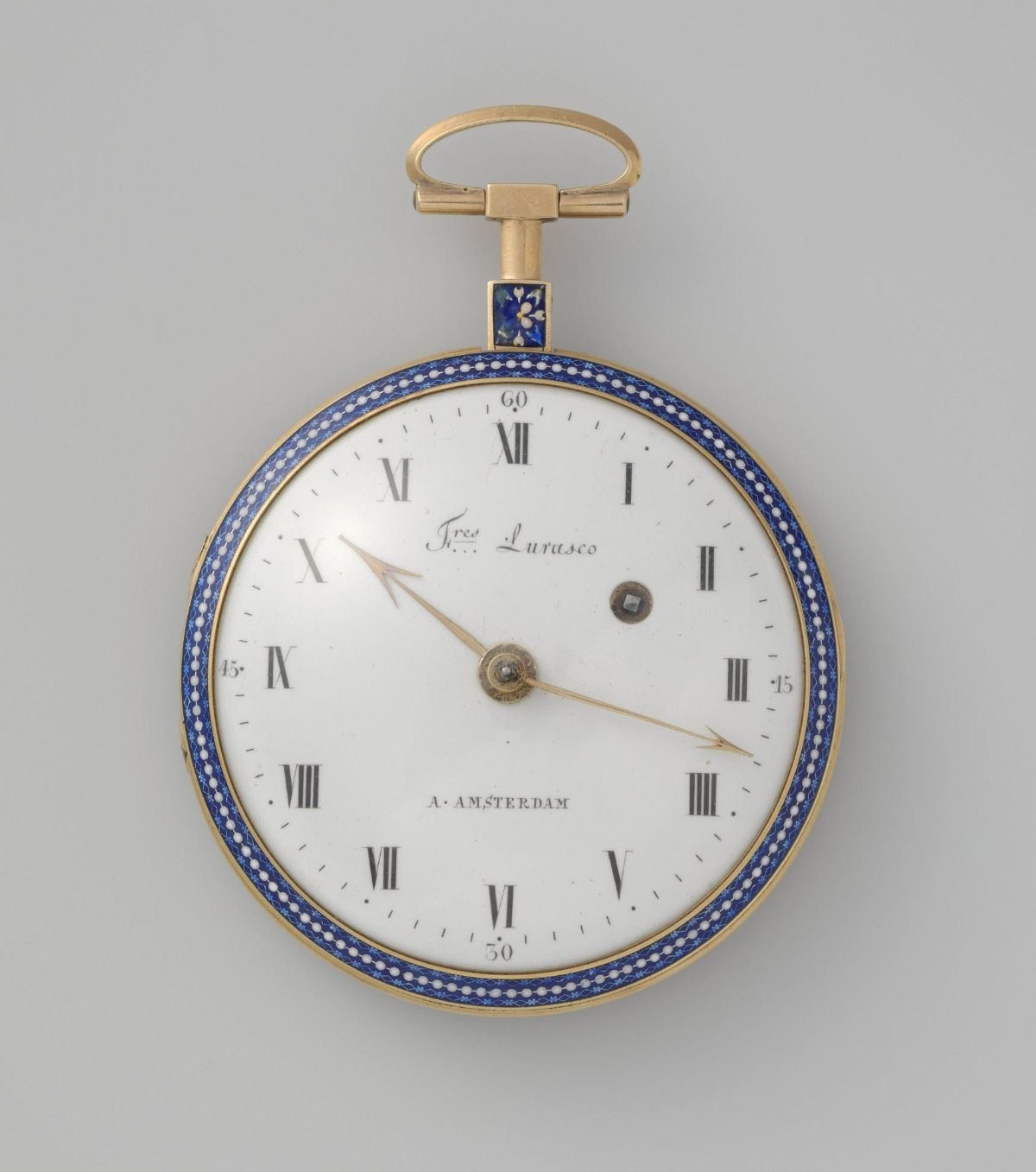
Front view of the pocket watch showing the white dial with Roman hour numerals and the signature of Lurasco.
Front view of the pocket watch showing the white dial with Roman hour numerals and the signature of Lurasco. — Rijksmuseum. Rights pending — permission not yet requested. Original source

Catalogue identity

Source
www.rijksmuseum.nl
Category
Pocket watch · Pocket watch
Maker / attribution
Lurasco, Frères
Reference
Not recorded
Catalogue / lot identifier
BK-15011
Source-reported date
c. 1790 - c. 1810
Source-reported place
Switzerland
Source-reported serial
5752

Source-reported attribution and specifications are not independent authentication. A listing does not establish present ownership, current display, availability or permission to reproduce.

Object description

Case and Dial Design

The enamel work illustrates a young girl holding a basket with two birds while a cat climbs upward, all positioned upon a translucent blue enamel background. This stylistic choice is associated with 18th-century production practices in Geneva, where small gold items decorated with colored enamel were crafted for European export.

The front of the watch presents a white enameled dial featuring Roman numeral hour markers. Arabic numerals are used to indicate minutes at the quarter-hour positions. The dial is signed "Fres. Lurasco à Amsterdam," identifying the firm of the Lurasco brothers who operated in Amsterdam starting in 1795. The entire dial is framed by a decorative blue enamel border.

Evidence for this section
  • “Gouden horloge met geëmailleerd tafereel, voorstellende een meisje met blauwe sjerp, een korf houdend, waarin twee vogels, terwijl een poes tegen haar opklimt, op een achtergrond van blauw translucide email.”
  • “De wit geëmailleerde wijzerplaat met Roemeinse uur- en Arabische minuut-cijfers op de kwartieren is gemerkt: Frès. Lurasco à Amsterdam.”

Movement and Identification

The internal mechanics of the watch are attributed to anonymous makers in Geneva, Switzerland. The watch relies on a movement built from various materials, housed within a case that bears the serial number 5752. This specific number is engraved on the platine of the watch, which also carries the signature of the Lurasco firm.

The Lurasco brothers served as a retail business, sourcing the watch movements from Switzerland and installing them into the finished cases. These gold watches were part of a broader inventory of goods sold by the brothers, including barometers and thermometers, which they began vending in Amsterdam towards the end of the 18th century.

Evidence for this section
  • “uurwerkmaker: anoniem, Zwitserland”
  • “De platine is eveneens getekend en tevens genummerd 5752.”

Provenance and Collection History

The watch was bequeathed to the museum in 1937 as part of the Maurits Elzas collection from Arnhem. Prior to its inclusion in the Elzas collection, the object is traced to the collection of Van Balveren. Documentation suggests this may have been Walraven Elias Johan baron van Balveren, who lived in Arnhem until 1920.

Following the potential ownership by the Van Balveren family, the item was purchased by Maurits Elzas in 1921. It formed part of a significant group of 107 watches that Elzas eventually donated to the Rijksmuseum. The provenance record notes this acquisition history through the Rijksmuseum's inventory logs.

Evidence for this section
  • “Collectie Maurits Elzas, Arnhem”
  • “collection Van Balveren, possibly Walraven Elias Johan baron van Balveren (1858-1920), Arnhem;”
  • “by whom bequeathed with 106 other watches, as part of the 'Maurits Elzas Collection', to the museum, 1937”

Open research questions

  • What specific type of movement (e.g., cylinder or verge escapement) is housed within the watch?
  • Can the specific identity of the 'anonymous' Swiss manufacturer be narrowed down through the serial number 5752?

Source evidence

Recorded claims and source quotations for Horloge met meisje met vogels en kat
FieldSource-reported valueSource quotation
Object numberBK-15011“Objectnummer BK-15011”
MakerLurasco, Frères“winkelbedrijf: Lurasco, Frères, Amsterdam”
Movement originSwitzerland, Geneva“uurwerkmaker: anoniem, Zwitserland uurwerkmaker: anoniem, Genève”
Inscription5752“inscriptie, platine: ‘5752’”
MaterialsGold, enamel, glass“Fysieke kenmerken goud, email, glas; uurwerk: diverse materialen”
Dial signatureFres. Lurasco à Amsterdam“signatuur, wijzerplaat: ‘Fres. Lurasco à Amsterdam’”
ProvenanceCollection Maurits Elzas, Arnhem“Credit line Collectie Maurits Elzas, Arnhem”
AcquisitionLegacy 1937“Verwerving legaat 1937”

Visible details

  • Blue enameled border on the dial
  • Winding hole at the 3 o'clock position
  • Roman numeral hour indicators
  • Bow-style top pendant

Research qualifications

  • The movement manufacturer is described only as anonymous and originating from Switzerland or Geneva.
  • The identification of the previous owner as Walraven Elias Johan baron van Balveren is marked as possible in the provenance records.

Photograph identity and source facts were screened before import; rights clearance remains pending.

Consulted source

Pocket watch, c. 1790 - c. 1810

Reviewed 2026-11-02 · Record c687460e68

Terms in this record

Glossary explanations for terms named in this object’s record.