
Skip to content
The Encyclopedia of Horology

Tool · Nuremberg horizontal dial

Horizontal Dial

Partially verified

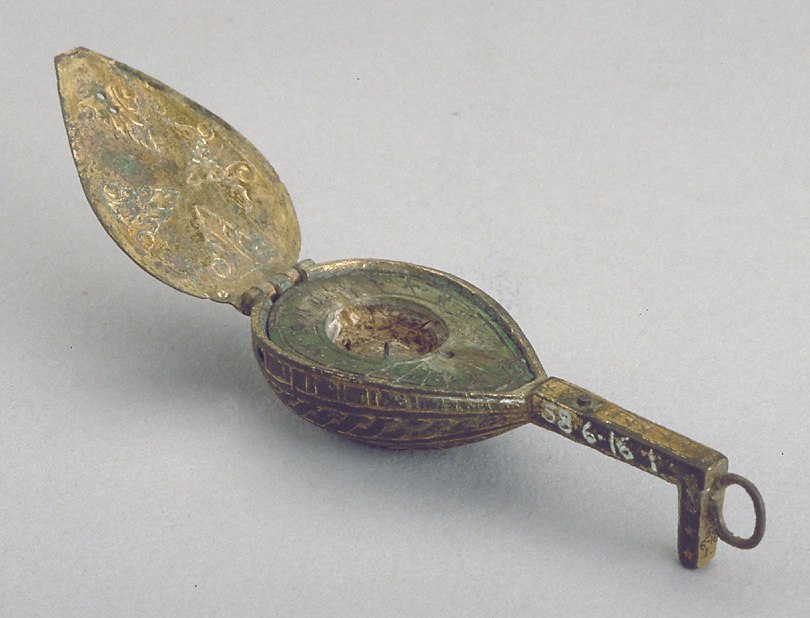
This horizontal sundial is shaped like a small lute, measuring 64 x 26 x 15 mm. Constructed from ivory and brass, the instrument features a hinged lid and a suspension ring at the top of the neck, suggesting its function as a piece of jewellery rather than a practical timekeeper. The interior of the lute body contains an ivory plate carved with hour lines ranging from 4 to 12 to 8 for a string gnomon, which is currently missing. The exterior and lid are decorated with stars, geometrical patterns, and foliage. The instrument is unsigned and attributed to Nuremberg, dating from approximately 1600. It is held within the British Museum collection. The device includes a central compass, though the overall condition is reported as not well-preserved, with the top of the lid formerly featuring glass inlay that is now broken.

Horizontal Lute-form dial, unsigned, Nuremberg, circa 1600.
Horizontal Lute-form dial, unsigned, Nuremberg, circa 1600. — British Museum, London. Rights pending — permission not yet requested. Original source

Catalogue identity

Source
www.mhs.ox.ac.uk
Category
Tool · Nuremberg horizontal dial
Maker / attribution
Not established
Reference
Not recorded
Catalogue / lot identifier
MLA 1858, 6-16.1
Source-reported date
circa 1600 ?
Source-reported place
Nuremberg

Source-reported attribution and specifications are not independent authentication. A listing does not establish present ownership, current display, availability or permission to reproduce.

Object description

Construction and Design

The instrument is designed in the shape of a miniature lute, an unusual form for a horizontal sundial. It incorporates a hinged lid, which provides protection for the internal components when the device is closed. A suspension ring is located at the top of the neck, facilitating its use as a pendant, which implies the object served a decorative purpose as jewellery.

The internal ivory plate is carved with hour lines calibrated from 4 to 12 to 8. A compass is positioned centrally on this plate. The exterior, including the neck and back of the instrument, features ornamental star symbols, foliage, and geometric patterns. The lid previously featured glass inlay, which is now broken, and a paper layer underneath that has detached.

Evidence for this section
  • “This dial has the form of a small lute.”
  • “The inside of the lid is decorated.”
  • “Three star symbols are carved on the bottom part of the ivory leaf, and there is a compass in the centre.”
  • “Underneath the glass was a paper, now detached.”

Condition and Attribution

The provenance of this dial is recorded under the British Museum accession number MLA 1858, 6-16.1. The instrument was acquired in 1858. The source indicates that the condition is not optimal, noting specific losses and damage to the original materials.

The dial is unsigned, but it is attributed to Nuremberg with a date of circa 1600. The source acknowledges the uncertainty of this dating by appending a question mark. It is noted that a similar lute-shaped pendant exists in the Museum of London, though that item does not function as a horizontal dial.

Evidence for this section
  • “The instrument is unfortunately not very well preserved.”
  • “The instrument was purchased in 1858”
  • “Unsigned”
  • “circa 1600 ?; Nuremberg”

Functionality

The sundial relies on a string gnomon for its operation, although the string is currently absent from the device. Given its small size and the presence of a suspension ring, it is suggested that the instrument was not intended for precise timekeeping tasks.

The dial is categorized as a horizontal dial despite its unconventional casing. The hour lines, ranging from 4 to 8, are fixed onto the ivory plate inside the lute body, indicating a specialized layout for a string-gnomon style dial. The central compass would have been required to orient the dial correctly during use, regardless of its primary role as jewellery.

Evidence for this section
  • “The very small size and design of the instrument together with the fact that it has a suspension ring show that it was not intended for practical use but more likely was used as a piece of jewellery.”
  • “The actual hour lines from 4 to 12 to 8 for the string gnomon dial (string missing) are carved on an ivory plate inside the lute itself.”

Open research questions

  • What was the original content or purpose of the paper found beneath the glass?
  • Are there other similar lute-form dials from the same region or period in existence?

Source evidence

Recorded claims and source quotations for Horizontal Dial
FieldSource-reported valueSource quotation
Dimensions64 x 26 x 15 mm“64 x 26 x 15 mm”
MaterialsIvory and brass“Ivory and brass”
FormLute“This dial has the form of a small lute.”
Dial markingsHour lines 4 to 12 to 8“The actual hour lines from 4 to 12 to 8 for the string gnomon dial (string missing) are carved on an ivory plate inside the lute itself.”
DecorationStars, geometrical decoration and foliage“The neck and the back of the lute are decorated with stars, geometrical decoration and foliage.”
Accession numberMLA 1858, 6-16.1“MLA 1858, 6-16.1”

Visible details

  • Hinged lid opens to reveal the internal dial plate
  • Suspension ring attached to the end of the lute neck
  • Central compass positioned within the ivory dial plate
  • Exterior surfaces decorated with stars and geometric motifs

Research qualifications

  • The gnomon string is missing
  • The date is speculative and marked with a question mark in the source

Photograph identity and source facts were screened before import; rights clearance remains pending.

Consulted source

Horizontal Dial

Reviewed 2026-10-26 · Record 3d0a0ccb65

Terms in this record

Glossary explanations for terms named in this object’s record.