
Skip to content
The Encyclopedia of Horology

Clock · Chess timer

Heuer 'Chess Champion' Timer

Partially verified

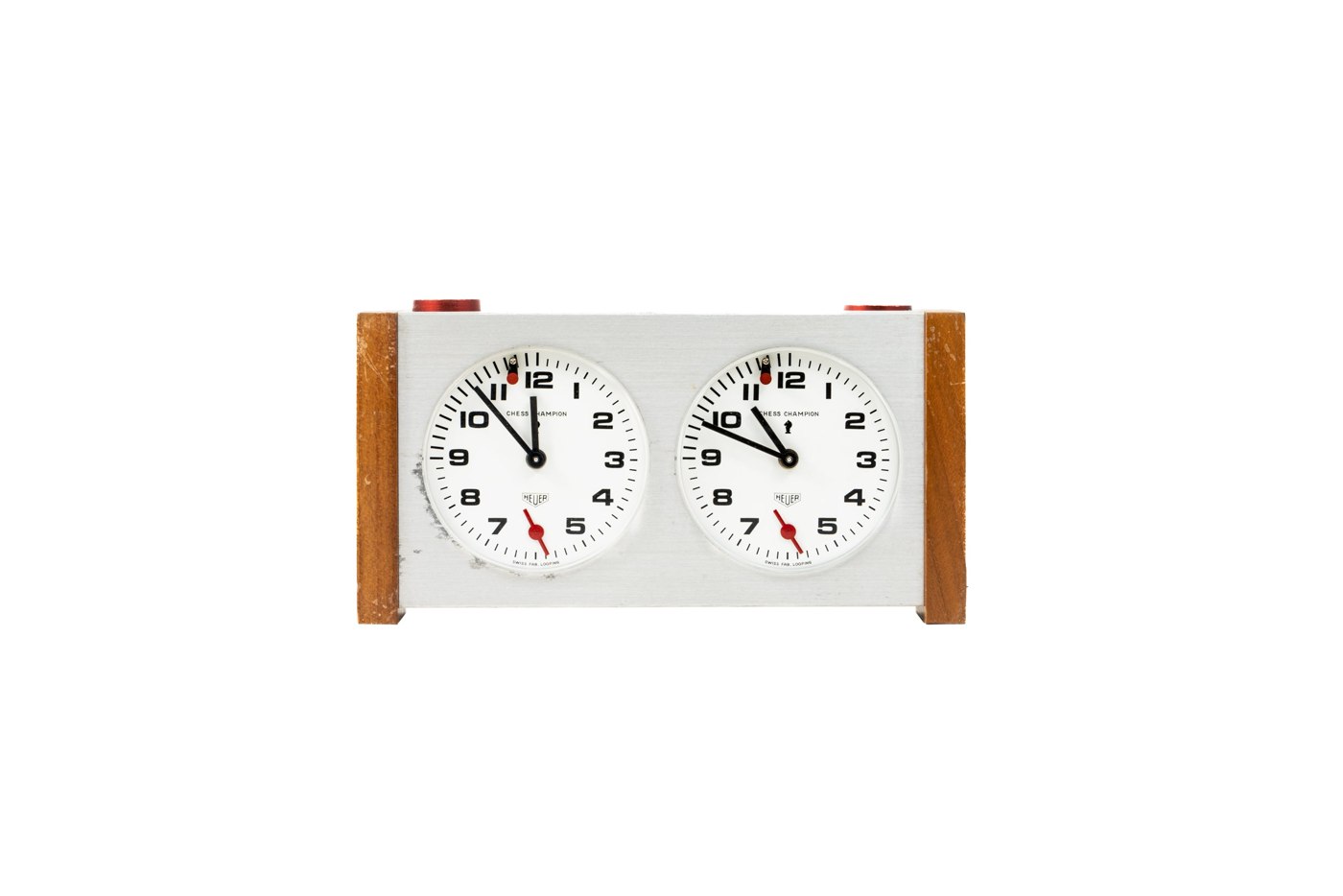
This Heuer-branded chess timer was manufactured by Looping, a Swiss maker specialized in travel and desk clocks. Dating to the 1960s or 1970s, the unit is constructed with a combination of wood and stainless steel, measuring approximately 6” x 3” x 3”. The housing features two distinct white dials, each displaying black Arabic numeral hour markers and baton handsets. The clock is operated by red stainless steel pushers located on the top of the case, which allow players to alternate the active timing mechanism by starting the opponent's clock while simultaneously stopping their own. Power is supplied by dual hand-wound movements, with the winding and setting functions positioned on the back of the device. The design incorporates dual acrylic crystals to protect the dials, providing a physical interface for competitive gameplay that predates digital timekeeping technologies.

Front view of the Heuer Chess Timer showing the dual dials and red pushers.
Front view of the Heuer Chess Timer showing the dual dials and red pushers. — Analog:Shift. Rights pending — permission not yet requested. Original source

Catalogue identity

Source
shop.analogshift.com
Category
Clock · Chess timer
Maker / attribution
Heuer
Reference
Not recorded
Catalogue / lot identifier
asm0219
Source-reported date
1960s-1970s
Source-reported place
Switzerland

Source-reported attribution and specifications are not independent authentication. A listing does not establish present ownership, current display, availability or permission to reproduce.

Object description

Construction and Design

The chess timer is housed in a rectangular frame measuring 6 inches by 3 inches by 3 inches. The case material is a combination of stainless steel and wood. The front face of the unit displays two identical clock faces, each covered by an acrylic crystal. The dials are white with black Arabic numerals and baton-style hands. Red push-button actuators are integrated into the top surface of the case, serving as the mechanical control for alternating the timekeeping between the two internal movements.

The device relies on dual hand-wound mechanical movements to track time for two players during a game. The user adjusts the settings and winds the springs using controls located on the reverse side of the clock. This design excludes any electronic or digital components, requiring manual interaction from the players to cycle the timers during competitive matches.

Evidence for this section
  • “Housed in a 6” x 3” x 3” stainless steel and wooden case, it features dual acrylic crystals”
  • “Powered by dual hand-wound movements that are wound and set on the back of the case”

Operational Functionality

The primary function of the device is to measure the time elapsed during a chess match. Players manage their time by manipulating the red stainless steel buttons situated on top of the enclosure. Pressing the button stops the internal mechanism of one clock while simultaneously engaging the balance of the second clock. This mechanism provides a tactile feedback system for tracking how much time each participant has remaining to complete their turn or the overall duration of the game.

The movements are strictly mechanical, requiring the user to wind the springs to store potential energy for the clocks. The lack of quartz-based or digital technology makes the timer an example of manual timekeeping hardware.

Evidence for this section
  • “a chess player stops his own clock — thereby simultaneously starting his opponent’s clock — using the button on the case top”
  • “this chess timer is a nostalgic reminder of an era before digital timekeeping”

Attribution and Provenance

The source specifies that while it carries the Heuer branding, the physical production was undertaken by Looping, a Swiss firm noted for producing desk and travel clocks. The timeline for this object is attributed to the period between the 1960s and the 1970s.

The presence of the Heuer logo on the dials serves as the primary branding, while the 'Swiss Fab. Looping' inscription on the lower portion of the dials identifies the actual manufacturer.

Evidence for this section
  • “chess timer clock made for Heuer by Looping, a Swiss manufacturer of travel and desk clocks”
  • “Dating to the 1960s-1970s”

Open research questions

  • What specific Looping movement caliber is utilized in these dual-clock units?
  • Are there variations of this chess timer that carry different branding or dial layouts within the same manufacturing period?

Source evidence

Recorded claims and source quotations for Heuer 'Chess Champion' Timer
FieldSource-reported valueSource quotation
MakerLooping“chess timer clock made for Heuer by Looping”
Case dimensions6” x 3” x 3”“6” x 3” x 3” stainless steel and wooden case”
MaterialsStainless steel, wood, acrylic“stainless steel and wooden case, it features dual acrylic crystals”
DialsWhite with black Arabic indices“white dials, painted black ‘Arabic’ indices”
OperationHand-wound mechanical“Powered by dual hand-wound movements”
FunctionChess timer“chess timer clock made for Heuer by Looping”
Dating1960s-1970s“Dating to the 1960s-1970s”

Visible details

  • Red start and stop buttons on top
  • Wood and metal external case construction
  • Two separate timing dials
  • Signature on dials includes Heuer logo

Research qualifications

  • Exact year of production within 1960s-1970s range remains unverified
  • Internal movement condition and functionality not specified

Photograph identity and source facts were screened before import; rights clearance remains pending.

Consulted source

ساعت شطرنج Heuer Chess Timer ساخت Looping

Reviewed 2026-11-02 · Record 1fd778aafe

Terms in this record

Glossary explanations for terms named in this object’s record.