
Skip to content
The Encyclopedia of Horology

Clock · Table clock

Heisenberg clock

Partially verified

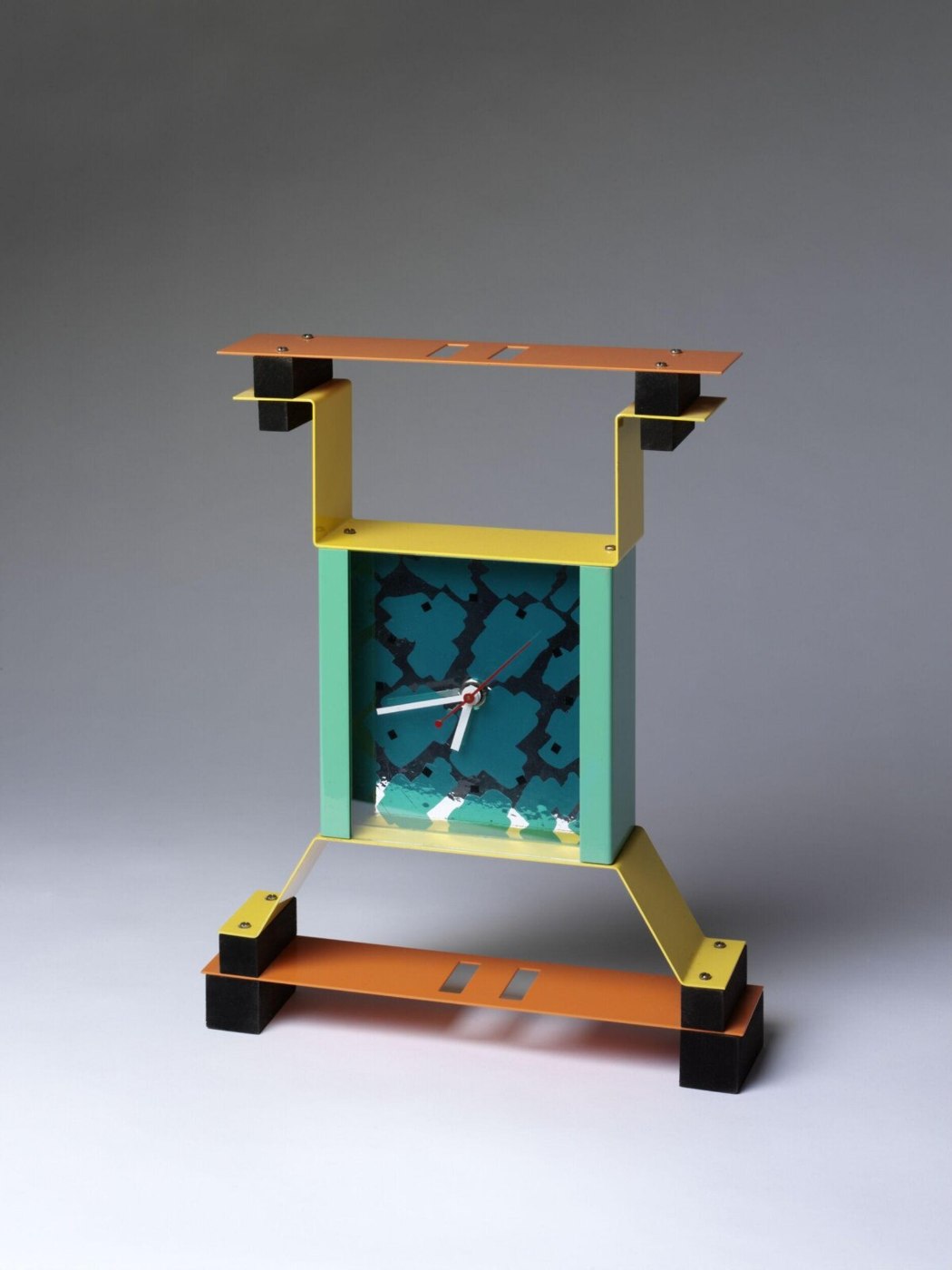
The Heisenberg clock is a decorative table clock designed by George Sowden and produced in Milan in 1983. It serves as one of twelve objects in the series titled 'Objects for an Electronic Age', a project developed by Sowden and Nathalie du Pasquier. and features a silk-screened dial powered by a quartz mechanism. The name references the physicist Werner Heisenberg, specifically his uncertainty principle, serving as a metaphor for the ambiguity observed in post-modern art and design.

The Heisenberg clock, featuring a painted sheet steel frame with a silk-screened dial and a quartz mechanism.
The Heisenberg clock, featuring a painted sheet steel frame with a silk-screened dial and a quartz mechanism. — Victoria and Albert Museum, London. Rights pending — permission not yet requested. Original source

Catalogue identity

Source
collections.vam.ac.uk
Category
Clock · Table clock
Maker / attribution
George Sowden (designed by); ARC 74 S.A.S. (produced by)
Reference
W.22-2010
Catalogue / lot identifier
W.22-2010
Source-reported date
1983
Source-reported place
Italy

Source-reported attribution and specifications are not independent authentication. A listing does not establish present ownership, current display, availability or permission to reproduce.

Object description

Design and Development

The Heisenberg clock was designed by George Sowden as part of the series 'Objects for an Electronic Age', a collaborative project with Nathalie du Pasquier. Developed independently from the Memphis group, the series was conceived to explore the transition from mechanical to electronic devices.

The designers argued that while mechanical objects required specific shells to house their internal components, electronic devices offered flexibility in their outer appearance. Consequently, the series prioritized sculptural form and decoration, with Sowden noting that electronic objects were focused on decoration rather than traditional function.

Evidence for this section
  • “The Heisenberg clock is part of the series Objects for an Electronic Age , initiated and designed by George Sowden and his wife, the designer Nathalie du Pasquier.”
  • “Sowden claimed: 'If mechanical design is about function, then electronic objects will be about decoration'.”

Construction and Appearance

The clock is manufactured in Milan, Italy, utilizing sheet steel that has been painted in various colors. The structure features a central box housing the clock face, which is finished with a silk-screened design. The quartz movement is mounted within this central section.

Visually, the clock adopts a micro-architectural composition, characterized by the use of vibrant, contrasting colors and geometric shapes. The form is designed to be sculptural, explicitly departing from traditional clock aesthetics to embody post-modern design principles through the use of ornament and painted surfaces.

Evidence for this section
  • “Clock in painted sheet steel, clock face silk-creened, quartz mechanism.”
  • “The micro-architectural composition is reminiscent of other designs by Memphis including Ettore Sottsass Murmansk centrepiece (M.35-2010).”

Conceptual Inspiration

The title of the clock, Heisenberg, refers to the physicist Werner Heisenberg. The choice of name specifically invokes the 'uncertainty principle', which states that the observation of an atomic particle alters its location, preventing the fixation of a single position.

This concept serves as a metaphor for the designers' approach to the ambiguity present in post-modern art. The piece functions as an abstract representation of this theory, aligning with the series' goal of exploring new forms in the electronic age.

Evidence for this section
  • “The title of the clock pays tribute to the physicist Werner Heisenberg and his famous 'uncertainty principle' which held that observation of an atomic particle (an electron) changes its location, so that a 'true' location cannot be fixed - an apt metaphor for post-modern ambiguity.”

Open research questions

  • What is the specific composition of the silk-screened pattern on the dial?
  • Were there any design variations between the twelve objects in the series beyond their structural shapes?

Source evidence

Recorded claims and source quotations for Heisenberg clock
FieldSource-reported valueSource quotation
DesignerGeorge Sowden“designed by George Sowden”
ProducerARC 74 S.A.S.“produced by ARC 74 S.A.S. (now Design Gallery Milano srl)”
MaterialsSheet steel, paint, quartz“Clock in painted sheet steel, clock face silk-creened, quartz mechanism.”

Visible details

  • Central clock housing supported by yellow steel framework
  • Silk-screened pattern on the clock face
  • Horizontal orange steel top and bottom plates
  • Visible quartz movement hands at the center of the dial

Research qualifications

  • The exact number of produced units in the series is not specified
  • The specific type of quartz movement mechanism is not described

Photograph identity and source facts were screened before import; rights clearance remains pending.

Consulted source

Heisenberg clock

Reviewed 2026-11-02 · Record 8fceb0fc7f

Terms in this record

Glossary explanations for terms named in this object’s record.