
Skip to content
The Encyclopedia of Horology

Tool · Gunter quadrant

Gunter quadrant by Walter Hayes

Partially verified

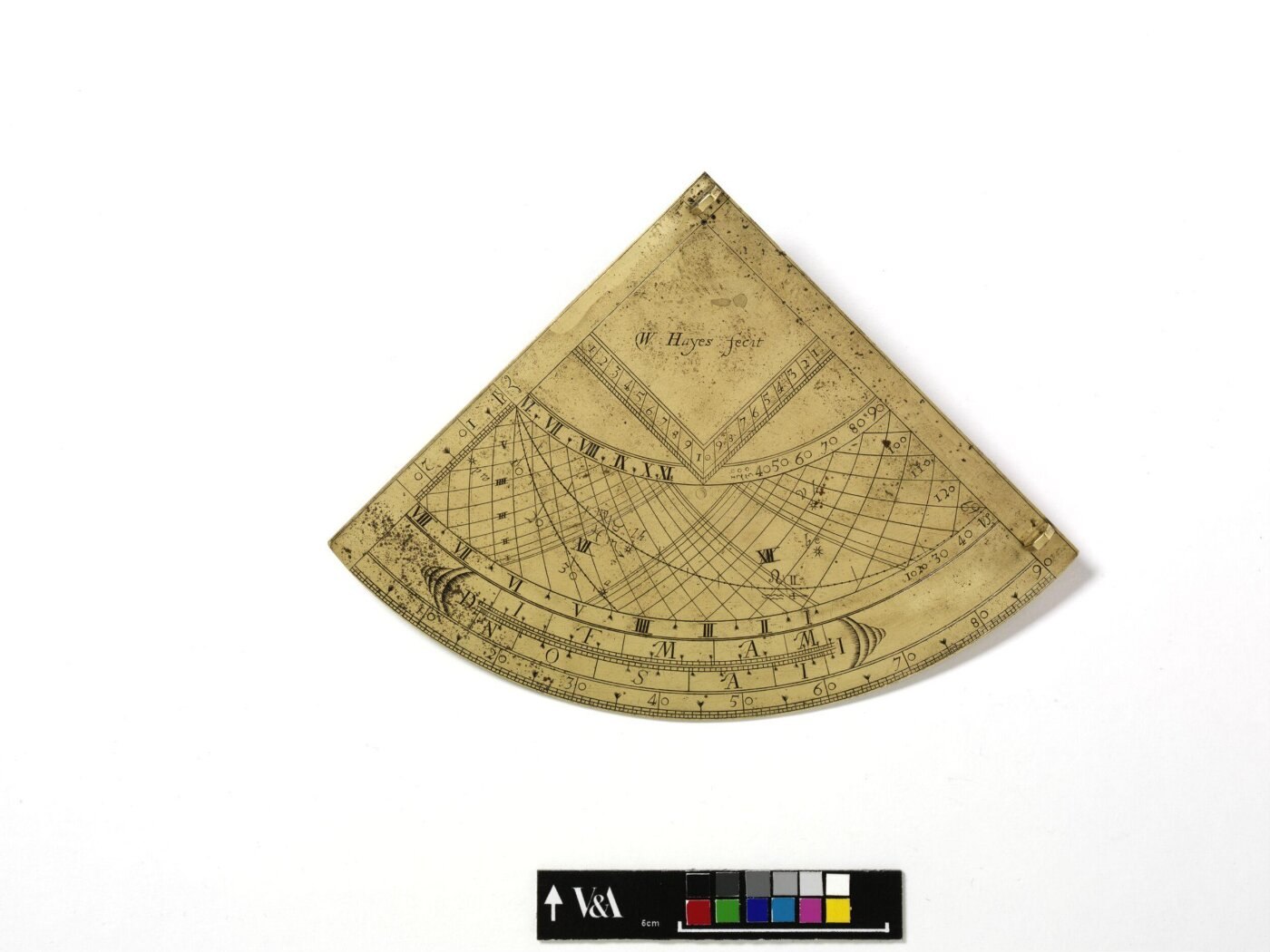
This Gunter quadrant, accession number M.341-1926, was produced in London between 1648 and 1690. The instrument is a quarter-circle made from sheet brass, which features intricate, engraved projections of star coordinates. Quadrants of this design were utilized in fields such as astronomy, astrology, and architecture for the calculation of heights and angles. This specific type of device is named after its inventor, Edmund Gunter, who passed away in 1626. The instrument is signed by the maker, Walter Hayes, an engraver based in Moorfields who worked with brass, silver, and wood. The quadrant is presently missing its original plumb-line, which would have been suspended from the apex to function as a vertical reference point during observation and calculation.

Obverse of the Gunter quadrant, showing the engraved scales and the signature 'W Hayes fecit'.
Obverse of the Gunter quadrant, showing the engraved scales and the signature 'W Hayes fecit'. — V&A Museum. Rights pending — permission not yet requested. Original source

Catalogue identity

Source
collections.vam.ac.uk
Category
Tool · Gunter quadrant
Maker / attribution
Walter Hayes
Reference
Not recorded
Catalogue / lot identifier
M.341-1926
Source-reported date
1648-90
Source-reported place
London, England

Source-reported attribution and specifications are not independent authentication. A listing does not establish present ownership, current display, availability or permission to reproduce.

Object description

Construction and Design

The Gunter quadrant is constructed as a flat quarter-circle sheet of brass. The surface is heavily worked with detailed engraving, featuring various mathematical scales and coordinate grids necessary for its astronomical and architectural functions. The obverse side displays the primary navigational and calculation scales, while the reverse features decorative and technical engravings including constellations and celestial figures.

The device was designed to be used in conjunction with a plumb-line, which would allow the user to establish a vertical reference for taking measurements. The source notes that this specific component is currently missing from the object. Despite this loss, the underlying brass substrate remains intact, showing the precision of the late 17th-century engraving work attributed to Walter Hayes.

Evidence for this section
  • “Quarter-circle of sheet brass, engraved (plumb-line missing)”
  • “This type, with engraved projections of star coordinates, is named after its inventor, Edmund Gunter”

Maker and Attribution

The instrument is attributed to the London-based engraver Walter Hayes, who was active between 1648 and 1690. Hayes operated a workshop in Moorfields where he worked across a variety of materials including silver, wood, and brass. His work included the production of mathematical and scientific instruments of the type pioneered by Edmund Gunter.

Hayes is also notable for his role in the training of Edmund Culpeper. The signature on the quadrant, 'W Hayes fecit', identifies it as a product of Hayes' shop during his period of professional activity in London.

Evidence for this section
  • “Made by Walter Hayes (active 1648-90)”
  • “Walter Hayes, an engraver from Moorfields, worked in brass, silver and wood. He trained Edmund Culpeper”
  • “signed in Latin 'W Hayes made this'”

Utility and Provenance

Quadrants of the Gunter type were essential tools for practitioners of astronomy, astrology, and architecture during the 17th century. They allowed users to perform complex calculations related to angular measurements and heights by utilizing engraved coordinate projections on the brass plate. The invention of this specific form of quadrant is credited to Edmund Gunter, who developed the system prior to his death in 1626.

The quadrant entered the Victoria and Albert Museum collection as part of the Hildburgh Gift. Its accession number, M.341-1926, marks its integration into the museum's holdings. The provenance remains tied to the broader acquisition of scientific instruments associated with this institutional gift.

Evidence for this section
  • “Quadrants were used in astronomy, astrology and architecture to calculate heights and angles.”
  • “This type, with engraved projections of star coordinates, is named after its inventor, Edmund Gunter, who died in 1626.”
  • “Credit line: Hildburgh Gift”

Open research questions

  • What is the specific purpose of the celestial figures engraved on the reverse side of this quadrant?
  • Are there remaining traces of wear that indicate the frequency of use for this instrument during the 17th century?

Source evidence

Recorded claims and source quotations for Gunter quadrant by Walter Hayes
FieldSource-reported valueSource quotation
Object typeGunter quadrant“Object type: Gunter quadrant”
MakerWalter Hayes“Made by Walter Hayes (active 1648-90)”
Date of manufacture1648-90“1648-90”
Place of originLondon, England“London (made)”
MaterialsBrass“Sheet brass, engraved”
SignedW Hayes fecit“signed in Latin 'W Hayes made this'”

Visible details

  • Engraved scales for calculation on the obverse face
  • Pictorial engravings of constellations and figures on the reverse face
  • Missing plumb-line
  • Signed W. Hayes fecit on the obverse

Research qualifications

  • Plumb-line is explicitly recorded as missing in the source
  • Exact production date within the 1648-1690 range is not provided

Photograph identity and source facts were screened before import; rights clearance remains pending.

Consulted source

Gunter quadrant

Reviewed 2026-10-26 · Record 1a2df9f0fb

Terms in this record

Glossary explanations for terms named in this object’s record.