
Skip to content
The Encyclopedia of Horology

Component · Watch chatelaine

Gold Chatelaine with Watch and Accessories

Partially verified

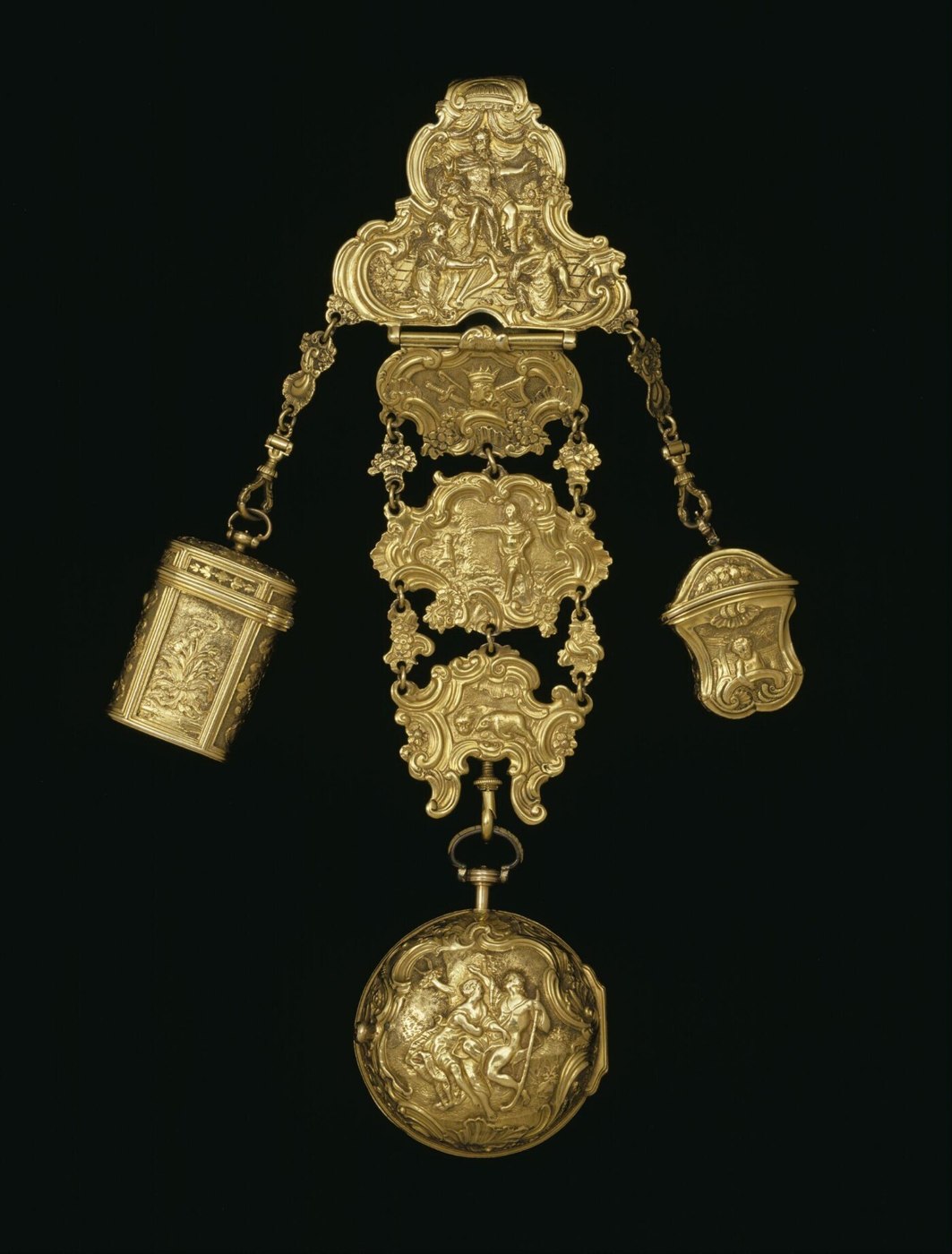
This gold chatelaine, created in London in 1755, consists of a belt hook suspension system featuring relief scenes from the life of King David. Suspended from the central structure are three primary items: a pocket watch, a snuff étui, and an additional étui. The pocket watch, signed by Robert Cawley of Chester and numbered 91, features a case engraved with a scene from Ludovico Ariosto's Orlando Furioso, depicting Angelica and Medoro. The snuff étui dates to approximately 1730 and contains a gold spoon and a 19th-century watch key. The chatelaine and the watchcase are both decorated with ornamental figure scenes. The ensemble was presented to the Victoria and Albert Museum by Mary Whiteley, and is associated by family tradition with the architect John Stewart. The object measures 200 mm in total length.

Gold chatelaine with three suspended items including a pocket watch, a snuff étui with a spoon, and a small container.
Gold chatelaine with three suspended items including a pocket watch, a snuff étui with a spoon, and a small container. — Victoria and Albert Museum, London. Rights pending — permission not yet requested. Original source

Catalogue identity

Source
collections.vam.ac.uk
Category
Component · Watch chatelaine
Maker / attribution
Robert Cawley
Reference
Not recorded
Catalogue / lot identifier
M.4:1 to 5 -2004
Source-reported date
1755
Source-reported place
United Kingdom
Source-reported serial
91

Source-reported attribution and specifications are not independent authentication. A listing does not establish present ownership, current display, availability or permission to reproduce.

Object description

Construction and Decoration

Its design incorporates detailed repoussé figure scenes, specifically illustrating episodes from the life of King David. The overall ensemble length is 200 mm, supporting three suspended components of varying origins and dates.

The watchcase, which is of similar age to the chatelaine, is decorated with a narrative scene from the Italian epic Orlando Furioso. This particular scene depicts the characters Angelica and Medoro engraving their initials into a tree trunk. The snuff étui located on the left side of the arrangement is an older component, originating from approximately 1730, and includes a functional gold spoon for administering snuff.

Evidence for this section
  • “The chatelaine and the watchcase are decorated with figure scenes.”
  • “On the chatelaine there are scenes from the life of King David as described in the Bible.”
  • “On the watchcase is a scene of Angelica and Medoro carving their initials in a tree, taken from the epic Orlando Furioso”

Watch and Accessories

The central timepiece suspended from the chatelaine is signed by the maker Robert Cawley of Chester, with the movement identified by the number 91. The watch is presented alongside a small empty étui on the right, which shares a similar chronological origin with the main chatelaine.

The snuff étui on the left contains a small gold spoon for scooping snuff. Additionally, this container houses a watch key, which the documentation notes is of 19th-century origin, distinguishing its age from the primary components of the chatelaine set.

Evidence for this section
  • “In the middle is a watch, which bears the name of the watchmaker, Robert Cawley, Chester, movement no. 91.”
  • “The watch and the small empty container or étui on the right are of approximately the same date as the chatelaine.”
  • “It contains a small gold spoon for ladling out the snuff and a 19th century watch key.”

Provenance and Documentation

The provenance of the chatelaine is documented through its donation by Mary Whiteley. The object may have remained within the family of the Liverpool architect John Stewart (1791-1871) prior to its acquisition by the museum.

The dating of the chatelaine is confirmed by the presence of London hallmarks on the belt hook, which allow for a precise assignment to the period of 1755-1756. The chatelaine is constructed in gold, featuring a belt hook at the top for attachment to the wearer's clothing.

Evidence for this section
  • “The chatelaine has London hallmarks on the hook, so it can be dated precisely to 1755-6.”
  • “possibly by descent from the family of the architect John Stewart (1791-1871)”

Open research questions

  • Is there any evidence to confirm if the watch and chatelaine were originally manufactured together as a suite?
  • Does the 19th-century watch key function with the Robert Cawley movement?

Source evidence

Recorded claims and source quotations for Gold Chatelaine with Watch and Accessories
FieldSource-reported valueSource quotation
Object typeChatelaine“Object type: Chatelaine”
Dimensions200 mm“Length: 200 mm”
WatchmakerRobert Cawley“watch by Robert Cawley, Chester”
Watch number91“movement no. 91”
Chatelaine date1755“Chatelaine, London, 1755”
Snuff étui datecirca 1730“dates from about 1730”
Watch case sceneAngelica and Medoro“scene of Angelica and Medoro carving their initials in a tree”
Maker locationChester“watch by Robert Cawley, Chester”

Visible details

  • Decorative relief scenes from the Bible on the chatelaine structure
  • Angelica and Medoro scene on the watchcase
  • Gold spoon for snuff contained within the left étui
  • 19th-century watch key attached to the snuff container

Research qualifications

  • The snuff étui is dated by the source to circa 1730, predating the main chatelaine
  • The watch key is specified as a 19th-century addition to the 18th-century snuff étui

Photograph identity and source facts were screened before import; rights clearance remains pending.

Consulted source

Chatelaine

Reviewed 2026-10-26 · Record 819b56650f

Terms in this record

Glossary explanations for terms named in this object’s record.