
Skip to content
The Encyclopedia of Horology

Clock · Chariot clock

Gilt metal chariot pendulum clock featuring Telemachus and Athena

Partially verified

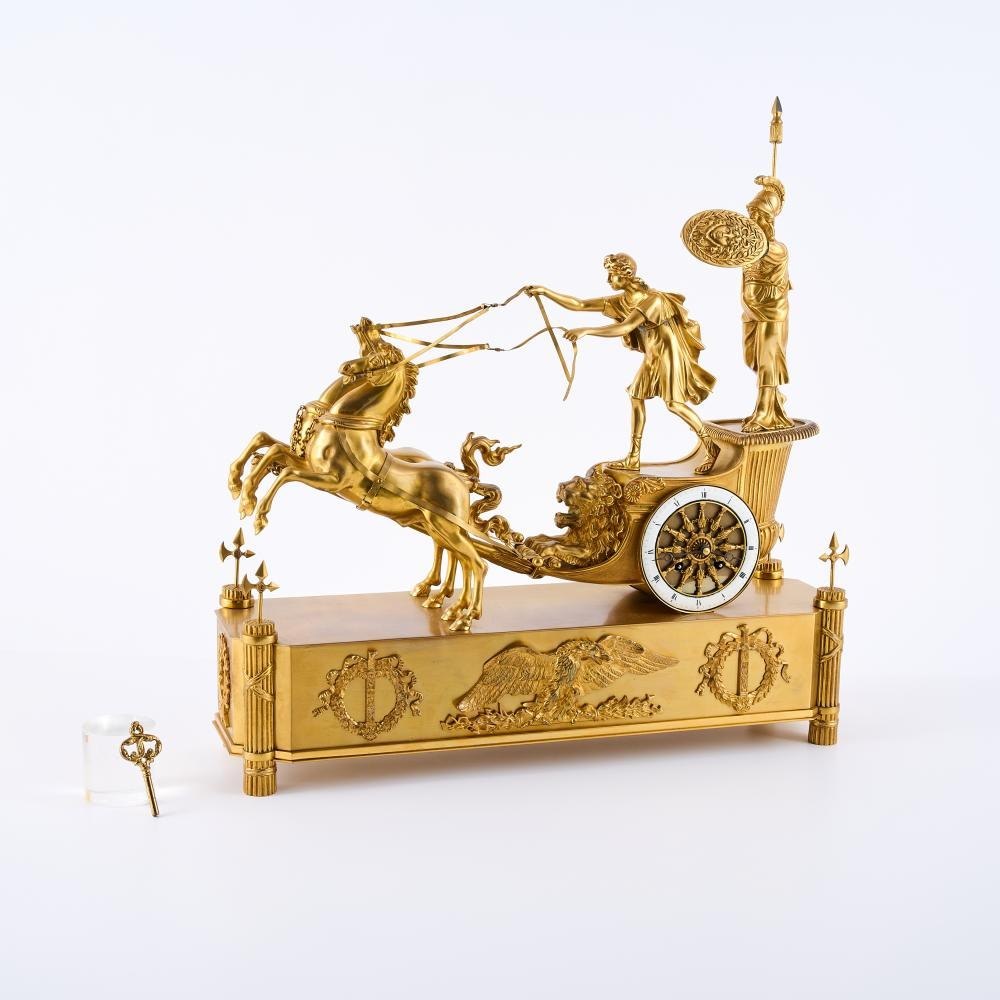
This 20th-century decorative pendulum clock is constructed from gold-plated metal with additional components in enamel and blued steel. The horological mechanism is housed within a circular watch case that is integrated into the body of a two-horse chariot, serving as the vehicle's wheel. The figurative assembly depicts Telemachus leading the chariot, with the goddess Athena positioned on a raised rear platform, holding a spear and shield. The clock is supported by an oblong pedestal base featuring surface reliefs and feet shaped as bundles of ligatures. The timepiece features a white enamel dial marked with Roman numerals. Measuring 49 by 47.5 by 14 centimeters, the object serves as both a functional timepiece and an ornate display. The clock is accompanied by a winding key. This item reflects a decorative application of figurative imagery within a clock structure, utilizing a pocket watch movement for timekeeping.

The chariot clock featuring Telemachus and Athena, shown with its winding key.
The chariot clock featuring Telemachus and Athena, shown with its winding key. — Auction house “Van Ham Kunstauktionen”, via Invaluable. Rights pending — permission not yet requested. Original source

Catalogue identity

Source
orbiscollectibles.com
Category
Clock · Chariot clock
Maker / attribution
Not established
Reference
Not recorded
Catalogue / lot identifier
Source URL identifies the listing
Source-reported date
20th century
Source-reported place
Not established

Source-reported attribution and specifications are not independent authentication. A listing does not establish present ownership, current display, availability or permission to reproduce.

Object description

Figurative Design and Construction

The primary sculptural group centers on a two-horse chariot. Telemachus is represented guiding the horses, while the goddess Athena stands upon a raised platform at the rear of the chariot, armed with a spear and shield. The chariot body integrates the timekeeping element as its wheel.

The structure is elevated on four feet, each modeled in the form of bundles of ligatures. The materials utilized throughout the construction include gold-plated metal, enamel for the dial, and blued steel components, contributing to the visual finish of the figurative piece.

Evidence for this section
  • “primary sculptural element depicts a two-horse chariot led by Telemachus, with the goddess Athena standing on a raised rear platform”
  • “oblong pedestal base, which is ornamented with intricate surface reliefs and supported by four feet shaped like bundles of ligatures”
  • “utilizes various materials, including blued steel components”

Timekeeping Mechanism and Dial

The timekeeping function of the object is provided by a pocket watch movement integrated into the side of the chariot. This movement is housed within a circular case that functions visually as the chariot wheel, connecting the horological function to the sculptural design.

The dial is rendered in white enamel and is inscribed with Roman numerals to indicate the time. The assembly is accompanied by a winding key, which is required to operate the internal movement. The integration of the dial into the side of the vehicle allows the object to operate as a functional timepiece.

Evidence for this section
  • “Integrated into the side of the chariot body is a circular watch case that functions as the chariot wheel, housing a pocket watch movement.”
  • “The dial is constructed from enamel and is detailed with Roman numerals.”
  • “The clock is accompanied by a winding key.”

Dimensions and Documentation

The clock measures 49 centimeters in height, 47.5 centimeters in width, and 14 centimeters in depth. The object is catalogued as a 20th-century decorative piece. Documentation is based on a single auction-house listing.

The listing provides physical dimensions and material descriptions. It does not cite specific manufacturer marks or catalogue references for the item. The classification is noted as partial, with the status of the item described from a single recorded source.

Evidence for this section
  • “Measuring 49 by 47.5 by 14 centimeters”
  • “Described from a single auction-house listing”

Open research questions

  • What is the identity of the movement maker contained within the wheel-shaped housing?
  • Does the base ornamentation bear any specific foundry or artisan marks that could refine the dating?

Source evidence

Recorded claims and source quotations for Gilt metal chariot pendulum clock featuring Telemachus and Athena
FieldSource-reported valueSource quotation
Date20th century“20th-century”
MaterialGold-plated metal, enamel, blued steel“Gold-plated metal, enamel, blued steel”
Dimensions49 x 47.5 x 14 cm“49 by 47.5 by 14 centimeters”
MovementPocket watch movement“housing a pocket watch movement”
Base DetailFeet shaped like bundles of ligatures“four feet shaped like bundles of ligatures”
Dial FeaturesRoman numerals“detailed with Roman numerals”

Visible details

  • Integrated wheel-form dial with Roman numerals
  • Figural group depicting Telemachus and Athena on a two-horse chariot
  • Oblong base supported by feet cast as bundles of ligatures
  • Included winding key positioned to the left of the base

Research qualifications

  • Attribution of the specific workshop or manufacturer remains unverified
  • The 20th-century dating provided is based on the source's descriptive assessment
  • Precise horological origins of the internal pocket watch movement are not specified

Photograph identity and source facts were screened before import; rights clearance remains pending.

Consulted source

Gilt metal chariot pendulum clock featuring Telemachus and Athena

Reviewed 2026-11-02 · Record 7dd9e5dd33

Terms in this record

Glossary explanations for terms named in this object’s record.