
Skip to content
The Encyclopedia of Horology

Clock · Mantel clock

Gilt bronze mantel clock by Chapsal l'ainé

Partially verified

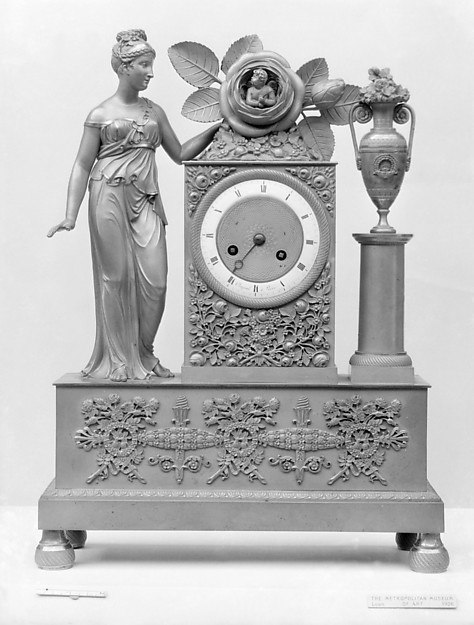
This mantel clock is constructed from gilt bronze and dates to approximately 1815–1830. Attributed to the maker Chapsal l'ainé, who was active between 1812 and 1820, the clock is held by The Metropolitan Museum of Art as accession number 26.223.5. The design incorporates a central square section housing the dial, flanked by a standing female figure on the left and a pedestal topped by a decorative urn on the right. The clock sits on a rectangular base decorated with foliage and floral motifs. The dial itself features numerical markings and two winding holes, set within a highly ornate, relief-decorated case. The entire structure stands 16 3/4 inches tall, with a width of 12 3/4 inches and a depth of 4 5/8 inches. This piece was acquired by the museum through the Rogers Fund in 1926 and is categorized under European sculpture and decorative arts.

Mantel clock in gilt bronze, depicting a standing figure, a floral rose motif with a cherub, and a pedestal-mounted urn, by Chapsal l'ainé, ca. 1815–1830.
Mantel clock in gilt bronze, depicting a standing figure, a floral rose motif with a cherub, and a pedestal-mounted urn, by Chapsal l'ainé, ca. 1815–1830. — The Metropolitan Museum of Art — Rogers Fund, 1926. Rights pending — permission not yet requested. Original source

Catalogue identity

Source
orbiscollectibles.com
Category
Clock · Mantel clock
Maker / attribution
Chapsal l'ainé
Reference
Not recorded
Catalogue / lot identifier
26.223.5
Source-reported date
ca. 1815–30
Source-reported place
French, Paris

Source-reported attribution and specifications are not independent authentication. A listing does not establish present ownership, current display, availability or permission to reproduce.

Object description

Case and Design

The central square housing the dial is densely decorated with floral and fruit relief motifs, providing a detailed surface that frames the circular dial face. To the left of this central housing stands a female figure, while the right side features a columnar pedestal topped by a lidded urn.

The entire arrangement is supported by a rectangular base raised on bun feet. The base itself is decorated with a continuous band of floral garlands and vertical scrollwork, contributing to the overall ornate aesthetic of the object.

The top of the central case incorporates a naturalistic rose motif, within which a small, seated figure of a cherub is integrated, adding a layer of figurative detail to the clock's upper profile.

Evidence for this section
  • “Gilt bronze”
  • “Overall: 16 3/4 × 12 3/4 × 4 5/8 in.”

Maker and Attribution

The timepiece is attributed to the maker Chapsal l'ainé. Documentation from The Metropolitan Museum of Art indicates that this maker was active in Paris between the years 1812 and 1820. The object is listed within the museum's European Sculpture and Decorative Arts department.

It is recognized that the production of such clocks often involved separate workshops for the movement and the decorative bronze case. As a result, the museum record notes that movements and cases were sometimes produced by different artisans and potentially married at a later date, leaving the exact provenance of the internal mechanism alongside the exterior case as a subject for continued observation.

Evidence for this section
  • “Clockmaker: Chapsal l'ainé (working 1812–20)”
  • “movements and cases were frequently made by different workshops and were sometimes married later.”

Acquisition and Status

The clock is documented as part of the permanent collection of The Metropolitan Museum of Art under the accession number 26.223.5. It was acquired by the institution in 1926 through the Rogers Fund.

The information provided originates directly from the museum's own internal records. The entry is maintained as an individual horological object record, though the source advises that verifying the broader collectible type against additional specialist literature is recommended for further accuracy.

Evidence for this section
  • “The Metropolitan Museum of Art holds this object as 26.223.5.”
  • “Credit line: Rogers Fund, 1926.”

Open research questions

  • Determine if the movement signature matches the case maker's attributed period of activity.
  • Identify if similar case designs by Chapsal l'ainé exist in other museum collections to verify the consistency of the aesthetic.

Source evidence

Recorded claims and source quotations for Gilt bronze mantel clock by Chapsal l'ainé
FieldSource-reported valueSource quotation
MakerChapsal l'ainé“Clockmaker: Chapsal l'ainé (working 1812–20)”
Dateca. 1815–30“ca. 1815–30”
MaterialsGilt bronze“Gilt bronze”
Dimensions16 3/4 x 12 3/4 x 4 5/8 inches“Overall: 16 3/4 × 12 3/4 × 4 5/8 in. (42.5 × 32.4 × 11.7 cm)”
Accession number26.223.5“26.223.5”
OriginFrench, Paris“French, Paris”
Credit LineRogers Fund, 1926“Rogers Fund, 1926”

Visible details

  • Central dial is surrounded by ornate relief patterns featuring fruits and florals
  • The base displays symmetrical ornamental bands with floral garlands and vertical motifs
  • A small figure of a cherub is positioned within a rose-like structure at the top center of the case

Research qualifications

  • The exact dating is estimated within the 1815–1830 range
  • The source notes that movements and cases were frequently made by different workshops and may have been combined later

Photograph identity and source facts were screened before import; rights clearance remains pending.

Consulted source

Clock, Chapsal l'ainé, ca. 1815–30

Reviewed 2026-11-02 · Record 938b1c15f0

Terms in this record

Glossary explanations for terms named in this object’s record.