
Skip to content
The Encyclopedia of Horology

Tool · Augsburg quadrant

Gilt Brass Quadrant by Christoph Schissler

Partially verified

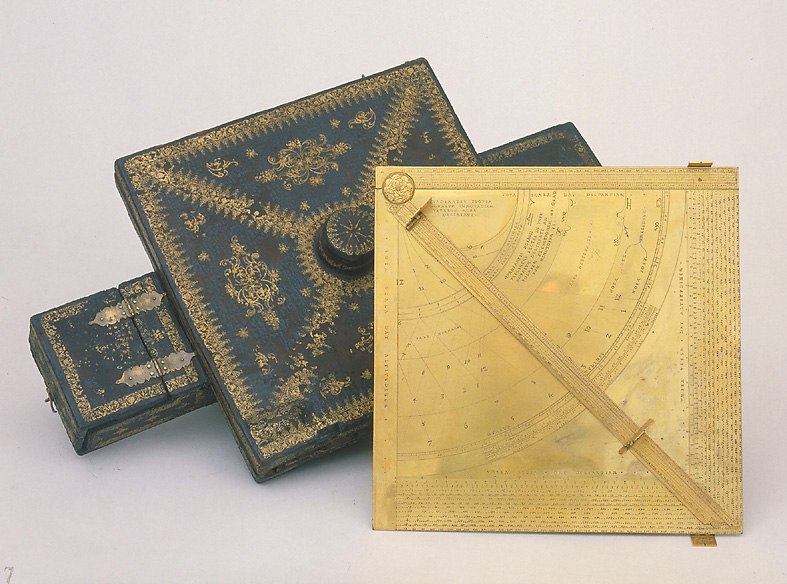
This 1599 gilt brass quadrant, measuring 380 x 380 mm, is signed by the artisan Christoph Schissler of Augsburg. The instrument is designed for the measurement of time, terrestrial distances, and heights. Its face features two horary quadrants—one for unequal hours with curved lines and one for equal hours with straight lines—calibrated for a latitude of 48 degrees 15 minutes, corresponding to Vienna. The instrument incorporates a shadow square for elevation measurements, a degree scale from 0 to 90, and a solar declination scale marked with zodiacal degrees. The assembly includes a fixed rule, a pivoting alidade with folding sights, and a rear mounting disc. It is supplied with a telescopic mahogany stand featuring a universal joint and a steel pointed base for field use, alongside a leather-bound wooden carrying case featuring gold-tooled decorations. The object is associated with a collection acquired from Germany by Prince Mattias de' Medici in 1635.

Gilt brass quadrant by Christoph Schissler, 1599, showing the face with horary scales and the leather-bound carrying case.
Gilt brass quadrant by Christoph Schissler, 1599, showing the face with horary scales and the leather-bound carrying case. — Istituto e Museo di Storia della Scienza, Firenze. Rights pending — permission not yet requested. Original source

Catalogue identity

Source
www.mhs.ox.ac.uk
Category
Tool · Augsburg quadrant
Maker / attribution
Christoph Schissler
Reference
Not recorded
Catalogue / lot identifier
155 and 156
Source-reported date
1599
Source-reported place
Augsburg

Source-reported attribution and specifications are not independent authentication. A listing does not establish present ownership, current display, availability or permission to reproduce.

Object description

Design and Functionality

The primary instrument face consists of a gilt brass plate containing two horary quadrants designed for calculating time. The inner quadrant utilizes curved lines for hours 'all'antica', while the outer quadrant uses straight lines for equal hours. This face also includes a degree scale for altitude (0 to 90 degrees) and a solar declination scale marked with zodiacal degrees.

Measurement capabilities extend to terrestrial distances and heights through the inclusion of a shadow square. Two sides of the square display 13 different pairs of scales, each divided in increments ranging from 0 to 1000. Additionally, the instrument possesses a fixed rule and a pivoting alidade equipped with folding sights for precise observations. Calibration is specifically set for the latitude of 48 degrees 15 minutes, identified as Vienna.

Evidence for this section
  • “Inside its face are two horary quadrants , one for hours 'all'antica', represented by curved lines, the other with straight lines.”
  • “The instrument, which is the work of the famous artisan Christoph Schissler , allowed the measurement of time and of terrestrial distances and heights.”
  • “The gilt brass plate has a rule riveted to one side, an alidade with folding sights pivoted at one corner, and two fixed folding sights.”

Mounting and Portability

For stationary use in the field, the instrument is designed to be mounted on a telescopic mahogany stand. This stand is provided with a universal joint to facilitate orientation and a steel pointed base meant for driving into the ground. A central disc, secured by four screws, is located on the reverse of the brass square to interface with the stand's central threaded post.

When not in use, the instrument can be dismantled for transport. It is housed in a dedicated wooden case, which is bound in leather. The exterior of this case features decorative gold tooling and includes brass hinges for secure closure.

Evidence for this section
  • “The instrument is fixed to a stand.”
  • “On the reverse the square has a central disc secured by four screws, with a central threaded post for mounting.”
  • “There is a telescopic mahogany stand and a universal joint, and a steel pointed base for driving into the ground.”

Provenance and Documentation

The quadrant is held within the collection of the Istituto e Museo di Storia della Scienza in Firenze under inventory numbers 155 and 156. Records indicate that the instrument originated in Germany and was brought into the collection of Prince Mattias de' Medici in 1635.

The piece is a recognized work by the artisan Christoph Schissler. The physical condition and configuration include a rule riveted to the side and scales continued on the alidade to 280, with individual segments divided by diagonal dots to one-fifth.

Evidence for this section
  • “It belonged to the collection brought from Germany by Prince Mattias de' Medici in 1635.”
  • “The instrument, which is the work of the famous artisan Christoph Schissler”
  • “The fixed rule and alidade have matching scales 10 to 200, divided to 5, subdivided to 1, numbered by 5, but on the alidade, which is longer, the scale is continued to 280.”

Open research questions

  • What is the specific metrological purpose of the 13 sets of scales on the square edges?
  • Are the wooden stand and metal stand components original to the 1599 manufacture?

Source evidence

Recorded claims and source quotations for Gilt Brass Quadrant by Christoph Schissler
FieldSource-reported valueSource quotation
MakerChristoph Schissler“Signed by Christoph Schissler”
Date1599“Dated 1599”
Place of originAugsburg“Augsburg”
Dimensions380 x 380 mm“380 x 380 mm”
Latitude calibration48 degrees 15 minutes“calibrated for a latitude of 48? 15' ( Vienna )”
ProvenancePrince Mattias de' Medici collection“It belonged to the collection brought from Germany by Prince Mattias de' Medici in 1635.”
MaterialsGilt brass, wood, leather“Gilt brass; 380 x 380 mm”
Inventory Numbers155 and 156“Inventory nos 155 and 156”

Visible details

  • Quadrants calibrated for Vienna latitude
  • Alidade with folding sights for measurement
  • Extensive engraved scales on perimeter
  • Leather case features gold tooling

Research qualifications

  • Originality of the mahogany stand is not explicitly confirmed
  • Exact historical function of the '13 different pairs of scales' requires further study

Photograph identity and source facts were screened before import; rights clearance remains pending.

Consulted source

Quadrant

Reviewed 2026-10-26 · Record 51b6f194cc

Terms in this record

Glossary explanations for terms named in this object’s record.