
Skip to content
The Encyclopedia of Horology

Clock · Table clock

Gilt and patinated bronze Venus clock

Partially verified

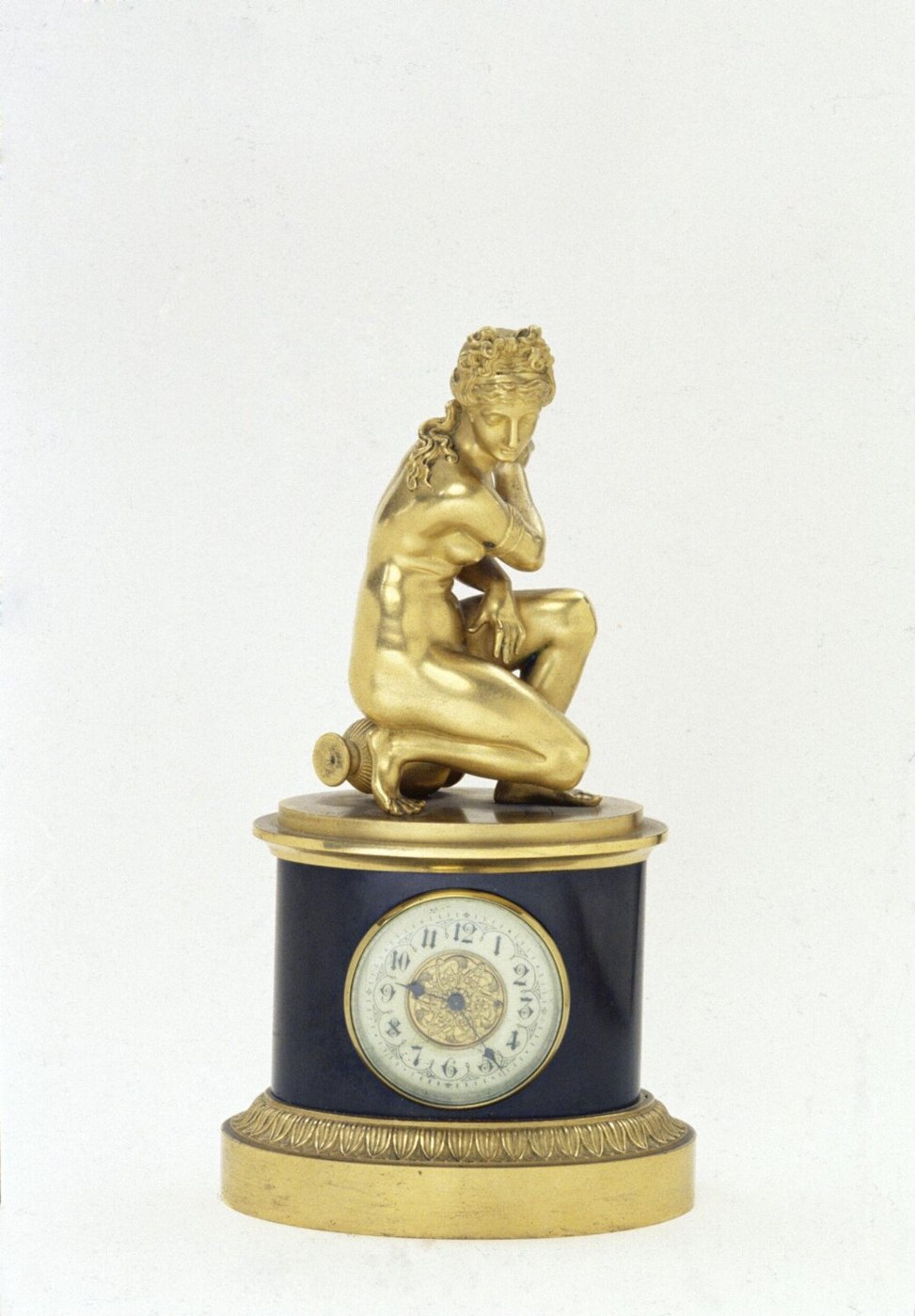
This French table clock features a gilt bronze figure of a crouching Venus, posed atop an oval, patinated bronze pedestal. A notable feature of the object is that the internal clock movement is a later replacement, documented by the museum as dating from 1880 to 1920. The pedestal is embellished with a gilt bronze plinth decorated with a moulded band of overlapping waterleaves, and the sides are capped by a projecting cornice. The clock dial is constructed from opaque white glass, featuring black enamel Arabic numerals to indicate the hours. This assembly indicates

Frontal view of the gilt bronze Venus clock, showing the later movement and dial inserted into the patinated bronze base.
Frontal view of the gilt bronze Venus clock, showing the later movement and dial inserted into the patinated bronze base. — Victoria and Albert Museum. Rights pending — permission not yet requested. Original source

Catalogue identity

Source
collections.vam.ac.uk
Category
Clock · Table clock
Maker / attribution
Not established
Reference
Not recorded
Catalogue / lot identifier
M.86-1987
Source-reported date
1800-1825
Source-reported place
France

Source-reported attribution and specifications are not independent authentication. A listing does not establish present ownership, current display, availability or permission to reproduce.

Object description

Case Construction and Design

The clock is composed of a gilt bronze figure of the crouching Venus positioned upon an oval, patinated bronze pedestal. The base structure is supported by a plain gilt bronze plinth, which features a decorative, moulded band of overlapping waterleaves. The central body of the pedestal is characterized by its plain, patinated surfaces, topped by a projecting cornice and an oval platform of gilt bronze.

The physical construction represents a modification of the object's original state. The front of the pedestal has been adapted to accommodate the clock dial and its associated movement. This insertion replaced the original gilt bronze decorative element, which took the form of a winged Cupid flying across clouds, complete with his bow and quiver.

Evidence for this section
  • “The naked gilt bronze figure of the crouching Venus is placed on an oval bronzed pedestal”
  • “surmounted by a moulded band of overlapping waterleaves”
  • “The clock dial and movement are inserted into the front replacing the original gilt bronze mount of the winged Cupid flying accross the clouds on his bow and quiver.”

Dial and Movement

The timepiece utilizes a dial fashioned from opaque white glass. The hour indices are rendered in black enamel, utilizing standard Arabic numerals. The arrangement reflects a deliberate integration of a movement that post-dates the primary structure of the pedestal and figure.

Records indicate that the internal mechanism is not contemporaneous with the bronze housing. While the outer casing is attributed to the early 19th century, the clock movement is significantly later, having been dated to the period between 1880 and 1920. This suggests an historical intervention where the functional element of the clock was updated or substituted at the turn of the 20th century.

Evidence for this section
  • “The dial is made of opaque white glass and painted in black enamel with arabic numerals for the hours.”
  • “The clock dial and movement are inserted into the front”
  • “movement, 1880-1920”

Provenance and Identification

The object is recorded in the museum collection under the accession number M.86-1987. The manufacture of the bronze components is attributed to France, consistent with the style of bronzes from the early 19th century. Despite the clear physical characteristics, the individual artist or maker responsible for the casting of the Venus figure remains unknown.

Documentation for this item emphasizes its status as a composite object. By isolating the production dates of the case from the replacement movement, the record acknowledges the dual-period nature of the current assembly, distinguishing between the original artistic intent of the early 19th-century bronze work and the subsequent late 19th- or early 20th-century horological adaptation.

Evidence for this section
  • “Accession number: M.86-1987”
  • “France 1800-25, movement, 1880-1920”
  • “artistMakerPerson: [{"name": {"text": "Unknown", "id": "A1848"}”

Open research questions

  • What is the original provenance of the movement fitted between 1880 and 1920?
  • Are there similar French bronzes that retain the original Cupid mount, allowing for a reconstruction of the lost ornament's scale?

Source evidence

Recorded claims and source quotations for Gilt and patinated bronze Venus clock
FieldSource-reported valueSource quotation
MakerUnknown“Unknown”
Place of originFrance“France”
Dateearly 19th century“early 19th century”
Movement date1880-1920“movement, 1880-1920”
MaterialsGilt bronze, enamel, glass“gilt bronze”

Visible details

  • Crouching gilt bronze Venus figure
  • Opaque white glass dial with black painted Arabic numerals
  • Gilt bronze plinth with waterleaf moulding
  • Patinated bronze oval pedestal housing the movement

Research qualifications

  • Movement is a documented 1880-1920 replacement
  • Original mount of a winged Cupid is missing

Photograph identity and source facts were screened before import; rights clearance remains pending.

Consulted source

Clock, early 19th century

Reviewed 2026-11-02 · Record 8e6dc10736

Terms in this record

Glossary explanations for terms named in this object’s record.