
Skip to content
The Encyclopedia of Horology

Pocket watch · Enamel-cased watch

G. Gamot gold and enamel watch

Partially verified

This gold and enameled watch is held by The Metropolitan Museum of Art under accession number 17.190.1623. The horological mechanism is attributed to the maker G. Gamot, who was active in France around 1646. The watch case features intricate enamel work, which is attributed to Robert Vauquer of the School of Blois. Vauquer was active between 1625 and 1670. The object is dated to approximately 1640, with the source noting subsequent work or additions described as "and later." The overall diameter of the timepiece is 2 1/4 inches (5.7 cm). The museum classifies the watch under its European Sculpture and Decorative Arts department, highlighting the combination of precision horology and period decorative arts in gold and enamel. The piece serves as a primary example of French watchmaking and enameling from the mid-17th century, incorporating both known and potentially attributed craft elements from the Paris and Blois regions.

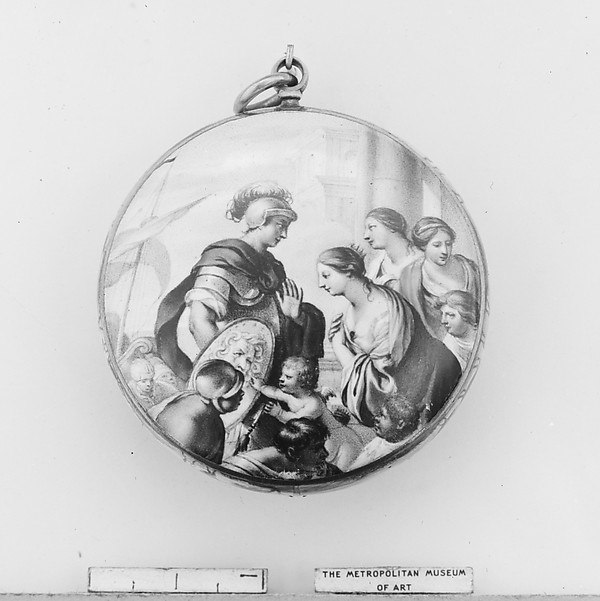
A detailed view of the enameled back of the gold watch, featuring a figurative scene.
A detailed view of the enameled back of the gold watch, featuring a figurative scene. — The Metropolitan Museum of Art, New York. Rights pending — permission not yet requested. Original source

Catalogue identity

Source
orbiscollectibles.com
Category
Pocket watch · Enamel-cased watch
Maker / attribution
G. Gamot
Reference
Not recorded
Catalogue / lot identifier
17.190.1623
Source-reported date
ca. 1640, and later
Source-reported place
France

Source-reported attribution and specifications are not independent authentication. A listing does not establish present ownership, current display, availability or permission to reproduce.

Object description

Construction and Materials

The object is a pocket watch constructed from gold and finished with enamel work. The primary housing for the mechanism is a gold casing, which serves as the substrate for the figurative enamel composition on the exterior. The diameter of the casing is documented as 2 1/4 inches, or 5.7 centimeters.

The exterior of the case is decorated with a detailed enamel scene, featuring a variety of figures, including a central individual in armor. This decorative application is specific to the period and region associated with the School of Blois. The combination of precious metal and vitreous enamel suggests a high-status object intended for wear or display.

Evidence for this section
  • “Gold, enameled”
  • “Diameter: 2 1/4 in. (5.7 cm)”

Attribution and Dating

The internal horological components are credited to G. Gamot, a watchmaker identified as active in France around 1646. The case decoration is attributed to Robert Vauquer, a figure associated with the School of Blois, who was active between 1625 and 1670. The source specifies that this attribution is possible, rather than definitively proven.

The item is dated to approximately 1640, though the presence of the phrase "and later" indicates that the object is not a single-period creation. This suggests potential later modifications, repairs, or additions to the watch mechanism or the case assembly following its initial production.

Evidence for this section
  • “Watch made by G. Gamot (French, ca. 1646)”
  • “Case possibly enameled by Robert Vauquer”
  • “ca. 1640, and later”

Provenance and Collection

The watch is currently held in the collection of The Metropolitan Museum of Art in New York. It is formally recorded within the museum’s European Sculpture and Decorative Arts department under the accession number 17.190.1623. The museum provides official documentation for the physical characteristics and the cultural context of the piece.

As a museum object, it has been catalogued based on institutional records. The museum's data provides the baseline for identifying the watch as a French piece, originating from the broader Parisian or Blois cultural spheres. The record serves as the primary reference for the object's current status and identity.

Evidence for this section
  • “The Metropolitan Museum of Art holds this object as 17.190.1623”

Open research questions

  • What is the specific nature of the "and later" additions mentioned in the museum documentation?
  • Does the internal movement of the watch contain signatures confirming the attribution to G. Gamot?

Source evidence

Recorded claims and source quotations for G. Gamot gold and enamel watch
FieldSource-reported valueSource quotation
MakerG. Gamot“Watch made by G. Gamot”
EnamelerRobert Vauquer“Case possibly enameled by Robert Vauquer”
MaterialGold and enamel“Gold, enameled”
Diameter5.7 cm“Diameter: 2 1/4 in. (5.7 cm)”
Accession Number17.190.1623“17.190.1623”
Dateca. 1640, and later“ca. 1640, and later”

Visible details

  • Circular gold case with detailed polychrome enamel decoration
  • Pendant and bow located at the top of the case for suspension
  • Figurative enamel scene featuring a central armored figure

Research qualifications

  • The enameling is attributed to Robert Vauquer, which the source qualifies as "possibly."
  • The dating is broad, with the source noting the object includes elements from "ca. 1640, and later."

Photograph identity and source facts were screened before import; rights clearance remains pending.

Terms in this record

Glossary explanations for terms named in this object’s record.