
Skip to content
The Encyclopedia of Horology

Clock · Mantel clock

French Restoration Gilt Bronze and Marble Mantel Clock

Partially verified

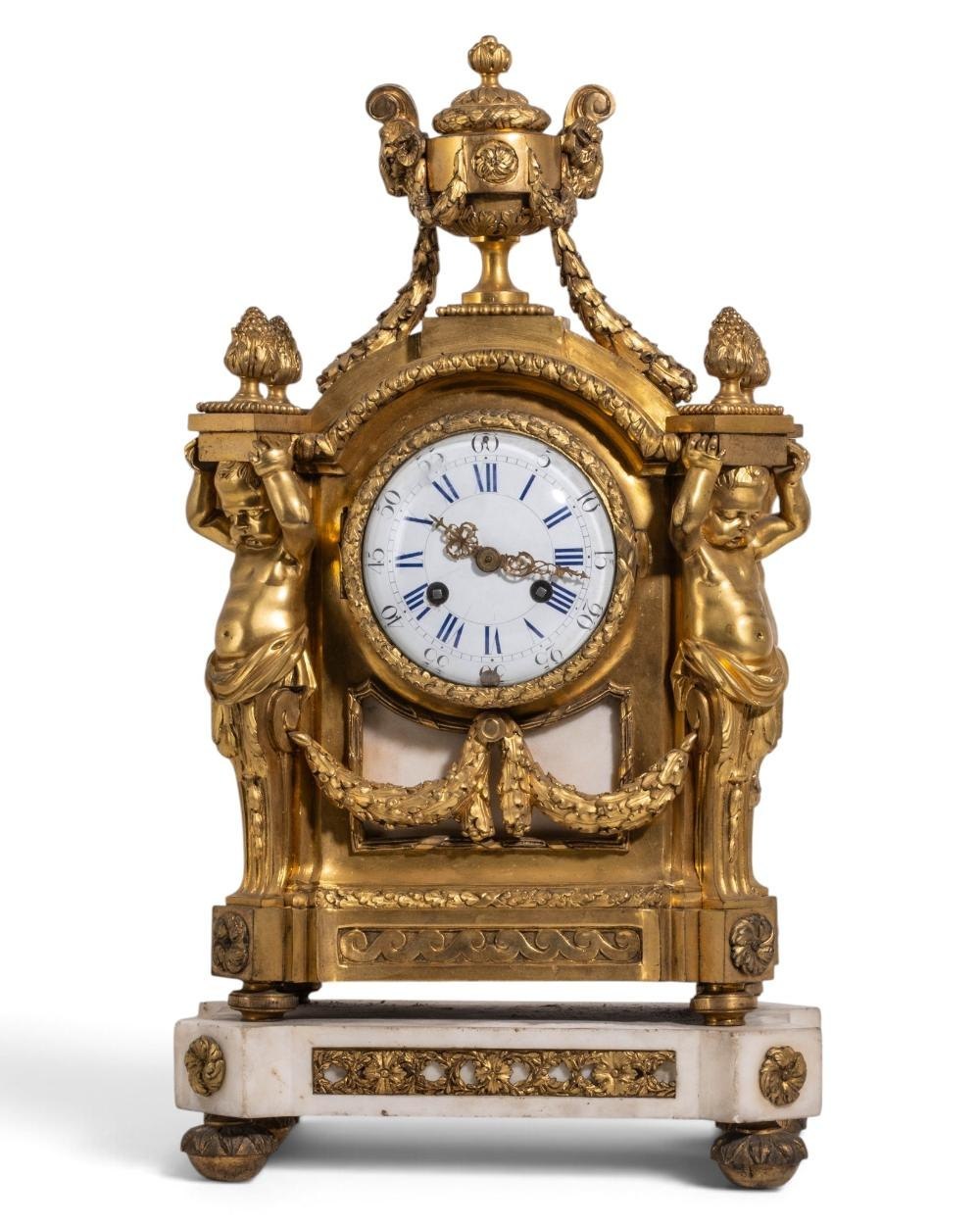
This mantel clock, dating to approximately 1827, is constructed from chased and gilt bronze (ormolu) supported on a white marble base. The circular white enamel dial features black Roman numerals for the hours and Arabic numerals for the minutes. The architectural case design includes two figural uprights modeled as putti, which support the upper section. This central portion is topped by an antique-style covered urn finial, decorated with laurel garlands and ram's head motifs, with pinecone finials positioned above the putti. The base is decorated with gilt bronze mounts and supported by turned feet. The movement, which includes the pendulum, bears a stamp from the French clockmaker Honoré Pons, indicating the inscription 'Médaille d'Or 1827'. Additionally, an inscription 'Lux 85' is found on the bronze components. The piece is attributed to the French Restoration period.

Front view of the French Restoration gilt bronze and marble mantel clock featuring the putti supports and central enamel dial.
Front view of the French Restoration gilt bronze and marble mantel clock featuring the putti supports and central enamel dial. — Collective Hudson, LLC, via Invaluable. Rights pending — permission not yet requested. Original source

Catalogue identity

Source
orbiscollectibles.com
Category
Clock · Mantel clock
Maker / attribution
Honoré Pons
Reference
Not recorded
Catalogue / lot identifier
Source URL identifies the listing
Source-reported date
c. 1827
Source-reported place
France

Source-reported attribution and specifications are not independent authentication. A listing does not establish present ownership, current display, availability or permission to reproduce.

Object description

Case and Dial Construction

The clock is designed in an architectural format, utilizing a combination of gilt bronze and white marble. The housing is centered by a white enamel dial with Roman hour numerals and Arabic minute markings. The structural elements are anchored by two uprights depicting putti or classical youths, which frame the central clock face.

The upper assembly features a covered urn finial, which is accented by ram's head motifs and laurel garlands. Supplementary decoration is provided by pinecone-style finials located above the figures. The entire structure rests upon a white marble base, finished with gilt bronze decorative mounts and elevated on turned feet.

Evidence for this section
  • “circular white enamel dial featuring Roman numerals for the hours and Arabic markings for the minutes”
  • “The architectural housing is supported by two figural uprights depicted as putti or classical youths”
  • “upper section is distinguished by an antique-style covered urn finial, intricately decorated with laurel garlands and flanked by ram's heads, further accented with pinecone finials”

Movement and Inscriptions

The movement is identified by the stamp of Honoré Pons, which includes a reference to a medal received in 1827. This stamp serves as the primary marker for the maker and the approximate dating of the object.

In addition to the maker's mark on the movement, the bronze case bears an alphanumeric inscription reading 'Lux 85.' These inscriptions represent the primary identifiers documented on the physical components of the clock.

Evidence for this section
  • “movement, which includes the pendulum, bears the stamp of Honoré Pons”
  • “marked 'Médaille d'Or 1827'”
  • “bronze components feature the inscription 'Lux 85.'”

Style and Provenance

The piece is categorized within the French Restoration period, displaying characteristics described as Neoclassical and Empire. The work is attributed to the output of Honoré Pons, who was active in the early 19th-century French clockmaking industry.

The record is based on an auction-house listing, which provides the technical and descriptive information for this specific item. Other examples of clocks attributed to this maker may feature differing specifications or details.

Evidence for this section
  • “This French Restoration period mantel clock, dating to approximately 1827”
  • “The clock embodies the refined craftsmanship typical of Honoré Pons”
  • “Details apply to that one example; other examples of the type may differ”

Open research questions

  • What is the specific manufacturer or inventory meaning of the 'Lux 85' marking?
  • Are there recorded variants of this specific model design in surviving Honoré Pons catalogues?

Source evidence

Recorded claims and source quotations for French Restoration Gilt Bronze and Marble Mantel Clock
FieldSource-reported valueSource quotation
MakerHonoré Pons“stamp of Honoré Pons”
Datec. 1827“c. 1827”
Inscription on movementMédaille d'Or 1827“marked 'Médaille d'Or 1827'”
Inscription on bronzeLux 85“inscription 'Lux 85.'”
Dial materialWhite enamel“circular white enamel dial”
Case materialsGilt bronze and white marble“Constructed from finely chased and gilt bronze (ormolu) set upon a white marble base”

Visible details

  • Clock features a white enamel dial with Roman and Arabic numerals
  • The case is mounted on a rectangular white marble plinth
  • Figural supports are modeled as putti
  • Gilt bronze ornaments include ram's heads and laurel garlands

Research qualifications

  • The exact significance or origin of the 'Lux 85' inscription remains unverified by historical documentation
  • The attribution to the French Restoration period is based on general stylistic dating for the maker's award stamp

Photograph identity and source facts were screened before import; rights clearance remains pending.

Consulted source

French Restoration Gilt Bronze and Marble Mantel Clock, Honoré Pons, c. 1827

Reviewed 2026-11-02 · Record 0aca062176

Terms in this record

Glossary explanations for terms named in this object’s record.