
Skip to content
The Encyclopedia of Horology

Clock · Figural mantel clock

French gilt-painted spelter and white marble figural mantel clock

Partially verified

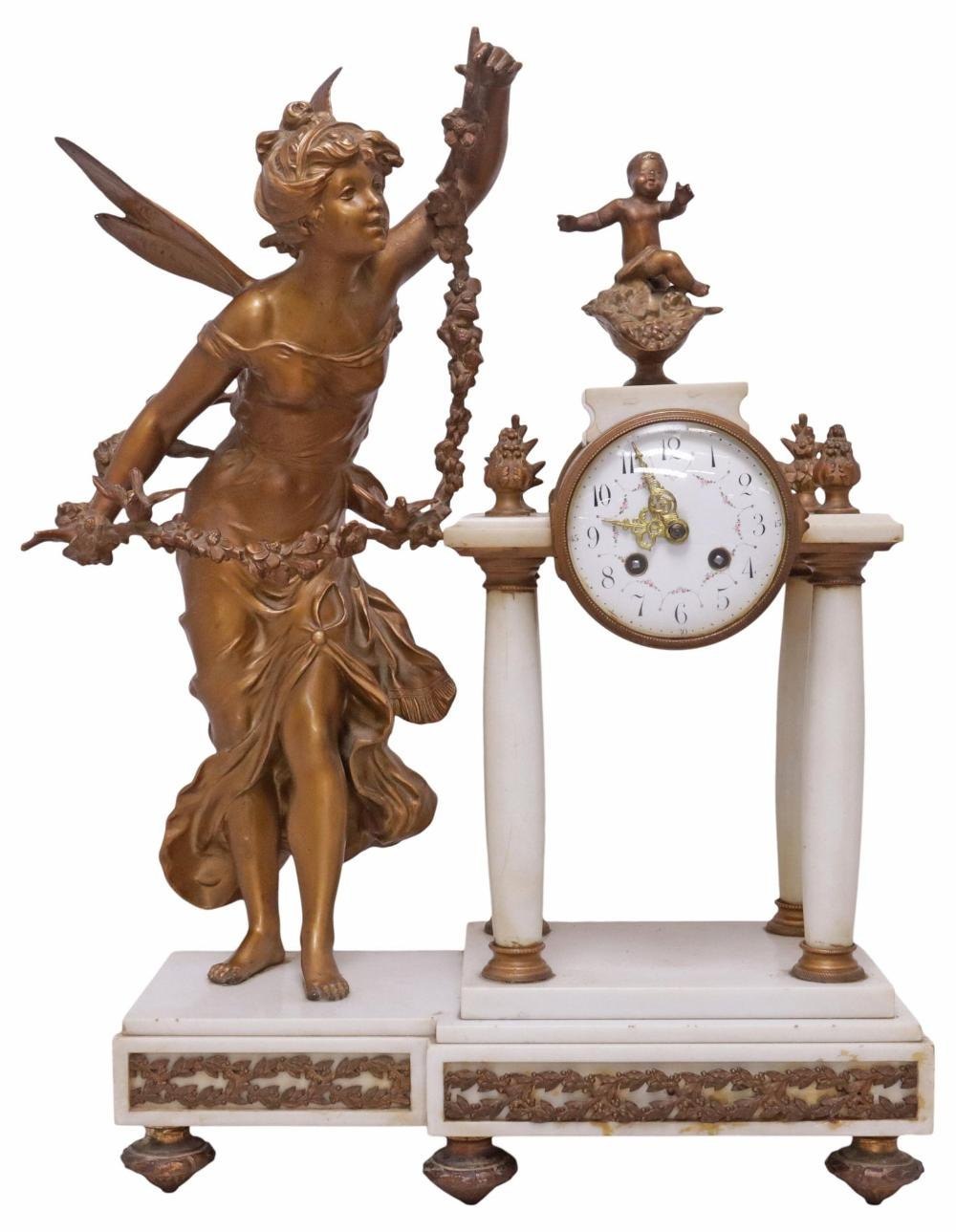
This French mantel clock is constructed from white marble and gilt-painted spelter. The design centers on a figural composition featuring a winged female figure holding a draped floral garland, positioned beside the main clock housing. The clock housing itself is surmounted by a sculptural element portraying a cherub seated within a flowering basket. The unit is supported by vertical columns and sits upon a rectangular marble base, which is elevated by foliate wreath feet. The clock features a white dial marked with Arabic numerals, shielded by a glazed window. It is equipped with a time-and-strike movement that bears the inscription "Made in France". Standing 22.5 inches high, 15.5 inches wide, and 7 inches deep, the clock has a total weight of 22 pounds.

Full view of the figural mantel clock, showing the winged female figure, column structure, and cherub finial.
Full view of the figural mantel clock, showing the winged female figure, column structure, and cherub finial. — Austin Auction Gallery, via Invaluable. Rights pending — permission not yet requested. Original source

Catalogue identity

Source
orbiscollectibles.com
Category
Clock · Figural mantel clock
Maker / attribution
Not established
Reference
Not recorded
Catalogue / lot identifier
Source URL identifies the listing
Source-reported date
early 20th c.
Source-reported place
France

Source-reported attribution and specifications are not independent authentication. A listing does not establish present ownership, current display, availability or permission to reproduce.

Object description

Case and Composition

The clock displays an elaborate figural composition primarily composed of white marble and gilt-painted spelter. The structural housing is supported by two distinct columns that flank the central clock dial. The entire assembly rests upon a rectangular marble platform base, which is finished with decorative foliate wreath feet.

A significant feature of the ornamentation is the primary sculptural group, which depicts a winged female figure standing beside the clock housing. She is shown holding a draped floral garland that extends across the front of the piece. A smaller sculptural element is positioned on top of the clock housing, consisting of a cherub figure seated within a flowering basket.

Evidence for this section
  • “crafted from gilt-painted spelter and white marble”
  • “winged female figure holding a draped floral garland”
  • “surmounted by a sculptural element depicting a cherub seated in a flowering basket”
  • “resting on a rectangular marble platform accented with foliate wreath feet”

Dial and Movement

The clock utilizes a white dial marked with Arabic hour numerals. The dial is protected by a glazed window, keeping the face and hand mechanism enclosed.

The movement is identified by an inscription reading "Made in France", providing an indication of the origin of the horological component. The piece includes a pendulum, which is required for the regulation of the time-and-strike movement within the housing.

Evidence for this section
  • “The dial is white with Arabic hour numerals, protected by a glazed window.”
  • “The clock utilizes a time-and-strike movement, which is marked "Made in France".”
  • “It includes a pendulum”

Design and Attribution

The design of the clock is formally associated with the stylistic conventions of the French sculptor Auguste Moreau. While it is classified as a figural mantel clock, the aesthetic is indicative of pieces created during the early 20th century, a period during which such decorative horological items were frequently produced in France.

The attribution is based on the specific sculptural motifs, such as the winged female and the cherub, which are noted as being consistent with the style attributed to Moreau. The object is presented as an example of this design tradition, rather than a confirmed work directly from the sculptor's personal hand.

Evidence for this section
  • “designed in the style associated with the French sculptor Auguste Moreau.”
  • “The design reflects an early 20th-century aesthetic”

Open research questions

  • Was the movement manufactured by a specific French clockmaker or a generic trade supplier?
  • Are there specific bronze or spelter foundries known to have utilized Moreau-style molds for this clock model?

Source evidence

Recorded claims and source quotations for French gilt-painted spelter and white marble figural mantel clock
FieldSource-reported valueSource quotation
Materialgilt-painted spelter, white marble“gilt-painted spelter and white marble”
Dimensions22.5"h, 15.5"w, 7"d“22.5 inches high, 15.5 inches wide, and 7 inches deep”
Weight22 pounds“total weight of 22 pounds”
MarkingsMade in France“marked "Made in France”
Movementtime-and-strike“time-and-strike movement”
Design influenceAuguste Moreau“designed in the style associated with the French sculptor Auguste Moreau”

Visible details

  • Winged female figure with floral garland
  • Cherub finial in a flowering basket
  • Two marble columns flanking the dial

Research qualifications

  • Attribution to Auguste Moreau is described as stylistic rather than confirmed authorship
  • Specific date of manufacture within the early 20th century is unverified

Photograph identity and source facts were screened before import; rights clearance remains pending.

Consulted source

French gilt-painted spelter and white marble figural mantel clock

Reviewed 2026-11-02 · Record 773314cd24

Terms in this record

Glossary explanations for terms named in this object’s record.