
Skip to content
The Encyclopedia of Horology

Clock · Mantel clock

French Empire ormolu gilt bronze figural mantel clock

Partially verified

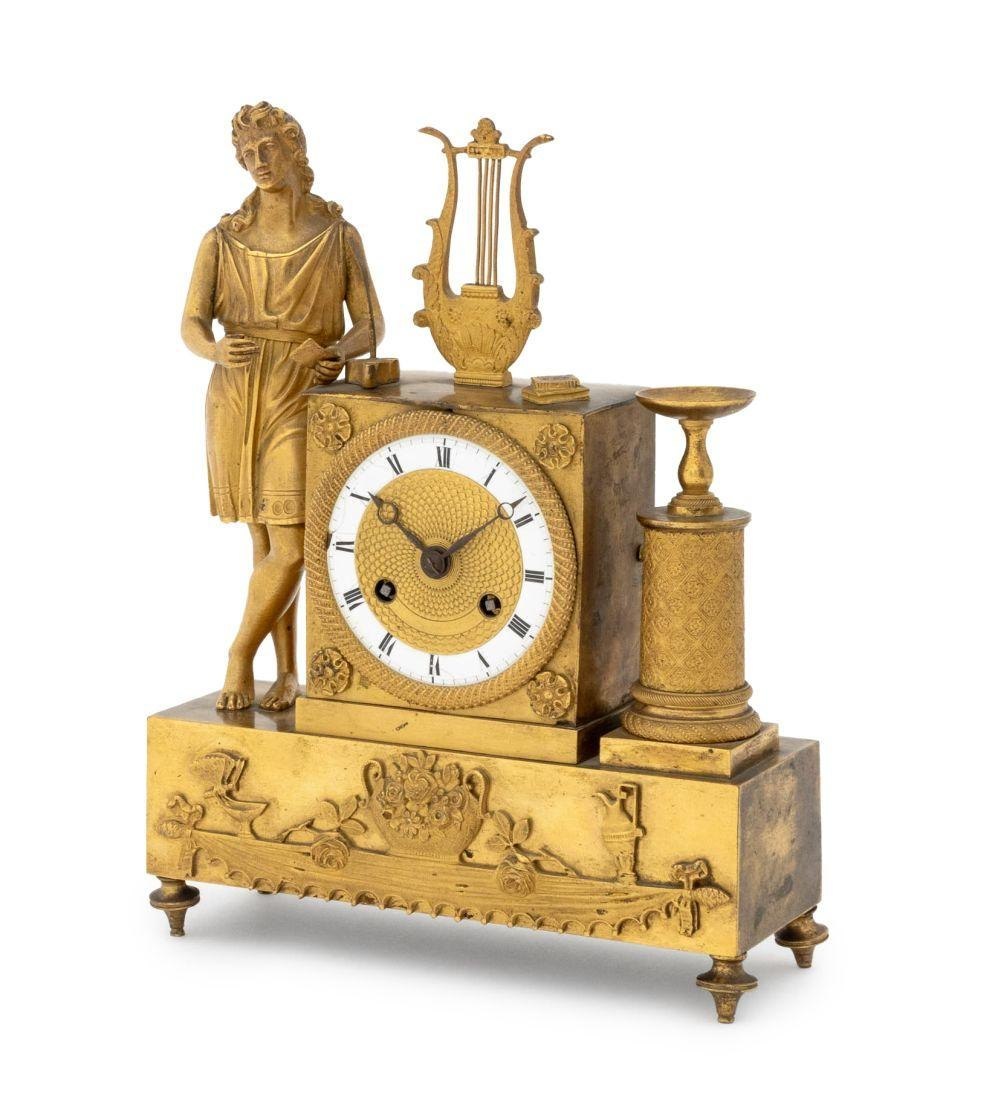
This French Empire period mantel clock is constructed from ormolu, also described as gilt bronze. The timepiece consists of a central square housing containing the clock movement, which is fronted by a circular porcelain dial featuring a Roman numeral chapter ring. The design is characterized by its figural composition, featuring a standing sculpture of a figure positioned to the left of the case, accompanied by various motifs including a lyre, an inkwell, and books. The entire assembly is supported on a rectangular base decorated with relief ornamentation, specifically a central floral basket motif. The clock measures approximately 9.24 inches in height, 7.5 inches in width, and 2.5 inches in depth. The overall aesthetic integrates a functional timekeeping element with neoclassical sculptural themes. The auction description reports a minor structural break to the rear right corner of the square clock case.

French Empire ormolu figural mantel clock with dial and figural composition.
French Empire ormolu figural mantel clock with dial and figural composition. — Auctions at Showplace, via Invaluable. Rights pending — permission not yet requested. Original source

Catalogue identity

Source
orbiscollectibles.com
Category
Clock · Mantel clock
Maker / attribution
Not established
Reference
Not recorded
Catalogue / lot identifier
Source URL identifies the listing
Source-reported date
Early nineteenth century
Source-reported place
France

Source-reported attribution and specifications are not independent authentication. A listing does not establish present ownership, current display, availability or permission to reproduce.

Object description

Case and Dial Design

The clock is designed in the French Empire style, characterized by the use of gilt bronze, or ormolu. The primary structural housing for the timekeeping mechanism is a square box, which serves as a foundation for the upper decorative elements. A porcelain dial is set into the front of this box, displaying a Roman numeral chapter ring.

The figural composition is placed atop and alongside the main housing. To the left stands a figure, while the top of the clock is adorned with a lyre element and small scholarly items. The rectangular base provides horizontal stability and is enriched with cast relief work, featuring a floral basket as the central focus. The entire object is raised on small feet, lifting the composition from the surface.

Evidence for this section
  • “The clock features a central square housing for the timekeeping mechanism, adorned with a porcelain dial that displays a classic Roman numeral chapter ring.”
  • “The design is highly figural, incorporating a standing sculpture of a figure leaning against the clock case, accompanied by artistic and scholarly motifs including a lyre, an inkwell, and books.”
  • “The entire assembly is mounted upon a rectangular base that features refined relief ornamentation, specifically a central floral basket motif.”

Dimensions and Physical Integrity

The clock is relatively compact, measuring 9.24 inches in height and 7.5 inches in width, with a depth of 2.5 inches. These proportions classify it as a mantel clock, intended for placement on a shelf or mantlepiece. The casting of the ormolu appears consistent with neoclassical decorative arts, prioritizing symmetry and ornamental detail.

The condition of the object is noted by the auction house regarding its physical state. A specific area of damage is identified at the rear right corner of the square case, where a structural break exists. This report provides a specific point of reference for the object's current state, distinguishing it from an pristine example.

Evidence for this section
  • “The clock stands approximately 9.24 inches high, 7.5 inches wide, and 2.5 inches deep.”
  • “The physical integrity of the piece is noted by a minor structural break to the rear right corner of the square clock case.”

Stylistic Context

The piece is attributed to the French Empire period of the early nineteenth century. This classification relates to the choice of materials and the specific decorative motifs used, such as the lyre and the figural sculpture. The ormolu finish is a hallmark of this era's decorative metalwork, highlighting a focus on both visual art and functional timekeeping devices.

As an object of the nineteenth century, the clock reflects the aesthetic preferences of the time, combining classical scholarly themes with the clockmaker's craft.

Evidence for this section
  • “This French Empire period mantel clock is crafted from ormolu, or gilt bronze, showcasing the high level of decorative metalwork characteristic of the early nineteenth century.”
  • “The overall composition balances the functional timekeeping element with neoclassical sculptural elements, reflecting the decorative arts aesthetic of the Empire era.”

Open research questions

  • What is the specific movement type (e.g., silk thread suspension or pendulum) contained within the housing?
  • Is there a maker's mark or signature concealed on the underside or back of the bronze casting?

Source evidence

Recorded claims and source quotations for French Empire ormolu gilt bronze figural mantel clock
FieldSource-reported valueSource quotation
Materialormolu (gilt bronze), porcelain“ormolu (gilt bronze), porcelain”
Dimensions9.24" H x 7.5" W x 2.5" D“9.24 inches high, 7.5 inches wide, and 2.5 inches deep”
NumeralsRoman“Roman numeral chapter ring”
Motiffigural with lyre, inkwell, books, and floral basket“incorporating a standing sculpture of a figure leaning against the clock case, accompanied by artistic and scholarly motifs including a lyre, an inkwell, and books”
ConditionMinor structural break to the rear right corner“minor structural break to the rear right corner of the square clock case”
BaseRectangular with relief ornamentation“mounted upon a rectangular base that features refined relief ornamentation, specifically a central floral basket motif”

Visible details

  • The dial center features an engine-turned or guilloché pattern.
  • The clock has two winding holes on the dial face.
  • A lyre-shaped ornament is mounted centrally atop the clock housing.

Research qualifications

  • The exact nineteenth-century production date is not specified.
  • The internal mechanism's state and completeness are not documented.

Photograph identity and source facts were screened before import; rights clearance remains pending.

Consulted source

French Empire ormolu gilt bronze figural mantel clock

Reviewed 2026-11-02 · Record 8041d66f17

Terms in this record

Glossary explanations for terms named in this object’s record.