
Skip to content
The Encyclopedia of Horology

Clock · Mantel clock

French Empire Mantel Clock

Partially verified

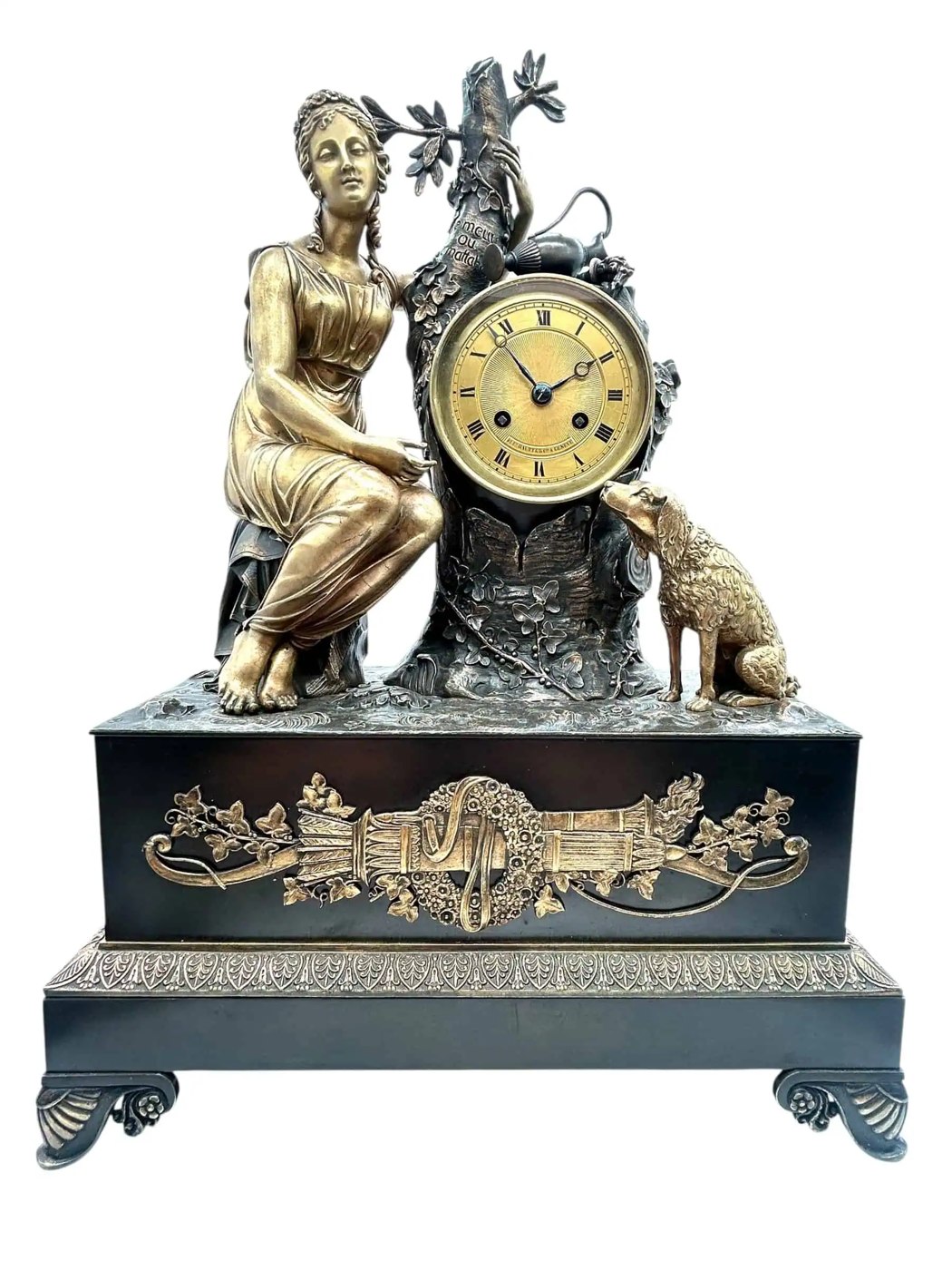
This French Empire mantel clock, dating to approximately 1830, features a solid bronze case with ormolu elements. The composition centers on a figure of a seated lady accompanied by a dog, positioned next to a tree-form housing for the clock dial. The dial displays black Roman numerals and is fitted with black Empire-style steel hands. The movement is a French bell-striking type with a silk suspension mechanism. The clock measures 49 cm in height, 36 cm in width, and 16 cm in depth. The object currently incorporates two bevelled glass bezels, added during its history to protect the dial and movement, as it was originally designed as an open bezel clock meant to be housed under a glass dome. It is reported to be in working order following a recent service and includes its pendulum and winding key.

Front view of the French Empire mantel clock featuring a seated lady figure and her dog.
Front view of the French Empire mantel clock featuring a seated lady figure and her dog. — Vintage Clocks UK. Rights pending — permission not yet requested. Original source

Catalogue identity

Source
vintageclocks.uk
Category
Clock · Mantel clock
Maker / attribution
Not established
Reference
JN78
Catalogue / lot identifier
Source URL identifies the listing
Source-reported date
circa 1830
Source-reported place
France

Source-reported attribution and specifications are not independent authentication. A listing does not establish present ownership, current display, availability or permission to reproduce.

Object description

Case and Aesthetic Design

The clock is constructed from solid bronze with an ormolu finish, featuring a detailed figural group on a rectangular base. The primary decorative elements include a female figure seated beside a dog, arranged against a tree-trunk-shaped support. The base is decorated with applied ormolu mounts and supported by carved bracket feet.

The original design of the clock was an open bezel configuration intended for display under a glass dome. It has since been modified to include two custom-made bevelled glass bezels, which are included with the object. The metal finish is noted as the original finish to the case.

Evidence for this section
  • “Fine solid bronze case”
  • “Lady Figure sitting with her dog”
  • “This clock is a open bezel would have started life under glass dome. Through the clocks long history a past owner has had 2 very nice bevelled glass bezels made to cover the dial and the movement.”

Movement and Dial

The dial is made of ormolu and features black Roman numerals paired with black Empire-style steel hands. It is a front-wind configuration. The clock is powered by a French bell-striking movement, which utilizes a silk suspension system.

The auction description reports that the movement has been recently serviced and is currently in working order. The clock includes its original pendulum and a winding key.

Evidence for this section
  • “Ormolu dial with Black Roman numerals”
  • “French bell striking movement”
  • “Silk suspension movement”
  • “Working order – recently fully serviced”

Condition and Attribution

The auction description reports the clock is in excellent antique condition. The ormolu mounts are noted to retain their original luster and chasing detail. While the description refers to the presence of Boulle marquetry, the primary material identified elsewhere is solid bronze.

The clock is attributed to a French origin and dated to circa 1830. Documentation indicates that while the dial and movement are signed, the specific manufacturer name is not explicitly identified in the source text.

Evidence for this section
  • “In excellent antique condition.”
  • “The original ormolu mounts retain their brilliant, deep golden luster with superb sharpness in the chasing.”
  • “Signed dial and movement”
  • “This clock dates to around 1830”

Open research questions

  • What is the name of the clockmaker or retailer signed on the movement and dial?
  • Does the object actually feature Boulle marquetry, or is this a descriptive error in the source text?

Source evidence

Recorded claims and source quotations for French Empire Mantel Clock
FieldSource-reported valueSource quotation
Datecirca 1830“This clock dates to around 1830”
Dimensions49 x 36 x 16 cm“Measures 49cm high by 36cm wide and 16cm depth.”
Movement typeFrench bell striking“French bell striking movement”
SuspensionSilk“Silk suspension movement”
ReferenceJN78“SKU: JN78”
Case materialSolid bronze“Fine solid bronze case”

Visible details

  • Seated female figure beside a dog
  • Black Roman numerals on ormolu dial
  • Carved bracket feet
  • Bell-striking movement with silk suspension

Research qualifications

  • Boulle marquetry condition claim is incongruent with the bronze case description
  • Specific maker's signature remains unverified by the provided text

Photograph identity and source facts were screened before import; rights clearance remains pending.

Consulted source

Outstanding French Empire Mantel Clock – Solid Bronze Ormolu Mantle Clock C1830

Reviewed 2026-11-02 · Record 0c6a849881

Terms in this record

Glossary explanations for terms named in this object’s record.