
Skip to content
The Encyclopedia of Horology

Tool · Sand-glass

Four-chambered sand-glass

Partially verified

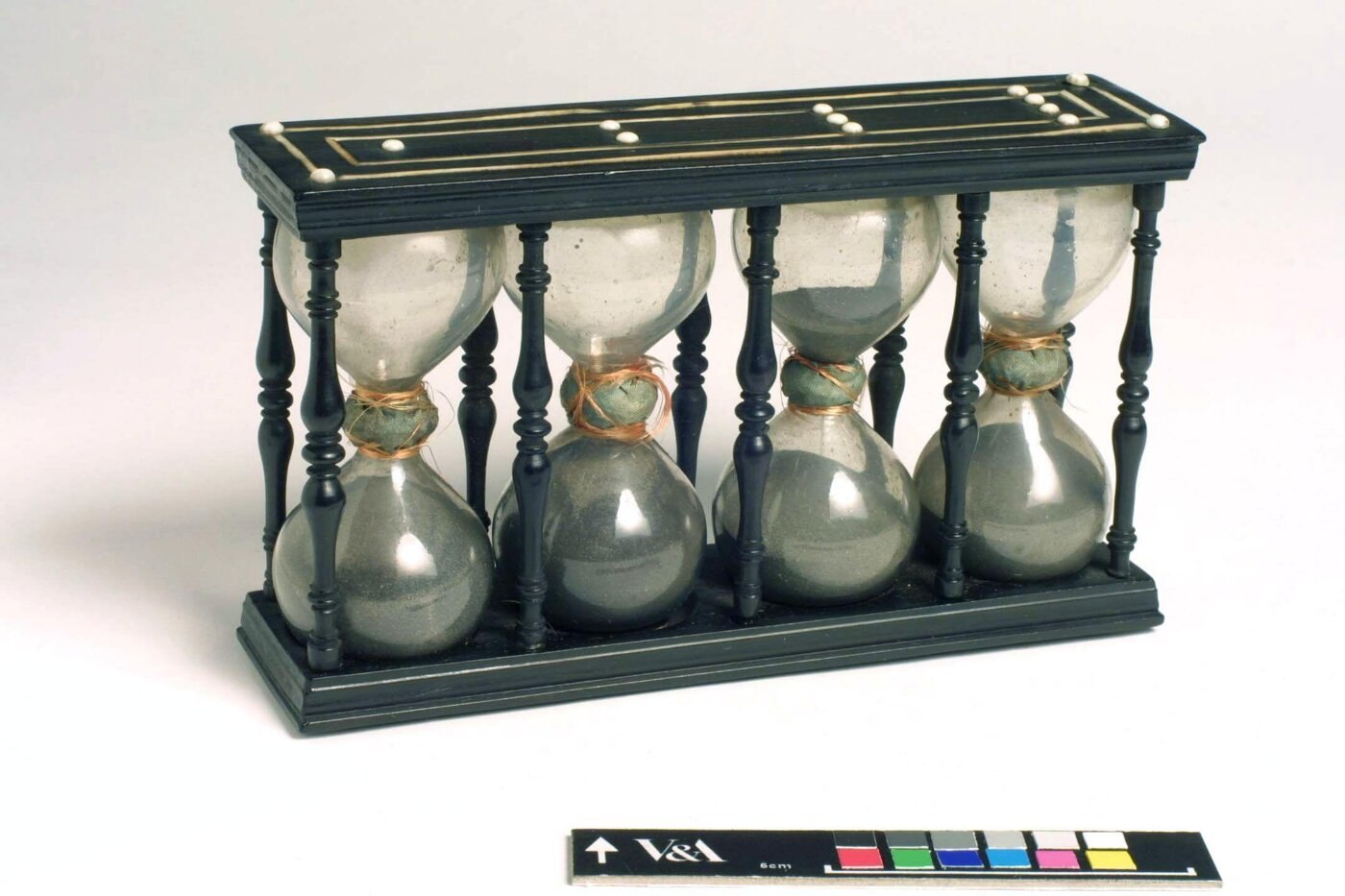
This sand-glass, also referred to as a 'battery', comprises four individual sand-glasses mounted within a single rectangular frame. Produced in Italy between 1575 and 1625, the instrument features blown glass ampoules housed in a dark, turned ebony frame, which is decorated with inlaid ivory or bone accents. Each of the four units consists of two glass phials joined at the center, secured with fabric bindings. The object measures 8.3 cm in height and 14.5 cm in width.

A four-chambered Italian sand-glass with turned ebony frame and inlaid details.
A four-chambered Italian sand-glass with turned ebony frame and inlaid details. — Victoria and Albert Museum. Rights pending — permission not yet requested. Original source

Catalogue identity

Source
collections.vam.ac.uk
Category
Tool · Sand-glass
Maker / attribution
Not established
Reference
Not recorded
Catalogue / lot identifier
82-1880
Source-reported date
1575-1625
Source-reported place
Italy

Source-reported attribution and specifications are not independent authentication. A listing does not establish present ownership, current display, availability or permission to reproduce.

Object description

Construction and Materials

The object is constructed as a battery of four sand-glasses, each composed of two blown glass ampoules or phials joined together. The junctions between the phials are obscured by fabric bindings, a method often employed to secure the seal between the two chambers. These glasses are fixed within a rectangular frame constructed from turned ebony components.

The structural integrity of the frame is provided by vertical turned spindles connecting the base and the top platform. The top surface of the frame features linear and circular inlaid decorations, which consist of either ivory or bone. This combination of dark ebony wood and light-colored inlay is consistent with the material composition documented for this piece.

Evidence for this section
  • “A sand-glass set or ‘battery’ of four glasses each composed of two ampoules or phials, mounted in a frame of ebony with ivory or bone inlay.”
  • “Blown glass in a frame of ebony inlaid with ivory (or bone)”

Utility and Historical Context

During the 16th and 17th centuries, sand-glasses served as instruments for monitoring specific durations in domestic, scholarly, and ecclesiastical settings.

While it has been suggested that these represent subdivisions of an hour, such as 15, 30, 45, and 60 minutes, it remains impossible to verify these durations. The internal particles have ceased to flow freely, preventing any practical testing of the individual chambers' timing capacities.

Evidence for this section
  • “During the 16th and 17th centuries sandglasses were used in various situations”
  • “It is likely to have been used for timing private study or personal devotions.”
  • “These four sandglasses in a single frame run for different periods, probably 15min, 30min, 45min &”

Provenance and Documentation

Fulgence in Paris. Records indicate that it was displayed in Room 5 by 1925 alongside another related item, catalogued as 83-1880. Subsequently, the object was moved through different display locations within the institution, including Room 74 in 1964, before eventually being placed in storage in Room 125s by the 1980s.

The object is documented in historical research regarding sand-glasses, with comparable examples noted in horological literature. There is also a suggestion in the museum records that this specific item may correspond to one illustrated in a 2015 publication focusing on historic sand-glasses.

Evidence for this section
  • “Bought for £3 from Mons. Fulgence, Paris.”
  • “Possibly the same piece as included in Anna, Dominique and Eric Delalande, Sabliers d’autrfefois... , Paris 2015, pp. 170-173”

Open research questions

  • Can the material used for the inlay be definitively identified as ivory versus bone?
  • Does any evidence remain to confirm if the four chambers were originally calibrated for specific timed intervals?

Source evidence

Recorded claims and source quotations for Four-chambered sand-glass
FieldSource-reported valueSource quotation
Accession number82-1880“82-1880”
MakerUnknown“Maker: Unknown”
Place of originItaly“Place of origin: Italy (made)”
Date1575-1625“1575-1625”
MaterialsEbony, glass, ivory or bone“Blown glass in a frame of ebony inlaid with ivory (or bone)”
Dimensions8.3 cm height x 14.5 cm width“Height: 8.3 cm; Width: 14.5 cm”
FunctionMultiple duration intervals“These four sandglasses in a single frame run for different periods, probably subdivisions of an hour”

Visible details

  • Four glass bulb units arranged side-by-side in a single frame
  • Turned ebony supports for the top and bottom plates
  • Inlaid circular ivory or bone decorative markers on the top frame
  • Green fabric bindings securing the joints of each sand-glass

Research qualifications

  • Material of inlay is identified as ivory or bone
  • Intervals for each glass are unknown and cannot be tested

Photograph identity and source facts were screened before import; rights clearance remains pending.

Consulted source

Sand-glass

Reviewed 2026-10-26 · Record 4f2dd43d0a

Terms in this record

Glossary explanations for terms named in this object’s record.