
Skip to content
The Encyclopedia of Horology

Clock · Table clock

Florentine court cabinet and clock

Partially verified

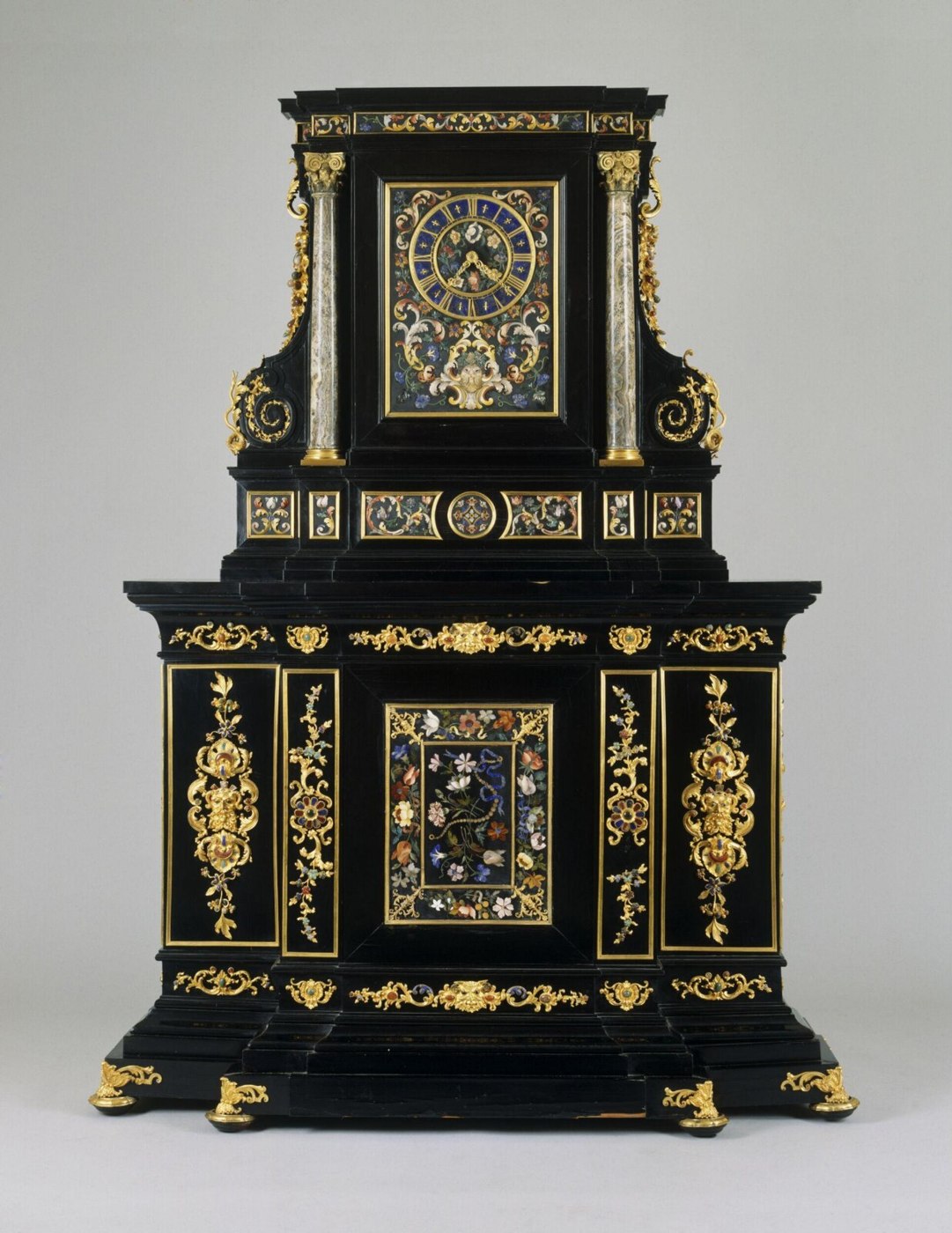
This object is a table clock and cabinet of architectural form constructed from ebonised wood, gilt bronze, and various hardstones in a pietre dure mosaic technique. The upper cabinet, created in the Grand Ducal workshops in Florence between 1704 and 1705, is attributed to the sculptor and architect Giovanni Battista Foggini and Leonardo van der Vinne. It features a dial made of lapis lazuli mounted on a mosaic face depicting Dionysos, with the movement attributed to Johannes Hittorff. The object exhibits decorative gilt bronze grotesque mounts and columns.

Front view of the Florentine court cabinet and clock, showing the architectural wooden housing, mosaic panels, and central lapis lazuli dial.
Front view of the Florentine court cabinet and clock, showing the architectural wooden housing, mosaic panels, and central lapis lazuli dial. — Victoria and Albert Museum, London. Rights pending — permission not yet requested. Original source

Catalogue identity

Source
collections.vam.ac.uk
Category
Clock · Table clock
Maker / attribution
Giovanni Battista Foggini, Leonardo van der Vinne
Reference
Not recorded
Catalogue / lot identifier
LOAN:GILBERT.74:1 to 4-2008
Source-reported date
1704-1705
Source-reported place
Florence

Source-reported attribution and specifications are not independent authentication. A listing does not establish present ownership, current display, availability or permission to reproduce.

Object description

Construction and Design

The upper cabinet is a complex structure featuring ebonised wood and an array of hardstone inlays executed in the pietre dure technique. The architectural design incorporates carved volutes and columns, housing a clock with a lapis lazuli dial. A central element of this upper section is the mosaic face of Dionysos, which utilizes calcedonio di volterra to capture realistic skin tones. The entire upper portion is attributed to the Grand Ducal workshops in Florence, under the guidance of Giovanni Battista Foggini and Leonardo van der Vinne.

The lower section, added in the 19th century, supports the upper clock cabinet and introduces further ebonised wood and gilt bronze elements. This section incorporates a decorative mosaic panel that predates the cabinet's enlargement, believed to originate from around 1700. This panel displays a tromp l'oeil pearl necklace motif, an aesthetic choice intended to mimic the appearance of real objects.

Evidence for this section
  • “The upper cabinet is of ebony with stone mosaicc (commessi di pietre dure) panels and includes a clock with a lapis lazuli dial mounted on a pietre dure grotesque face.”
  • “The pink stone used for the skin is calcedonio di volterra, a stone that’s natural hues enhaced the realistic appearance of flesh and facial expressions.”
  • “The lower plinth incorporates a panel which dates from about 1700 and incorporates the representation of a pearl necklace”

Movement and Signatures

The clock movement currently fitted in the cabinet is the work of Johannes Hittorff, dating to 1704. Documentation indicates that this movement is not original to the cabinet but acts as a replacement for an earlier mechanism produced by Ignatius Huggeford. The shift between these movements reflects the various hands through which the object has passed during its history.

Identification of the cabinet's original intended owner is provided by the silk lining found inside the clock cabinet. This interior is embroidered with the initials of Anna Maria, Electress Palatine, surmounted by the coronet of the palatinate.

Evidence for this section
  • “clock movement Johannes Hittorff, Bonn, 1704”
  • “Hittorff's clock movement has replaced an earlier English movement by Ignatius Huggeford.”
  • “'AMEP' (for Anna Maria Electress Palatine) embroidered in gold thread and surmounted by the coronet of the palatinate on the silk lining inside the clock cabinet”

Provenance and Later Additions

The object subsequently appeared at a 1927 Christie's auction before arriving in the Petite Musée in Montreal in 1974.

The final transition of the object into a public collection occurred when Sir Arthur Gilbert and his wife Rosalinde donated their decorative arts collection to the British state in 1996.

Evidence for this section
  • “Provenance: Anna Maria Luisa, Electress Palatine, Düsseldorf. Robert Staynor Holford. Sir George Lindsay Holford, Dorchester House, England.”
  • “The lower plinth was probably made for Robert Staynor Holford (1808-92) who bought the clock cabinet for display at his palatial London home, Dorchester House, Park Lane”
  • “Arthur Gilbert donated his extraordinary collection to Britain in 1996.”

Open research questions

  • What physical evidence remains on the cabinet case indicating the original mounting of the Ignatius Huggeford movement?
  • To what extent did the 1860 addition modify the original dimensions of the upper cabinet's base?

Source evidence

Recorded claims and source quotations for Florentine court cabinet and clock
FieldSource-reported valueSource quotation
MakerGiovanni Battista Foggini“Giovanni Battista Foggini, Grand Ducal workshops, Florence, 1704-05”
Clock MovementJohannes Hittorff“clock movement Johannes Hittorff, Bonn, 1704”
Upper Section Date1704-1705“Upper section 1704-05”
Lower Section Datecirca 1860“lower section ca. 1860”
MaterialsEbonised wood, gilt bronze, brass, hardstone, lapis lazuli“Cabinet of ebonised wood with a projecting middle section and a high, moulded plinth. The facade has three doors with gilt bronze grotesque mounts. The upper cabinet is of ebony with stone mosaicc (commessi di pietre dure) panels and includes a clock with a lapis lazuli dial mounted on a pietre dure grotesque face.”
InscriptionAMEP“'AMEP' (for Anna Maria Electress Palatine) embroidered in gold thread and surmounted by the coronet of the palatinate on the silk lining inside the clock cabinet”

Visible details

  • Projecting middle section of the cabinet facade
  • Three doors with gilt bronze grotesque mounts
  • Lapis lazuli dial mounted on a pietre dure face
  • Columns supporting the upper clock housing

Research qualifications

  • The exact extent of Foggini's personal involvement in the construction remains a subject of investigation
  • The original English clock movement by Ignatius Huggeford has been replaced by one from Johannes Hittorff
  • The precise date of the enlargement of the lower section is based on architectural history rather than documentary proof

Photograph identity and source facts were screened before import; rights clearance remains pending.

Consulted source

Florentine court cabinet and clock

Reviewed 2026-11-02 · Record 6f0ea77fac