
Skip to content
The Encyclopedia of Horology

Clock · Astronomical master pendulum regulator

Fedchenko AchF-3 Astronomical Master Pendulum Regulator Clock

Partially verified

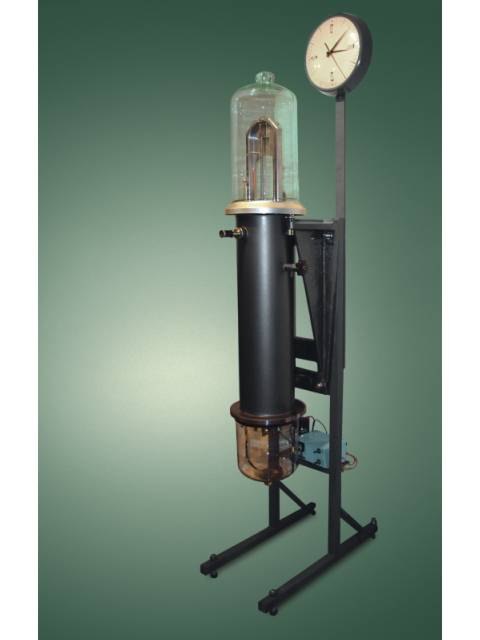
This astronomical master pendulum regulator is a model AchF-3 designed by Feodosii Mikhailovich Fedchenko and produced in 1970 at the All-Union Scientific Research Institute of Physicotechnical and Radiotechnical Measurements in the USSR. Built to operate at constant pressure with an isochronous suspension, it incorporates a 10-kilogram invar pendulum beating two-second periods alongside an electromagnetic impulse device powered by a mercury oxide battery. The assembly features a central steel cylinder sealed with bell glass jars at both ends, mounted on a cast-iron bracket and steel frame alongside a secondary clock with a white dial displaying tapered hands and fifteen-minute Arabic numerals.

Overall view of the AchF-3 master pendulum regulator assembly on its stand with attached secondary dial
Overall view of the AchF-3 master pendulum regulator assembly on its stand with attached secondary dial — Antiquorum. Rights pending — permission not yet requested. Original source

Catalogue identity

Source
catalog.antiquorum.swiss
Category
Clock · Astronomical master pendulum regulator
Maker / attribution
Feodosii Mikhailovich Fedchenko
Reference
AchF-3
Catalogue / lot identifier
149
Source-reported date
1970
Country
USSR
Source-reported serial
25

Source-reported attribution and specifications are not independent authentication. A listing does not establish present ownership, current display, availability or permission to reproduce.

Object description

Physical Configuration

The AchF-3 is a 1.5-meter tall astronomical master pendulum regulator. The central component is a steel cylinder designed for constant pressure, sealed at the top and bottom with bell glass jars. The assembly is supported by a cast-iron bracket mounted to a steel frame.

A secondary clock system is integrated into the frame, featuring a white dial with tapered indices, fifteen-minute Arabic markers, and sharp point tapered hands. Ancillary components, including a mercury oxide battery and an electronic control unit, are mounted to a small bracket at the back.

Evidence for this section
  • “Dim. Height 1,5 meter.”
  • “Cast-iron bracket supporting constant pressure steel cylinder with heavy bell glass jars at the top and bottom”
  • “fastened to a steel frame holding a steel bar with the dial on the right”
  • “small bracket at the back for the mercury oxide battery of capacity 2.5 amp hour”
  • “White with tapered indexes and fifteen-minute Arabic markers. Sharp point tapered hands.”

Pendulum and Timekeeping Mechanism

The timekeeper utilizes a 10-kilogram invar pendulum with a two-second period. The movement incorporates an isochronous suspension, an electromagnetic impulse delivery device, a pressure-controlling baroscope, and a microscope for amplitude checking.

Power is provided by a mercury oxide battery. The electromagnetic system delivers a short, unidirectional impulse of approximately 0.002 amps, lasting 0.02 seconds, by interacting with magnets mounted to the lower portion of the pendulum rod. Users may transition the clock from mean solar time to sidereal time by adjusting a weight on the pendulum.

Evidence for this section
  • “Consists of 10 kilogram invar pendulum with 2 secods period”
  • “electro-magnetic impulse delivery device, pressure controlling baroscope, microscope for amplitude checking”
  • “mercury oxide battery of capacity 2.5 amp hour”
  • “The unidirectional impulse load is only about 0.002 amp and lasts 0.02 seconds.”
  • “switching from mean time to sidereal time by moving a small weight in the pendulum.”

Operational Specifications

The regulator is designed to operate with internal pressure maintained between 8 and 10 mm Hg, managed by a solid-state baroscope. It was produced at the All-Union Scientific Research Institute of Physicotechnical and Radiotechnical Measurements in the USSR in 1970.

The source notes an average accuracy of approximately 0.002 seconds per day. The movement is described as signed on the front at the suspension.

Evidence for this section
  • “made at the All-Union Scientific Research Institute of Physicotechnical and Radiotechnical Measure-ments, USSR, in 1970.”
  • “The pressure in the cylinder, kept between 8 and 10 mm Hg, is controlled by a baroscope”
  • “average accuracy of approximately 0,002 seconds per day.”
  • “Signed on front at the suspension.”

Open research questions

  • What specific maintenance is required to address the 'Overhaul recommended' status noted in the source documentation?
  • Does the current physical state of the baroscope and internal seals align with the operational pressure requirements of 8 to 10 mm Hg?

Source evidence

Recorded claims and source quotations for Fedchenko AchF-3 Astronomical Master Pendulum Regulator Clock
FieldSource-reported valueSource quotation
Maker and ModelFeodosii Mikhailovich Fedchenko, model AchF-3, No. 25“Feodosii Mikhailovich Fedchenko, model AchF-3, No. 25”
OriginAll-Union Scientific Research Institute of Physicotechnical and Radiotechnical Measurements, USSR, 1970“made at the All-Union Scientific Research Institute of Physicotechnical and Radiotechnical Measure-ments, USSR, in 1970.”
Height1.5 meters“Dim. Height 1,5 meter.”
Pendulum Mass10 kilograms“Consists of 10 kilogram invar pendulum with 2 secods period”
ModelAchF-3“model AchF-3”
Serial Number25“No. 25”
Battery Capacity2.5 amp hour“mercury oxide battery of capacity 2.5 amp hour”

Visible details

  • A central vertical black cylinder fitted with transparent glass bell jars at the top and bottom
  • A freestanding metal frame supporting an elevated white dial on an offset upright to the right
  • A blue auxiliary control box mounted behind the lower cylinder section

Research qualifications

  • Internal suspension and baroscope mechanisms are largely enclosed within the cylinder and not directly viewable in detail.

Photograph identity and source facts were screened before import; rights clearance remains pending.

Terms in this record

Glossary explanations for terms named in this object’s record.