
Skip to content
The Encyclopedia of Horology

Wristwatch · Manual-winding wristwatch with aneroid barometer

Favre-Leuba Bivouac Ref. 53213

Partially verified

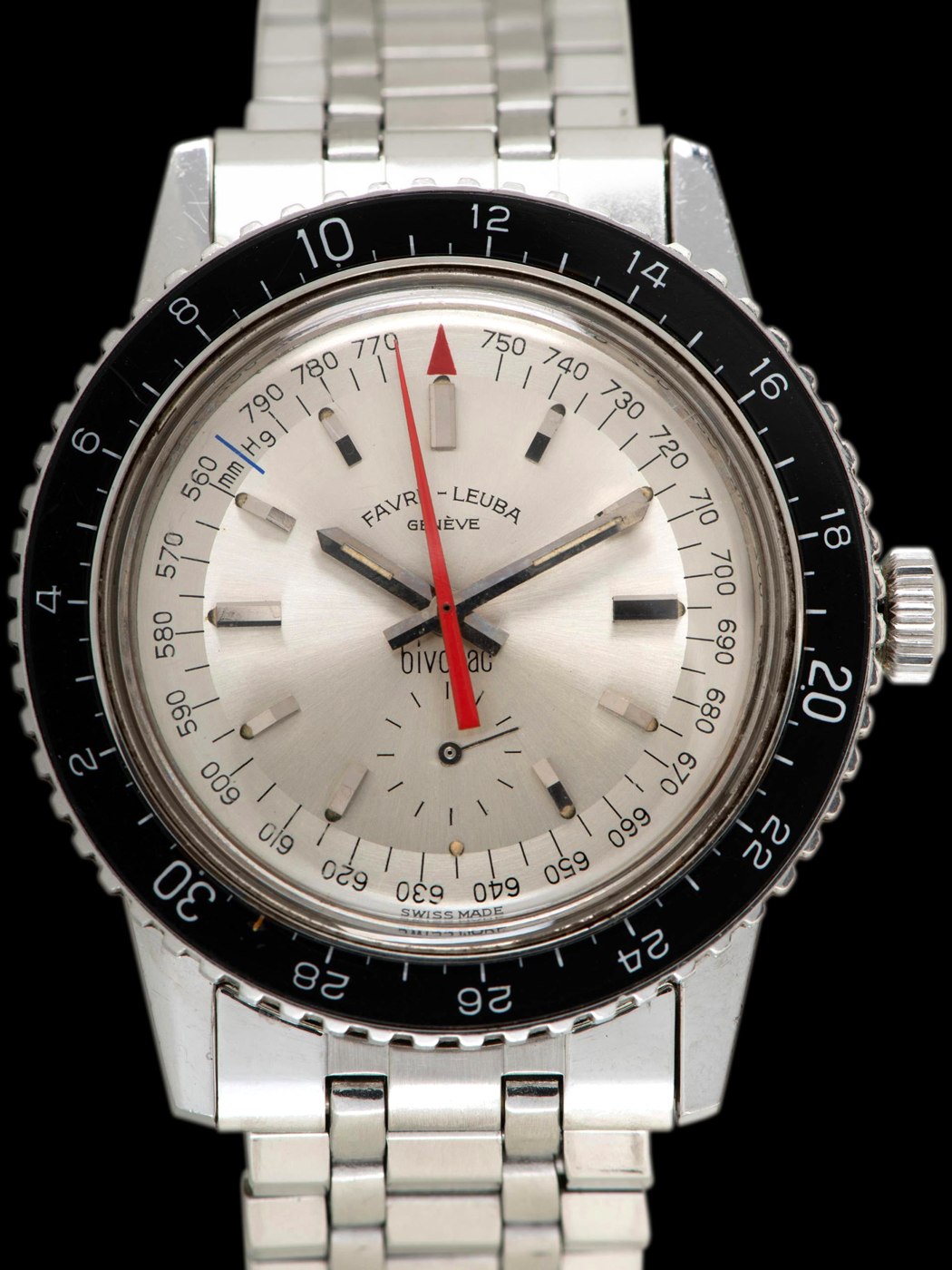
This Favre-Leuba Bivouac, reference 53213, is a stainless steel manual-winding wristwatch introduced in 1962. It is notable for its integrated aneroid barometer, which enables the measurement of altitude and atmospheric pressure alongside timekeeping functionality. The watch is powered by an in-house Favre-Leuba caliber 10032 movement. The 40mm stainless steel case features a bidirectional ratcheting bakelite bezel and is paired with a signature "Gay Freres" steel bracelet. The two-tone silver sunburst dial incorporates strontium lume hour markers and a matching hand set. Historically, the Bivouac was marketed for mountaineering and exploration, famously utilized by figures such as Walter Bonatti during his ascents of Pointe Whymper and the Matterhorn, as well as by polar explorer Paul-Emile Victor. The auction description reports that the timepiece has been serviced and the barometer remains functional.

A close-up view of the Favre-Leuba Bivouac dial featuring the barometric scale, red barometer indicator hand, and strontium-lume indices.
A close-up view of the Favre-Leuba Bivouac dial featuring the barometric scale, red barometer indicator hand, and strontium-lume indices. — Craft & Tailored. Rights pending — permission not yet requested. Original source

Catalogue identity

Source
craftandtailored.com
Category
Wristwatch · Manual-winding wristwatch with aneroid barometer
Maker / attribution
Favre-Leuba
Reference
53213
Catalogue / lot identifier
FVLBB53213
Source-reported date
1962
Source-reported place
Switzerland
Source-reported serial
18XX

Source-reported attribution and specifications are not independent authentication. A listing does not establish present ownership, current display, availability or permission to reproduce.

Object description

Case and Bracelet

The watch is housed in a 40mm stainless steel case. It features a bidirectional ratcheting bakelite bezel, which the auction description reports has a hairline crack positioned between the 6 and 8 markers. The case retains a Favre-Leuba signed crown. The rear of the case retains original factory markings and the majority of the black enamel fill.

The timepiece is fitted with its original stainless steel "Gay Freres" bracelet. It comprises 22 links and is noted to have minimal stretch, with a capacity to accommodate a wrist size up to 7.5 inches.

Evidence for this section
  • “The original bidirectional ratcheting bezel bakelite bezel is in exceptional condition, showing minimal signs of use apart from a hairline crack in between the "6" and " "8" markers.”
  • “The original Favre-Leuba "Gay Freres" stainless steel bracelet is in excellent condition”

Dial and Hands

The silver-toned dial utilizes a two-tone design, featuring a central sunburst pattern surrounded by a concentric finished outer ring. The indices are applied markers treated with strontium-based luminous material, which the auction description notes was exclusive to the early 1960s production period. Some of these plots exhibit a creamy patina, while others display a darkened appearance.

The handset includes a prominent red-tipped pointer hand dedicated to the barometer function, alongside standard time-telling hands. The luminous application on the hands matches the aesthetic of the dial markers, and inspection under ultraviolet light confirms no degradation of the material.

Evidence for this section
  • “The original two-tone silver dial is simply stunning, featuring a sunburst center and a concentric finish for the outer dial.”
  • “The dial features strontium lume, which was only used in the early 60s, and all of the lume plots remain fully intact”

Functionality and History

The Bivouac ref. 53213 is categorized as the first wristwatch to incorporate a functional aneroid barometer. This mechanical complication allows the user to monitor altitude and air pressure through the calibrated dial and the central red indicator hand. The movement is an in-house manual-winding caliber 10032.

Historically, the Bivouac gained recognition as a specialized tool for mountaineers and explorers. It was notably worn by mountaineer Walter Bonatti on significant alpine expeditions and by French polar explorer Paul-Emile Victor. The auction description reports the watch has been serviced and is currently in working order, including the barometric function.

Evidence for this section
  • “Favre-Leuba Bivouac ref. 53213 was the first watch to feature a functional aneroid barometer”
  • “The Bivouac ref, 53213 was famously worn by Walter Bonatti on the first ascent of the north point of Pointe Whymper”
  • “the aneroid barometer is also functional.”

Open research questions

  • What is the specific historical significance of the '18XX' serial number range in relation to Bivouac production?
  • Are there recorded instances of the strontium lume reacting with the barometer's internal housing over time?

Source evidence

Recorded claims and source quotations for Favre-Leuba Bivouac Ref. 53213
FieldSource-reported valueSource quotation
MakerFavre-Leuba“Favre-Leuba”
ModelBivouac“Bivouac”
Reference53213“Ref. 53213”
Introduction Date1962“Introduced in 1962”
MovementCaliber 10032“in-house Cal. 10032 manual winding movement”
Case MaterialStainless Steel“Stainless Steel”
Dial FeaturesStrontium lume“The dial features strontium lume, which was only used in the early 60s”
Bracelet MakerGay Freres“Favre-Leuba "Gay Freres" Bracelet”

Visible details

  • Bidirectional ratcheting bakelite bezel with black enamel
  • Two-tone silver sunburst dial with concentric finish
  • Strontium lume plots and hands showing varying patina
  • In-house manual-winding Caliber 10032 movement

Research qualifications

  • Hairline crack on the bakelite bezel between 6 and 8 markers
  • The serial number is partially obfuscated as 18XX

Photograph identity and source facts were screened before import; rights clearance remains pending.

Terms in this record

Glossary explanations for terms named in this object’s record.