
Skip to content
The Encyclopedia of Horology

Tool · Vertical sundial

F. Zappeck Vertical Pendant Sundial

Partially verified

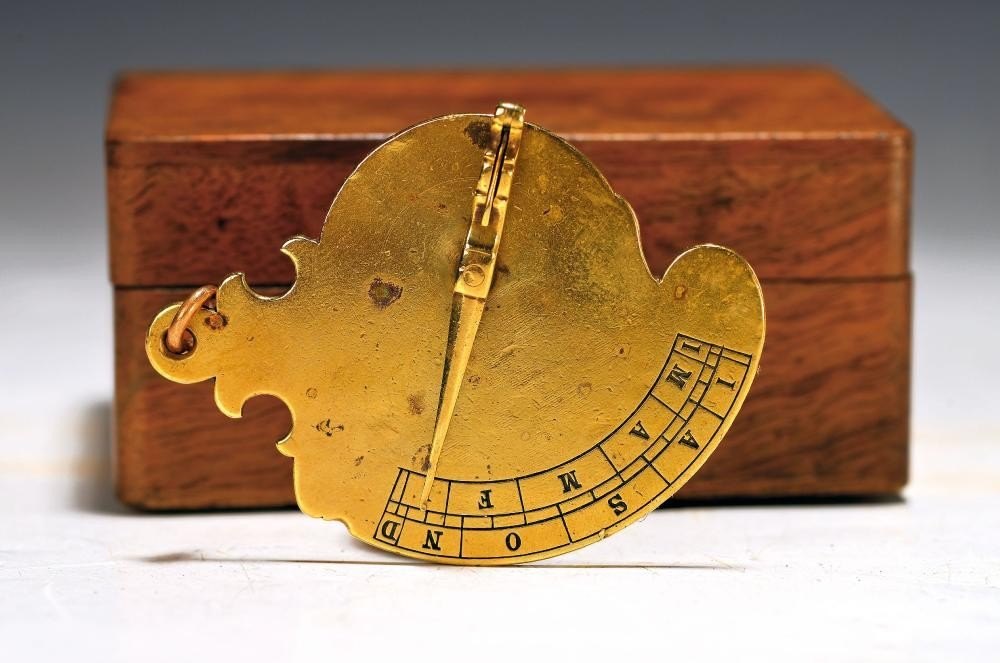
This horological instrument is a vertical sundial designed as a pendant clock, attributed to the maker F. Zappeck of Prague and dated between 1780 and 1820. The object is constructed of brass and features a distinctive "baroque coat of arms shape," characterized by intricate, engraved edges. The piece is dual-sided, with engraving on both the front and back. The front incorporates a rotatable month hand, a folding gnomon, and Latin month bands for calendar reference. The back contains an hour division scale used to indicate time through shadow casting. The numeric indices are highlighted with recessed black lacquer. Measuring approximately 6 cm in height, the device remains in an uncleaned state. The gnomon on the hand can be folded over 270 degrees to allow for time reading on the reverse side. This specific example is noted by the source as being nearly identical to a specimen held in a Vienna museum collection.

Vertical sundial of brass construction featuring a folding gnomon and baroque coat of arms profile.
Vertical sundial of brass construction featuring a folding gnomon and baroque coat of arms profile. — Henry's Auktionshaus / Invaluable. Rights pending — permission not yet requested. Original source

Catalogue identity

Source
orbiscollectibles.com
Category
Tool · Vertical sundial
Maker / attribution
F. Zappeck
Reference
Not recorded
Catalogue / lot identifier
202840500
Source-reported date
1780-1820
Source-reported place
Bohemia

Source-reported attribution and specifications are not independent authentication. A listing does not establish present ownership, current display, availability or permission to reproduce.

Object description

Construction and Design

The sundial is fabricated from brass and adheres to a decorative outline referred to as a 'baroque coat of arms shape.' The physical body of the instrument is engraved on both the obverse and reverse faces to provide specific timekeeping and calendar functions. The dimensions are compact, with a total height of approximately 6 centimeters, designed for wear as a pendant.

The front of the dial is equipped with a rotatable month hand and a folding gnomon. These components allow the user to track the solar month through the indicated month bands. The numeric scales are finished with recessed black lacquer, providing contrast against the brass surface to aid in the legibility of the engravings.

Evidence for this section
  • “brass, in the so-called 'baroque coat of arms shape', engraved on bothsides”
  • “rotatable month hand on the front with folding gnomon and month bands (lat.)”
  • “numbers with recessed blacklacquer, height approx. 6cm”

Functionality and Operation

The instrument functions by utilizing the shadow cast by the folding gnomon. The gnomon is designed to fold over 270 degrees, a feature that enables the user to reference time on the reverse side of the device. The back surface contains a specific hour division scale meant to display time through shadow projection.

The device serves as a multifunctional pendant, combining a calendar mechanism on the front with a functional hour-tracking dial on the rear. The uncleaned state of the brass surface preserves the historical appearance of the object, which is consistent with its reported manufacturing era in Bohemia.

Evidence for this section
  • “the gnomon on the hand is completely folded over (270 degrees) and shows the time on the other side with its shadow on the hour line.”
  • “on the back with hour division and signature: 'F. Zappeck (Prague)'”

Documentation and Attribution

The clock is attributed to the Prague-based maker F. Zappeck. Documentation provided by the source indicates that the object is comparable to an almost identical example currently held in a Vienna museum. This reference is supported by secondary literature, specifically referencing the Lexicon of Clocks by Radko Kynol.

While the auction description identifies the maker and provides a dating range, the source advises that independent authentication of the type and maker remains a subject for further research. The entry documents one specific recorded example, noting the presence of the signature 'F. Zappeck (Prague)' on the reverse of the dial.

Evidence for this section
  • “signature: 'F. Zappeck (Prague)'”
  • “(almost identicalobject, with the same Signature in Vienna Museum and Lit. Radko Kynol, Lexicon of Clocks, p. 34)”

Open research questions

  • Confirm the production records of F. Zappeck in Prague during the late 18th century.
  • Verify the specific museum collection in Vienna that houses the identical reference example.

Source evidence

Recorded claims and source quotations for F. Zappeck Vertical Pendant Sundial
FieldSource-reported valueSource quotation
MakerF. Zappeck“F. Zappeck (Prague)”
Date1780-1820“1780/1820”
HeightApproximately 6 cm“height approx. 6cm”
FormVertical pendant sundial“Vertical sundial, as a pendant clock”
EngravingEngraved on both sides“engraved on bothsides”

Visible details

  • Asymmetrical baroque coat of arms silhouette
  • Recessed black lacquer filling in numeric engravings
  • Folding gnomon mechanism for dual-side utility

Research qualifications

  • Independent type authentication remains research required
  • Historical attribution to F. Zappeck relies on source documentation

Photograph identity and source facts were screened before import; rights clearance remains pending.

Consulted source

Clock, F. Zappeck, Prague, 1780-1820

Reviewed 2026-11-02 · Record 5413e1426e

Terms in this record

Glossary explanations for terms named in this object’s record.