
Skip to content
The Encyclopedia of Horology

Tool · Central European astronomical compendium

Erasmus Habermel Astronomical Compendium

Partially verified

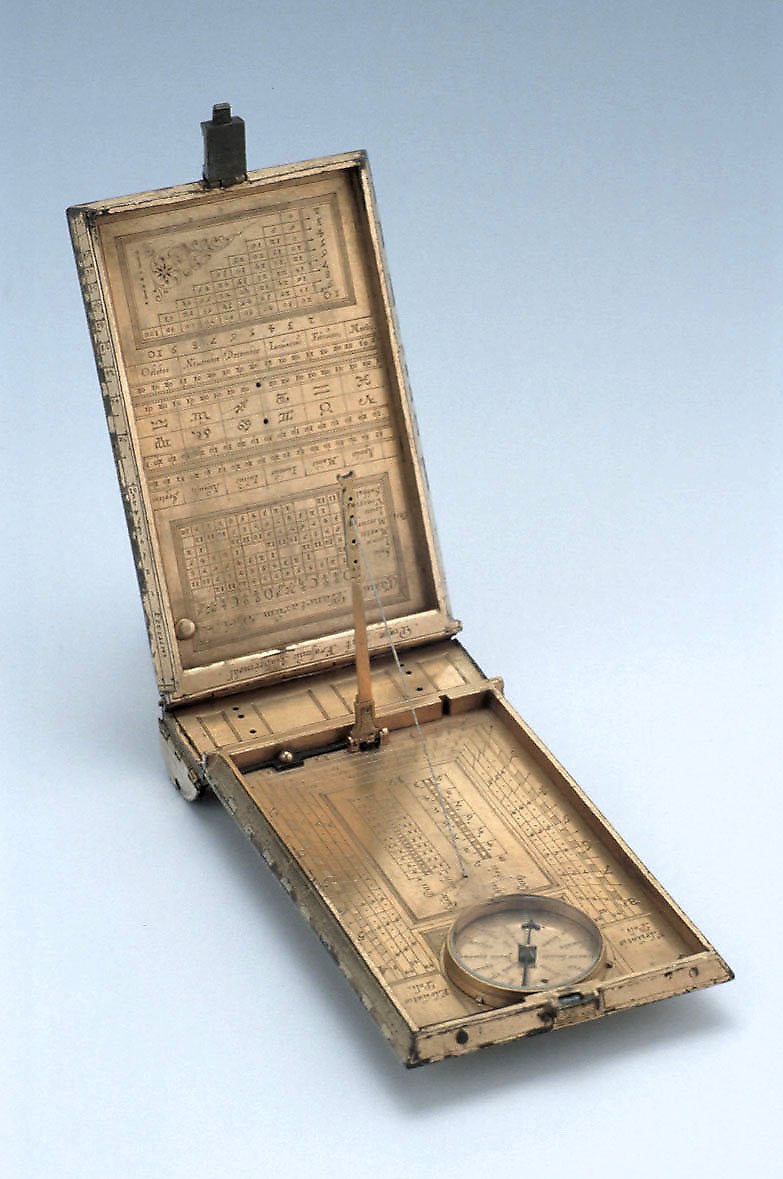
This late 16th-century astronomical compendium is constructed from gilt copper and measures 105 x 60 x 22 mm. It is designed in the form of a book, featuring two leaves mounted on a hollow arched spine, intended to hold paper or tablets for writing. The device includes a horizontal string gnomon sundial adjustable for four latitudes (50, 48, 45, and 42 degrees), a compass with 26 mm diameter engraved with Italian wind names, and assorted calendrical, astrological, and arithmetical tables. Miniature gunner's gauge scales for iron, lead, and stone are integrated into the bevelled sides. It remains part of the collection of the Museum of the History of Science, Oxford, under inventory number 44392.

The astronomical compendium opened, showing the interior covers, the sundial, and the compass.
The astronomical compendium opened, showing the interior covers, the sundial, and the compass. — Museum of the History of Science, Oxford. Rights pending — permission not yet requested. Original source

Catalogue identity

Source
www.mhs.ox.ac.uk
Category
Tool · Central European astronomical compendium
Maker / attribution
Erasmus Habermel
Reference
44392
Catalogue / lot identifier
44392
Source-reported date
Late 16th century
Source-reported place
Prague

Source-reported attribution and specifications are not independent authentication. A listing does not establish present ownership, current display, availability or permission to reproduce.

Object description

Construction and Design

The compendium is fashioned as a book with two leaves attached to a hollow arched spine, intended to accommodate paper or tablets for a notebook. When closed, the leaves maintain a 13 mm separation to allow for inserted material. The assembly is secured by a spring-held clasp operated via a button.

The outer face of the spine displays a table detailing the latitudes of 15 cities, ranging from Rome to Prague. At one end, a folding leaf attached to a thin plate provides a mechanism to retain the internal sheets or tablets within the spine's cavity.

Evidence for this section
  • “The compendium is shaped in the form of a notebook and its two leaves are mounted on a hollow arched spine.”
  • “The instrument is fastened with a spring-held clasp which is released by a button.”
  • “The outer arched face of the spine carries a table of the latitudes of 15 cities from Rome at 42? to Prag at 50?.”

Astronomical and Mathematical Functions

The interior of the lower cover houses a horizontal string gnomon sundial with a support adjustable for four specific latitudes. Accompanying the dial are two tables covering sunrise, sunset, and daylight duration. A compass with 26 mm diameter is also recessed into this face, engraved with the names of sixteen winds in Italian.

The upper cover features multiple tables including a 'Tabula Planetarum Diei', a multiplication table, and a Gregorian calendar scale. Two graphical conversion devices on the exterior face allow for the conversion between equal, Italian, and unequal hours.

Evidence for this section
  • “The inside face of the lower cover carries a horizontal string gnomon sundial.”
  • “The inside face carries the signature along the hinged side: 'Pragae fecit Erasmus Habermehl'.”
  • “The outer face has two graphical devices for converting hours; one labelled 'Horae ab Occasu' converts between equal hours and Italian hours; the other labelled 'Horae Planetarum' converts between equal and unequal hours.”

Gunner's Scales and Markings

In addition to its astronomical features, the device incorporates scales for gunnery. These are engraved onto the long bevelled sides of the inner faces and include 'Plumbum' (lead), 'Lapis' (stone), and 'Ferrum' (iron) markings, alongside a general scale of equal parts.

The object is signed 'Pragae fecit Erasmus Habermehl' along the hinge of the upper cover, attributing the work to the Prague-based instrument maker.

Evidence for this section
  • “Each long bevelled side of the inner faces carries a miniature version of one of a gunner's gauge scale”
  • “The inside face carries the signature along the hinged side: 'Pragae fecit Erasmus Habermehl'.”

Open research questions

  • What is the specific intended use for the two small, unlabelled holes found on the inside of the upper cover?
  • Are there remaining traces or records of the original paper or tablets that were intended to be bound within the device?

Source evidence

Recorded claims and source quotations for Erasmus Habermel Astronomical Compendium
FieldSource-reported valueSource quotation
MakerErasmus Habermel“Signed by Erasmus Habermel”
DateLate 16th century“Late 16th century; Prague”
Dimensions105 x 60 x 22 mm“105 x 60 x 22 mm”
MaterialGilt copper“Gilt copper; 105 x 60 x 22 mm”
SignaturePragae fecit Erasmus Habermehl“'Pragae fecit Erasmus Habermehl'”
Compass26 mm diameter“compass whose bowl is 26 mm in diameter”
Inventory Number44392“Inventory number: 44392”

Visible details

  • Hinged gilt copper book-like construction
  • Adjustable folding string gnomon
  • Compass bowl engraved with sixteen principal winds
  • Miniature gunner's scales labelled for iron, lead, and stone

Research qualifications

  • The exact purpose of two small holes on the inside face of the top cover remains unknown
  • The grid on the outer face lacks a clear function as it does not incorporate a degree scale

Photograph identity and source facts were screened before import; rights clearance remains pending.

Consulted source

Astronomical Compendium

Reviewed 2026-10-26 · Record a7124b6a43

Terms in this record

Glossary explanations for terms named in this object’s record.

Other central european astronomical compendium records