Instrument Layout and Functions
The compendium is housed in a square gilt brass box with a hinged cover. The exterior of the cover features a zodiac-calendar scale and a dual-layer lunar volvelle. The zodiac scale is divided into segments named in Latin, while the volvelle allows for tracking the age of the moon and observing lunar phases through a circular aperture, which reveals a faintly engraved face. An aspectarium on the upper volvelle uses numerical markers to represent trine, quadrature, and sextile alignments.
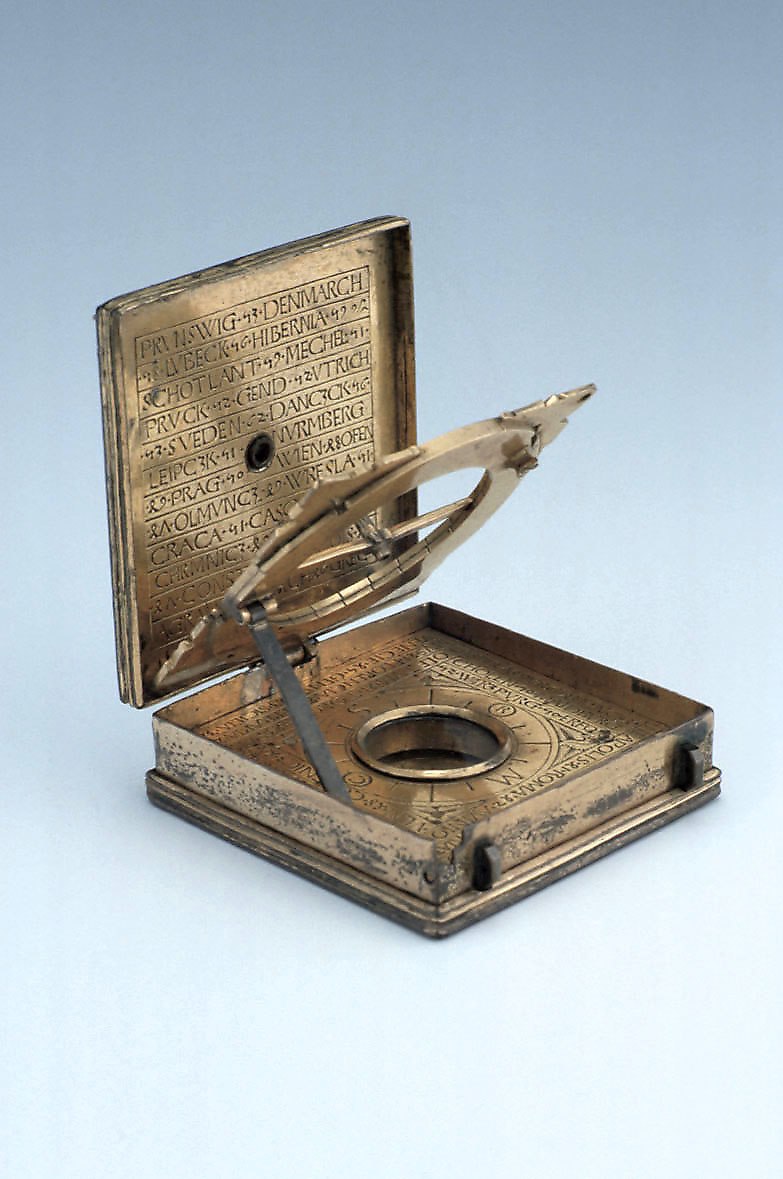
The internal face of the hinged cover contains a list of latitudes for 26 regional locations, such as 'HIBERNIA' and 'SCHOTLANT'. Attached to the same hinge mechanism is the equinoctial ring dial, which is supported by a folding strut that engages with a latitude scale on the base plate. The hour ring itself is decorated with relief-engraved scrollwork and includes a zodiac scale, intended for use with a sliding ring for reading Italian hours.
Evidence for this section
- “The zodiac occupies the outer of the two bands; each sign is named or abbreviated in Latin”
- “The reverse of this instrument's cover has a list of the latitudes of 26 places”
- “The hour ring is elevated by a folding strut (presumably a replacement) which engages with a latitude scale on the plate below.”
Timekeeping and Orientation
The equinoctial dial serves as a universal indicator for equal hour time within a latitude range of 20 to 60 degrees. The hour ring is inscribed with 1 to 12 sequences, though the nocturnal hours of 10 pm to 2 am are replaced by a zodiac scale to facilitate reading Italian hours via a sliding ring. This sliding ring incorporates a cross piece and a cylindrical holder intended for a removable gnomon, which is currently absent from the instrument.
A magnetic compass is integrated into the base plate, featuring a bowl 24 mm in diameter with an offset arrow to indicate magnetic variation. While the needle is missing, the surrounding bowl displays 16 directional markings with cardinal points abbreviated as 'S', 'RO', 'M', and 'CO'. Beneath the plate sits an unfinished quadrant with straight hour lines, while the removable base reveals an internal wooden block that supports the mechanical components.
Evidence for this section
- “The equinoctial dial gives valid indications of equal hour time in its latitude range.”
- “The sliding ring has a cross piece with a cylindrical holder for the gnomon (missing).”
- “The base of the instrument carries an unfinished quadrant with straight hour lines, whose sights are on the side of the box opposite the hinge.”
Attribution and Inscriptions
Although the instrument lacks a maker's signature, it is attributed to Hans Dorn, an instrument maker active in Buda from the late 1460s until the late 1480s. The piece is notable for its consistent use of Gothic numerals, particularly the distinct forms for 4, 5, and 7.
Integrated into the scrollwork decoration is the pious inscription 'AVE MARIA 1481', which establishes the object's completion date. Comparisons are drawn to a quadrant from 1438 in the Kunsthistorisches Museum, Vienna, which shares a similar layout regarding the zodiac-calendar scale and lunar volvelle. The construction reflects early developments in compact astronomical instruments, although certain elements, such as the folding support strut, appear to be non-original replacements.
Evidence for this section
- “Although not signed it has been attributed to Hans Dorn”
- “The instrument maker has consistently used Gothic numerals; the forms of 4, 5 and 7 are particularly distinctive.”
- “On the relief-engraved scrollwork around the sundial's hour ring is the pious inscription 'AVE MARIA 1481'.”