
Skip to content
The Encyclopedia of Horology

Tool · Equinoctial dial

Equinoctial Dial by Petrus ab Aggere

Partially verified

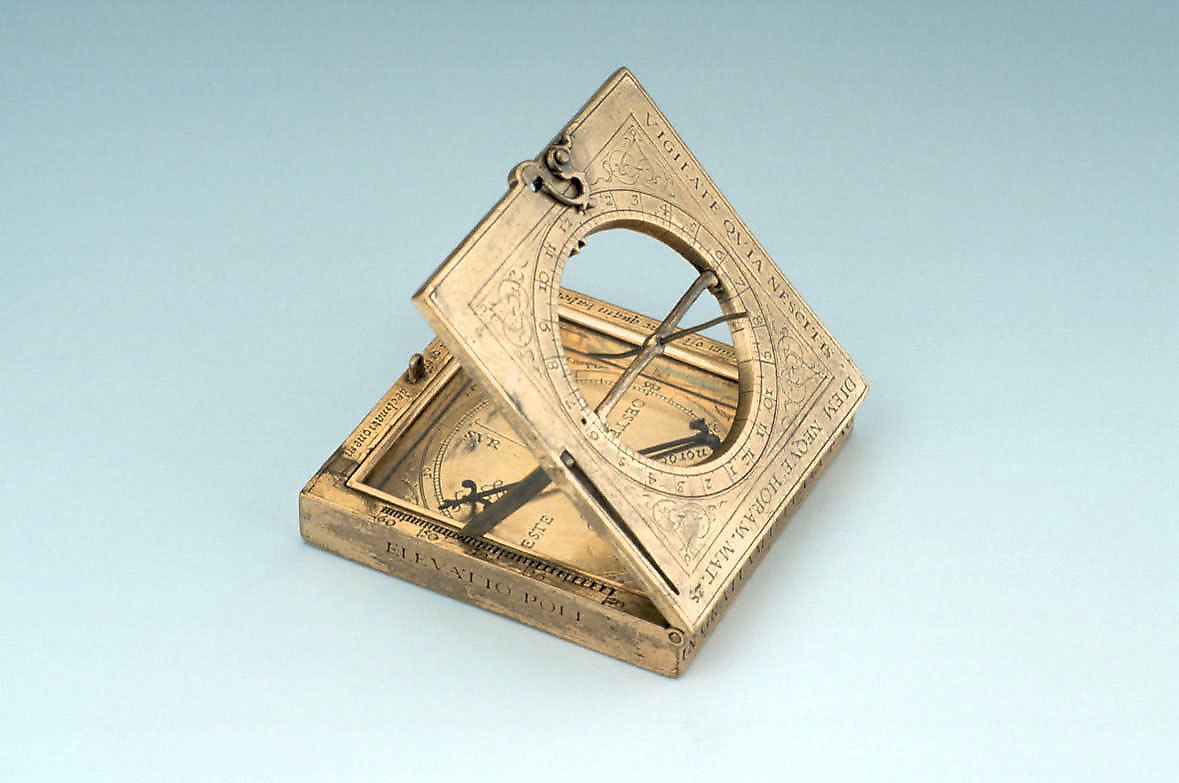
This equinoctial dial, crafted from gilt brass, measures 11 x 57 x 57 mm and was produced in Madrid in 1562. Signed by Petrus ab Aggere, the instrument features a square form and includes an internal compass with eight directional points. The lid's exterior is engraved with an hour circle marked 1 to 12 twice, alongside decorative arabesque spandrels and a Latin quotation from Matthew 25. The dial displays latitude tables on both the inner lid and the box bottom. Additional functional components include an unequal scale for latitudes on the right side and an instructional inscription regarding magnetic declination on the left and bottom edges. The outer edges of the instrument bear further inscriptions detailing the latitude settings, the maker's signature, and the date of production. It is currently held in the Lewis Evans Collection at the Museum of the History of Science, Oxford.

Gilt brass equinoctial dial by Petrus ab Aggere, dated 1562, showing the open lid and internal compass.
Gilt brass equinoctial dial by Petrus ab Aggere, dated 1562, showing the open lid and internal compass. — © Museum of the History of Science, Oxford. Rights pending — permission not yet requested. Original source

Catalogue identity

Source
www.mhs.ox.ac.uk
Category
Tool · Equinoctial dial
Maker / attribution
Petrus ab Aggere
Reference
Not recorded
Catalogue / lot identifier
35203
Source-reported date
1562
Source-reported place
Spain (Madrid)

Source-reported attribution and specifications are not independent authentication. A listing does not establish present ownership, current display, availability or permission to reproduce.

Object description

Construction and Design

The equinoctial dial is constructed from gilt brass and takes a square form, measuring 11 mm in depth and 57 mm in both width and length. The design incorporates a folding lid that functions as the equinoctial plane, which is decorated with arabesques in the spandrel spaces.

The lid's outer face displays an hour circle numbered 1 to 12 in two sequences. The instrument integrates a compass featuring eight named directions, located within the base of the box. These features facilitate the alignment and orientation of the dial for timekeeping.

Evidence for this section
  • “Gilt brass; 11 x 57 x 57 mm”
  • “The outer part of the lid of this dial has an hour circle numbered from 1 to 12 twice, is decorated with arabesques in the spandrel spaces”
  • “The box contains a compass with eight directions named and arabesques in the spandrels.”

Inscriptions and Latitude Data

The dial contains multiple instructional and moralizing inscriptions. The top border carries a quotation from the Gospel of Matthew 25, which serves as a memento mori. Further text, including instructions regarding magnetic declination, is found on the sides and bottom of the box.

Latitude information is provided through tables located on both the inner lid and the bottom of the box. A latitude scale, divided by degrees from 20 to 60, is located on the right side of the instrument. The edge inscriptions clarify the purpose of this scale and identify the maker and date.

Evidence for this section
  • “'VIGILATE QVIA NESCITIS DIEM NEQVE HORAM MAT 25'”
  • “On the right side is an unequal scale for latitudes divided from 20 to 60 by 1, and on the left and bottom sides is the inscription 'Acus suam ostendat quam habet loci a septentrione ad ortu declinationem'.”

Provenance and Attribution

The object is signed by Petrus ab Aggere and carries a date of 1562, confirming its production in Madrid. The piece was formerly part of the Lewis Evans Collection, documented as item S. 6.

The museum notes that the dial is comparable in form to another piece by Juan Cocart, a maker associated with Spain, which is also held in the collection of the Museum of the History of Science, Oxford.

Evidence for this section
  • “Signed by Petrus ab Aggere”
  • “Dated 1562; Madrid”
  • “Provenance: Lewis Evans Collection S. 6.”
  • “In its square form, this instrument is reminiscent of another dial in the collection of the Museum of the History of Science in Oxford by a maker with Spanish connections, Juan Cocart”

Open research questions

  • What is the specific historical role or identity of 'D. Petri Fag iardi F.' mentioned in the dedication?
  • Does the compass needle represent an original component or a later replacement?

Source evidence

Recorded claims and source quotations for Equinoctial Dial by Petrus ab Aggere
FieldSource-reported valueSource quotation
MakerPetrus ab Aggere“Signed by Petrus ab Aggere”
MaterialGilt brass“Gilt brass”
Dimensions11 x 57 x 57 mm“11 x 57 x 57 mm”
Place of originMadrid“Madrid”
Date1562“Dated 1562”
Inventory number35203“Inventory number: 35203”
InscriptionsMatthew 25“'VIGILATE QVIA NESCITIS DIEM NEQVE HORAM MAT 25'”
ProvenanceLewis Evans Collection“Provenance: Lewis Evans Collection S. 6”

Visible details

  • The dial is hinged to allow the lid to act as an adjustable gnomon
  • The magnetic compass is recessed within the square box
  • Latitude scale on the side is calibrated from 20 to 60 degrees
  • The dial face is integrated into the underside of the folding lid

Research qualifications

  • The exact identity of the recipient 'D. Petri Fag iardi F.' remains unverified
  • The functional precision of the magnetic compass in a contemporary setting is not documented

Photograph identity and source facts were screened before import; rights clearance remains pending.

Consulted source

Equinoctial Dial

Reviewed 2026-10-26 · Record c77b2b8a3d

Terms in this record

Glossary explanations for terms named in this object’s record.