
Skip to content
The Encyclopedia of Horology

Tool · Iberian equinoctial dial

Equinoctial Dial by Juan Cocart

Partially verified

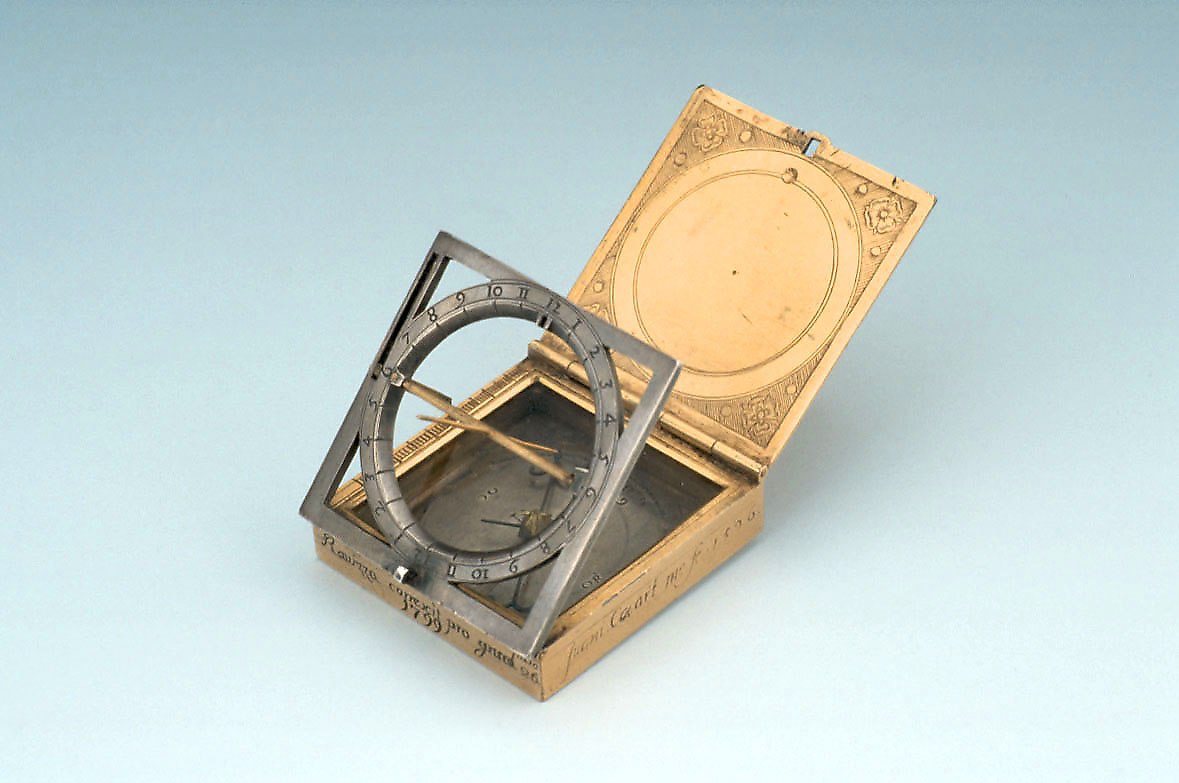
This square equinoctial dial, held by the Museum of the History of Science in Oxford, is constructed from gilt brass and silver, measuring 11 by 43 by 44 mm. It features a folding hour circle marked 1 to 12 twice, mounted on a square base that incorporates a latitude adjustment arm. The internal compass displays cardinal points in abbreviated form. Both the lid and the base of the box are engraved with latitude tables for sixteen locations. The object is signed by Juan Cocart and dated 1596. A later historical addition includes an engraved correction for magnetic deviation, signed by an individual named Ravizza and dated 1799. The instrument retains components that appear to be the original compass glass and needle. The design shares structural similarities with other extant dials attributed to Cocart and the maker Petrus ab Aggere.

Equinoctial dial in gilt brass and silver, signed by Juan Cocart and dated 1596.
Equinoctial dial in gilt brass and silver, signed by Juan Cocart and dated 1596. — Museum of the History of Science, Oxford. Rights pending — permission not yet requested. Original source

Catalogue identity

Source
www.mhs.ox.ac.uk
Category
Tool · Iberian equinoctial dial
Maker / attribution
Juan Cocart
Reference
Not recorded
Catalogue / lot identifier
51773
Source-reported date
1596
Source-reported place
Spain

Source-reported attribution and specifications are not independent authentication. A listing does not establish present ownership, current display, availability or permission to reproduce.

Object description

Construction and Design

The equinoctial dial is housed in a square gilt brass and silver box. The instrument features a central compass protected by glass, with the cardinal points indicated by the letters 'SE', 'OR', 'ME', and 'OC'. A folding hour circle is situated above the compass, with the hours represented twice in a 1 to 12 sequence. The mechanism includes a brass arm for adjusting latitude, with a corresponding scale located on the side of the box, graduated every degree and numbered from 10 to 70.

The outer lid and the base of the box are both engraved with tables listing latitudes for sixteen distinct locations. The interior of the lid is decorated with a geometric pattern, featuring two concentric circles in the central field and Tudor roses positioned within the spandrels of the square frame.

Evidence for this section
  • “The outer part of the lid of this equinoctial dial has a table of latitudes for 16 places.”
  • “The box contains a compass with the indication of the cardinal points 'SE', 'OR', 'ME', 'OC' and on one side is a scale for setting the dial to the appropriate latitude”

Signatures and Later Modifications

The instrument bears the signature of its maker on the right edge of the box, reading 'Juani Cocart me fe 1596', which identifies the year of its manufacture.

In 1799, the dial underwent a modification to correct for magnetic deviation. This intervention is recorded on the lower edge of the box via an inscription stating 'Ravizza correxit pro grad 26 m 10 , 1799'. This addition documents the continued use and maintenance of the dial two centuries after its creation.

Evidence for this section
  • “The lower edge is engraved with the inscription 'Ravizza correxit pro grad 26 m 10 , 1799'”
  • “the right edge with 'Juani Cocart me fe 1596'”

Provenance and Preservation

The object is currently part of the collection at the Museum of the History of Science in Oxford, specifically entering through the Lewis Evans Collection. The dial is documented as being in good condition, and the museum notes that the compass glass and needle appear to be original to the device.

The dial is comparable to other known works by Juan Cocart and bears a resemblance to instruments produced by Petrus ab Aggere, another maker active in Spain.

Evidence for this section
  • “The dial is very similar to the other surviving dials by the maker Juan Cocart .”
  • “Like them it is preserved in remarkably good condition, with, it seems, its original compass glass and needle.”

Open research questions

  • What are the 16 locations listed in the latitude tables on the lid and base?
  • Does the magnetic correction by Ravizza suggest the instrument was in use for navigation or scientific surveying in 1799?

Source evidence

Recorded claims and source quotations for Equinoctial Dial by Juan Cocart
FieldSource-reported valueSource quotation
MakerJuan Cocart“Signed by Juan Cocart”
Date1596“Dated 1596”
Dimensions11 x 43 x 44 mm“11 x 43 x 44 mm”
MaterialsGilt brass and silver“Gilt brass and silver”
Inventory Number51773“Inventory number 51773”
Modification1799 magnetic deviation correction by Ravizza“The lower edge is engraved with the inscription 'Ravizza correxit pro grad 26 m 10 , 1799'”
SignatureJuani Cocart me fe 1596“the right edge with 'Juani Cocart me fe 1596'”
ProvenanceLewis Evans Collection“Provenance: Lewis Evans Collection”

Visible details

  • Folding hour circle with double 1-12 numbering
  • Internal compass marked with cardinal points SE, OR, ME, OC
  • Latitude adjustment arm and scale ranging from 10 to 70
  • Engraved 1799 magnetic deviation correction by Ravizza

Research qualifications

  • The source notes the compass glass and needle appear original but does not confirm their state
  • Attributions of maker similarity are provided as observations by the source rather than as technical certainty

Photograph identity and source facts were screened before import; rights clearance remains pending.

Consulted source

Equinoctial Dial

Reviewed 2026-10-26 · Record 47b793e8b6

Terms in this record

Glossary explanations for terms named in this object’s record.

Other iberian equinoctial dial records