
Skip to content
The Encyclopedia of Horology

Tool · Iberian equinoctial dial

Equinoctial Dial by Hieronymus de Arresse

Partially verified

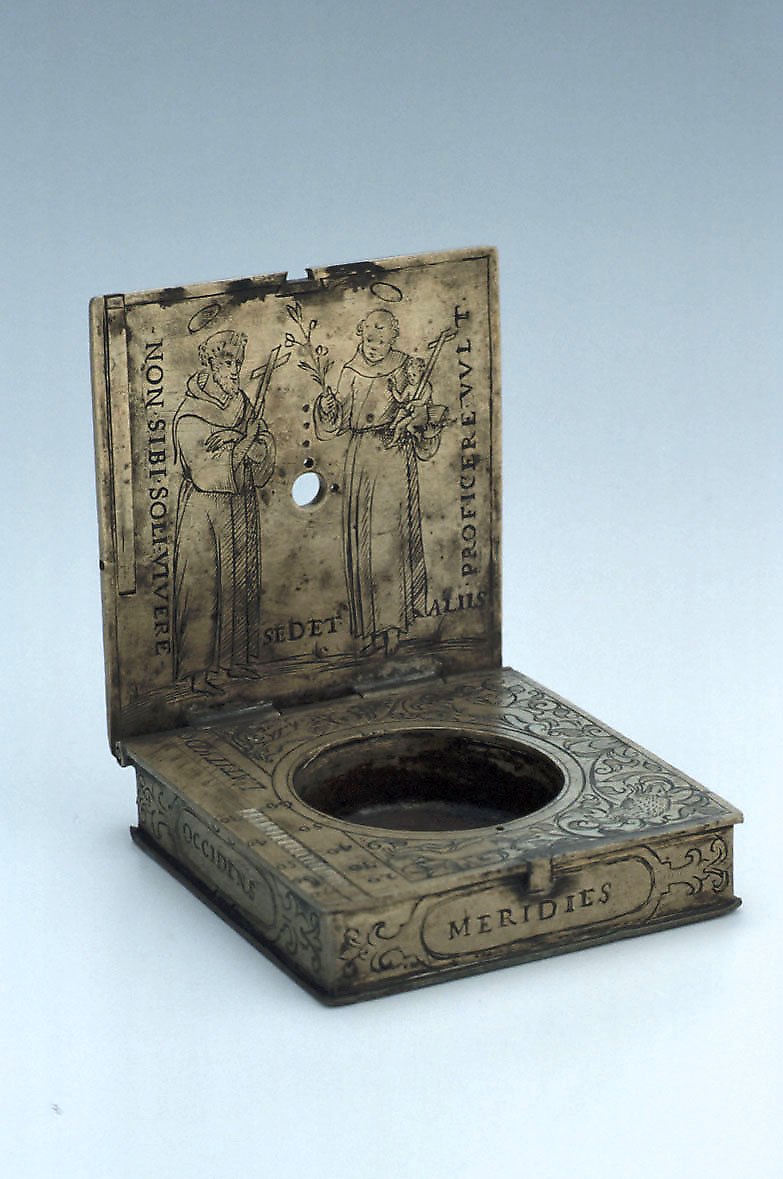
This equinoctial sundial, signed by Hieronymus de Arresse and dated 1598, is constructed from brass and measures 62 by 60 by 15 mm. The instrument features a box with a hinged cover leaf that serves as the hour plate, inscribed with a Latin maxim and engraved with figures of St Francis of Assisi and St Anthony of Padua. Designed as a universal dial, it includes a scale of latitudes ranging from 20 to 60 degrees. The maker further provided a table of latitudes for 24 cities located in Spain and Portugal. Currently, the object is incomplete; it lacks the gnomon, the compass needle, the direction plate, and a rotating disc for the lid. The box exterior displays decorative foliate engraving featuring a hare, a boar, and two dogs, alongside orientation labels for the cardinal directions.

Equinoctial sundial by Hieronymus de Arresse, 1598, showing the open lid with religious engravings.
Equinoctial sundial by Hieronymus de Arresse, 1598, showing the open lid with religious engravings. — Museum of the History of Science, Oxford. Rights pending — permission not yet requested. Original source

Catalogue identity

Source
www.mhs.ox.ac.uk
Category
Tool · Iberian equinoctial dial
Maker / attribution
Hieronymus de Arresse
Reference
Not recorded
Catalogue / lot identifier
38577
Source-reported date
1598
Source-reported place
Spain

Source-reported attribution and specifications are not independent authentication. A listing does not establish present ownership, current display, availability or permission to reproduce.

Object description

Construction and Design

The instrument is composed of a brass box base and a hinged cover leaf which acts as the hour plate. The cover features a central hole meant for a gnomon, supplemented by two smaller holes, and is used in conjunction with a folding arm for adjusting the plate's elevation. The outer face of this lid bears an hour scale marked from 1 to 12 twice.

The base of the box contains a hollowed circular space originally intended to house a compass, which is no longer present. The area surrounding this bowl is decorated with engravings of animals, specifically a hare, a boar, and two dogs, amidst foliate patterns. The sides of the box are labelled with the cardinal directions 'ORIENS', 'MERIDIES', and 'OCCIDENS' within decorative panels.

Evidence for this section
  • “The instrument consists of a box with a fixed suspension ring surmounted by a hinged brass lid serving as the hour plate.”
  • “The compass bowl is 35 mm in diameter and surrounded by foliate engraving through which a hare, a boar and two dogs are running.”

Inscriptions and Ornamentation

The interior surface of the hinged cover leaf is extensively decorated with religious iconography and text. It displays engraved figures of St Francis of Assisi and St Anthony of Padua. Flanking these figures is a Latin inscription: 'NON . SIBI . SOLI . VIVERE . SED . ET . ALIIS . PROFICERE . VVLT'.

A date, 1598, is positioned in a small cartouche above the midday point on the hour scale. Winged heads are engraved in the four corners of the plate. The base of the instrument houses a table listing the latitudes for 24 towns and cities located in Spain and Portugal.

Evidence for this section
  • “The inner face of the cover leaf carries the inscription 'NON . SIBI . SOLI . VIVERE . SED . ET . ALIIS . PROFICERE . VVLT' and engraved figures of St Francis of Assisi and St Anthony of Padua.”
  • “The base of the box carries the signature 'F. Hieronimus de Arresse' above a table of the latitudes of 24 Spanish and Portuguese towns.”

Condition and Completeness

The dial is reported as incomplete by the holding institution. Significant components required for the standard operation of the instrument are missing, including the gnomon, the compass needle, the direction plate, and a rotating disc for the lid.

Despite these losses, the main body and the cover leaf remain intact, preserving the majority of the original decorative work and technical inscriptions. The inventory history is documented through the Lewis Evans Collection.

Evidence for this section
  • “The instrument is incomplete and lacks its gnomon and the direction plate and needle of the compass , as well as a rotating disc for the lid.”
  • “Provenance: Lewis Evans Collection S. 8.”

Open research questions

  • What was the original configuration and material of the missing rotating disc?
  • Does documentary evidence exist confirming the specific town latitude data used by Arresse in his table?

Source evidence

Recorded claims and source quotations for Equinoctial Dial by Hieronymus de Arresse
FieldSource-reported valueSource quotation
MakerHieronymus de Arresse“Signed by Hieronymus de Arresse”
Date1598“Dated 1598”
Dimensions62 x 60 x 15 mm“62 x 60 x 15 mm”
Latitude Range20 to 60 degrees“adjustable for use in latitudes from 20 to 60?.”
ProvenanceLewis Evans Collection“Provenance: Lewis Evans Collection S. 8.”
Inventory Number38577“Inventory number 38577”

Visible details

  • Engraved figures of two saints on the inside lid
  • Foliate exterior engraving including animal motifs
  • Compass bowl void currently visible in the main box
  • Numbered latitude scale visible on the side of the box

Research qualifications

  • The gnomon is missing
  • The compass needle and rotating lid disc are missing

Photograph identity and source facts were screened before import; rights clearance remains pending.

Consulted source

Equinoctial Dial

Reviewed 2026-10-26 · Record 01d114282e

Terms in this record

Glossary explanations for terms named in this object’s record.

Other iberian equinoctial dial records