
Skip to content
The Encyclopedia of Horology

Tool · Central European equinoctial dial

Equinoctial Dial by Johann Christoph Keller

Partially verified

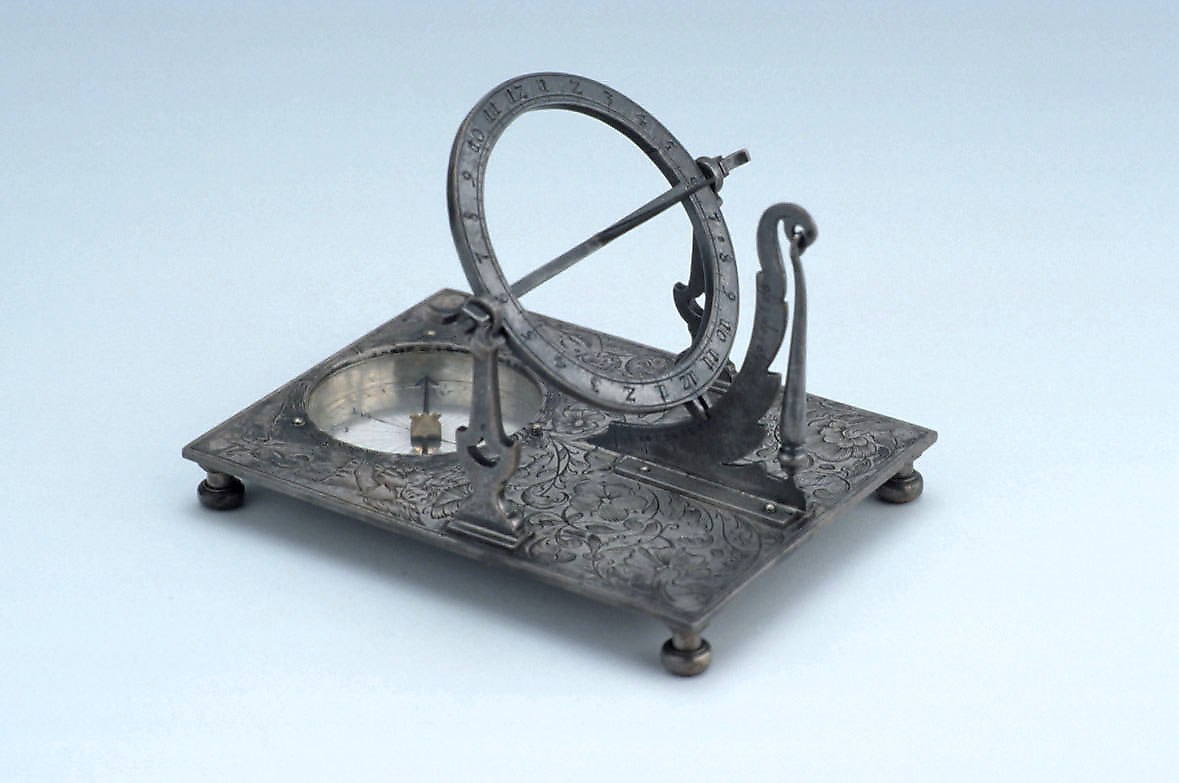
This equinoctial dial, held by the Museum of the History of Science in Oxford, is a silver portable instrument attributed to Johann Christoph Keller of Linz, dated circa 1580. Measuring 85 x 62 x 53 mm, the device features a rectangular base plate raised on four bun feet. The base is intricately engraved with floral and foliate motifs, alongside depictions of two angels positioned on either side of an inset compass. The compass includes magnetic deviation markings and cardinal points denoted as N, O, S, and W. Functionally, the dial utilizes an adjustable hour ring supported by two upright pillars, which can be calibrated to various latitudes. The mechanism includes a latitude scale marked from 0 to 90 degrees with a hanging plumb line for leveling. The instrument is signed by the maker on the hour ring, which displays common hours numbered from 1 to 12 twice.

Equinoctial dial by Johann Christoph Keller, circa 1580, featuring a compass and adjustable latitude scale.
Equinoctial dial by Johann Christoph Keller, circa 1580, featuring a compass and adjustable latitude scale. — Museum of the History of Science, Oxford. Rights pending — permission not yet requested. Original source

Catalogue identity

Source
www.mhs.ox.ac.uk
Category
Tool · Central European equinoctial dial
Maker / attribution
Johann Christoph Keller
Reference
Not recorded
Catalogue / lot identifier
51108
Source-reported date
circa 1580
Source-reported place
Linz

Source-reported attribution and specifications are not independent authentication. A listing does not establish present ownership, current display, availability or permission to reproduce.

Object description

Construction and Design

The equinoctial dial is constructed from silver and measures 85 x 62 x 53 mm. It rests on four small bun feet, providing a stable foundation for the instrument. The base plate serves as the primary mounting point for the vertical components and is decorated with detailed engravings of flowers, leaves, and two angels placed adjacent to the central compass.

The dial’s primary timekeeping component is an adjustable hour ring. This ring is held in position by two pillars rising from the base plate and can be modified to facilitate use at different latitudes. The hours are engraved as common hours, numbered 1 to 12 twice on the ring.

Evidence for this section
  • “The dial has an engraved silver base, standing on four bun feet, with two pillars supporting the hour ring.”
  • “The base plate is decorated with flowers, leaves and two angels on the sides of the compass.”
  • “The ring is adjustable by means of two screws, and has on one side common hours numbered 1 to 12 twice”

Compass and Latitude Calibration

Integrated into the base plate is a compass, which is marked with cardinal points 'N', 'O', 'S', and 'W'. This component also contains markings intended to indicate magnetic deviation. The design of the instrument allows for precise leveling, which is achieved through a hanging plummet suspended from a central latitude scale.

The latitude scale itself is graduated from 0 to 90 degrees, with intervals of 1 degree and numbering at every 10 degrees. This calibration allows the user to adjust the tilt of the hour ring according to their geographical position, confirming the object's function as a universal instrument.

Evidence for this section
  • “There is a levelling plummet hanging from a centrally placed latitude scale, marked [0] to 90? divided by 1?, numbered by 10?.”
  • “On the base plate is inset a compass with magnetic deviation marked and initials of the cardinal points 'N', 'O', 'S', 'W'.”

Signature and Identification

The instrument bears an inscription identifying the maker as Johann Christoph Keller of Linz. The signature is engraved directly onto the adjustable hour ring alongside the Latin term for a universal dial. The lettering is accompanied by decorative foliage.

The record indicates that the object is held by the Museum of the History of Science, Oxford, under the inventory number 51108. The specific attribution and dating to circa 1580 are provided by the museum's catalogue data.

Evidence for this section
  • “Signed by Johann Christoph Keller”
  • “on the other the signature 'IO ? CHRISTOF ? KELLER ? MATHE ?LINCI ? HOROLOGIVM [foliage] VNIVERSALE'”

Open research questions

  • What is the significance of the specific inclusion of magnetic deviation markings on this 16th-century dial?
  • Are there other known instruments by Johann Christoph Keller that share the same decorative angel motif?

Source evidence

Recorded claims and source quotations for Equinoctial Dial by Johann Christoph Keller
FieldSource-reported valueSource quotation
MakerJohann Christoph Keller“Signed by Johann Christoph Keller”
Datecirca 1580“circa 1580; Linz”
MaterialSilver“Silver; 85 x 62 x 53 mm”
Dimensions85 x 62 x 53 mm“85 x 62 x 53 mm”
Latitude Scale0-90 degrees“marked [0] to 90? divided by 1?, numbered by 10?”
SignatureIO CHRISTOF KELLER MATHE LINCI HOROLOGIVM VNIVERSALE“the signature 'IO ? CHRISTOF ? KELLER ? MATHE ?LINCI ? HOROLOGIVM [foliage] VNIVERSALE'”

Visible details

  • Rectangular silver base plate with four spherical bun feet
  • Inset compass on the base plate with cardinal point indicators
  • Engraved floral and foliate ornamentation across the base
  • Adjustable hour ring supported by two vertical metal pillars

Research qualifications

  • The exact extent of restoration or surface wear is not explicitly detailed in the source
  • The precise nature of the 'magnetic deviation' mechanism within the compass is not described

Photograph identity and source facts were screened before import; rights clearance remains pending.

Consulted source

Equinoctial Dial

Reviewed 2026-10-26 · Record 8edf3dd016

Terms in this record

Glossary explanations for terms named in this object’s record.