
Skip to content
The Encyclopedia of Horology

Clock · Table clock

English Porphyry Clock by Ellicott

Partially verified

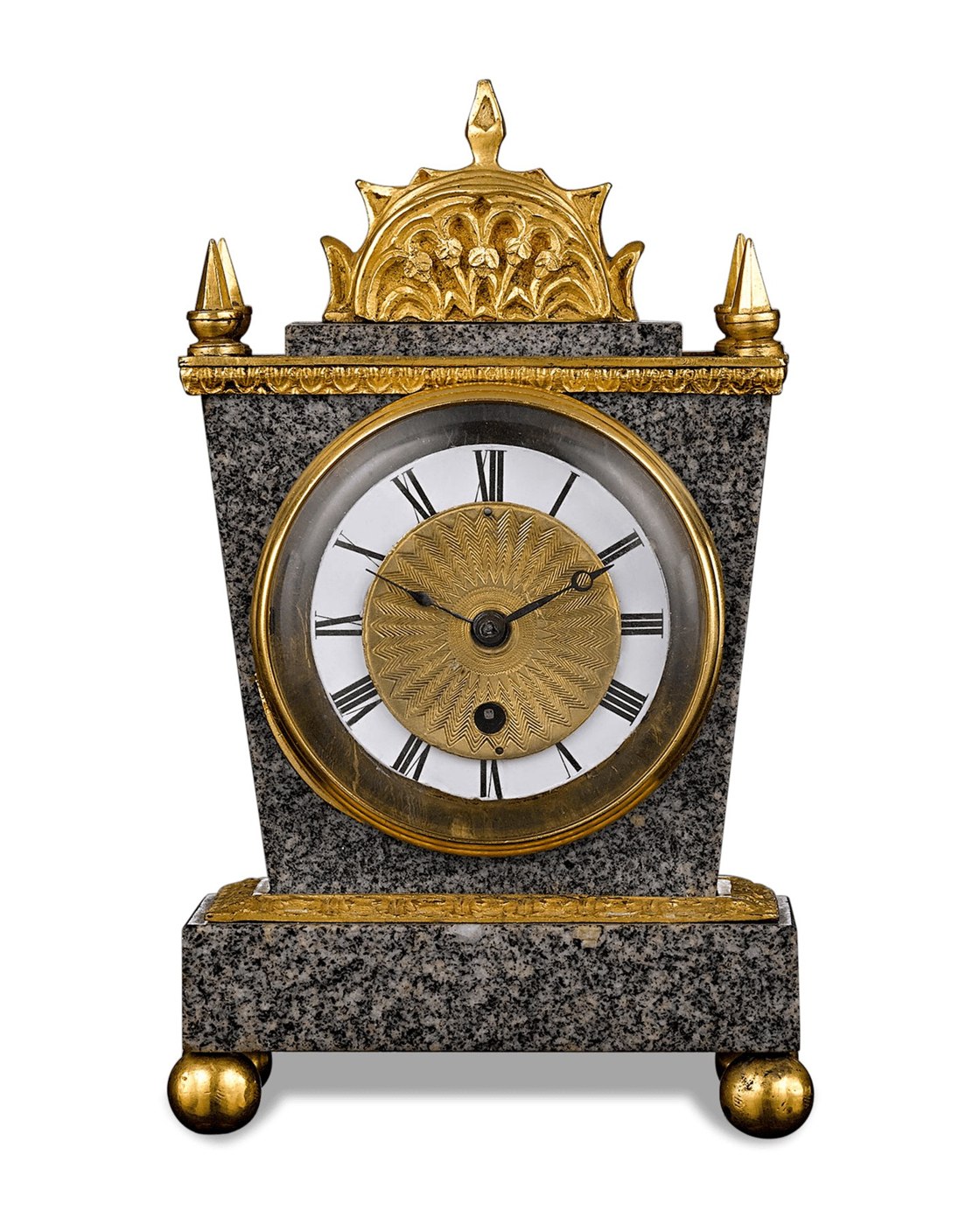
This table clock, attributed to the English clockmaker John Ellicott, is constructed from porphyry and doré bronze. Produced between 1760 and 1772, the piece dates to the period of collaboration between John Ellicott and his son, Edward Ellicott. The clock features a verge movement and stands 4.5 inches tall, 2.25 inches wide, and 1.5 inches deep. Its small, portable design incorporates gilded bronze elements atop the porphyry base and surrounding the dial and movement. The mechanism is signed "Ellicott / London". As a product of the mid-eighteenth century, the clock reflects the work of a maker known for his position as clockmaker to King George III.

Frontal view of the Ellicott table clock in porphyry and doré bronze.
Frontal view of the Ellicott table clock in porphyry and doré bronze. — M.S. Rau. Rights pending — permission not yet requested. Original source

Catalogue identity

Source
zamanito.com
Category
Clock · Table clock
Maker / attribution
John Ellicott
Reference
30-0710
Catalogue / lot identifier
Source URL identifies the listing
Source-reported date
circa 1760-1772
Source-reported place
England

Source-reported attribution and specifications are not independent authentication. A listing does not establish present ownership, current display, availability or permission to reproduce.

Object description

Design and Materials

The clock is housed in a case composed of porphyry stone accented with doré bronze mounts. The material combination is described in the source as a choice intended to convey a specific aesthetic presence. The structure features a flared body mounted on four spherical gilded feet, with additional gilded bronze decorative elements surrounding the dial and forming the top finial.

The dial includes a central circular disc with an engine-turned pattern, surrounded by a white chapter ring featuring Roman numerals. The dimensions are compact, measuring 11.43 centimeters in height, which distinguishes it as a miniature table clock within the context of eighteenth-century English production.

Evidence for this section
  • “بدنه این ساعت از ترکیب بسیار خاص و ارزشمند سنگ پورفیری (Porphyry) و برنز زراندود (doré bronze) تشکیل شده است.”

Movement and Signature

The timepiece is powered by a verge movement, a mechanical system identified by the source as a traditional technique used during the mid-eighteenth century. The movement is accessible and visible from the rear, housed within a circular frame set into the stone back of the clock.

The mechanism is signed with the inscription "Ellicott / London". According to the source, this signature confirms that the object originated during the twelve-year period in which John Ellicott collaborated with his son, Edward Ellicott. The technical execution of the movement is associated with the expertise attributed to John Ellicott, who served as the official clockmaker to King George III.

Evidence for this section
  • “این ساعت مجهز به یک موتور از نوع وِرژ (verge movement) است”
  • “مکانیزم این ساعت با عبارت «Ellicott / London» امضا شده است.”

Provenance and Historical Context

The clock is dated to the period between 1760 and 1772. The source identifies the maker as John Ellicott, a notable figure in English horology who held the appointment of clockmaker to King George III.

Collectors are advised to assess the condition of the stone and bronze elements as well as the authenticity of the signature on the mechanism. The source notes that such evaluations are necessary to verify the history and investment status of the object.

Evidence for this section
  • “این ساعت متعلق به بازه زمانی تقریبی ۱۷۶۰ تا ۱۷۷۲ میلادی است.”
  • “جان الیکات به عنوان یکی از نامدارترین اساتید صنعت ساعت‌سازی در قرن هجدهم میلادی شناخته می‌شود”

Open research questions

  • What is the specific nature of the stone identified as porphyry in this case?
  • Does the movement signature include any distinguishing hallmarks used by Edward Ellicott during the partnership?

Source evidence

Recorded claims and source quotations for English Porphyry Clock by Ellicott
FieldSource-reported valueSource quotation
MakerJohn Ellicott“جان الیکات (John Ellicott)”
Datecirca 1760-1772“۱۷۶۰ تا ۱۷۷۲ میلادی”
MaterialsPorphyry and doré bronze“سنگ پورفیری (Porphyry) و برنز زراندود (doré bronze)”
Movement TypeVerge movement“موتور از نوع وِرژ (verge movement)”
SignatureEllicott / London“«Ellicott / London»”
Dimensions4.5 in. x 2.25 in. x 1.5 in.“ارتفاع: 4.5 in. (11.43 cm) عرض: 2.25 in. (5.72 cm) عمق: 1.5 in. (3.81 cm)”

Visible details

  • Porphyry case with doré bronze mounts
  • Dial features a central engine-turned gilded disc
  • Movement visible through a circular aperture on the rear
  • Mounted on four small gilded ball feet

Research qualifications

  • Authentication of the signature as original to the piece is not independently verified
  • The operational status of the verge movement is not confirmed by the source

Photograph identity and source facts were screened before import; rights clearance remains pending.

Consulted source

ساعت انگلیسی سنگ پورفیری اثر Ellicott

Reviewed 2026-11-02 · Record 53ccde6779

Terms in this record

Glossary explanations for terms named in this object’s record.