
Skip to content
The Encyclopedia of Horology

Clock · Terrestrial globe clock

Empire Type World Clock

Partially verified

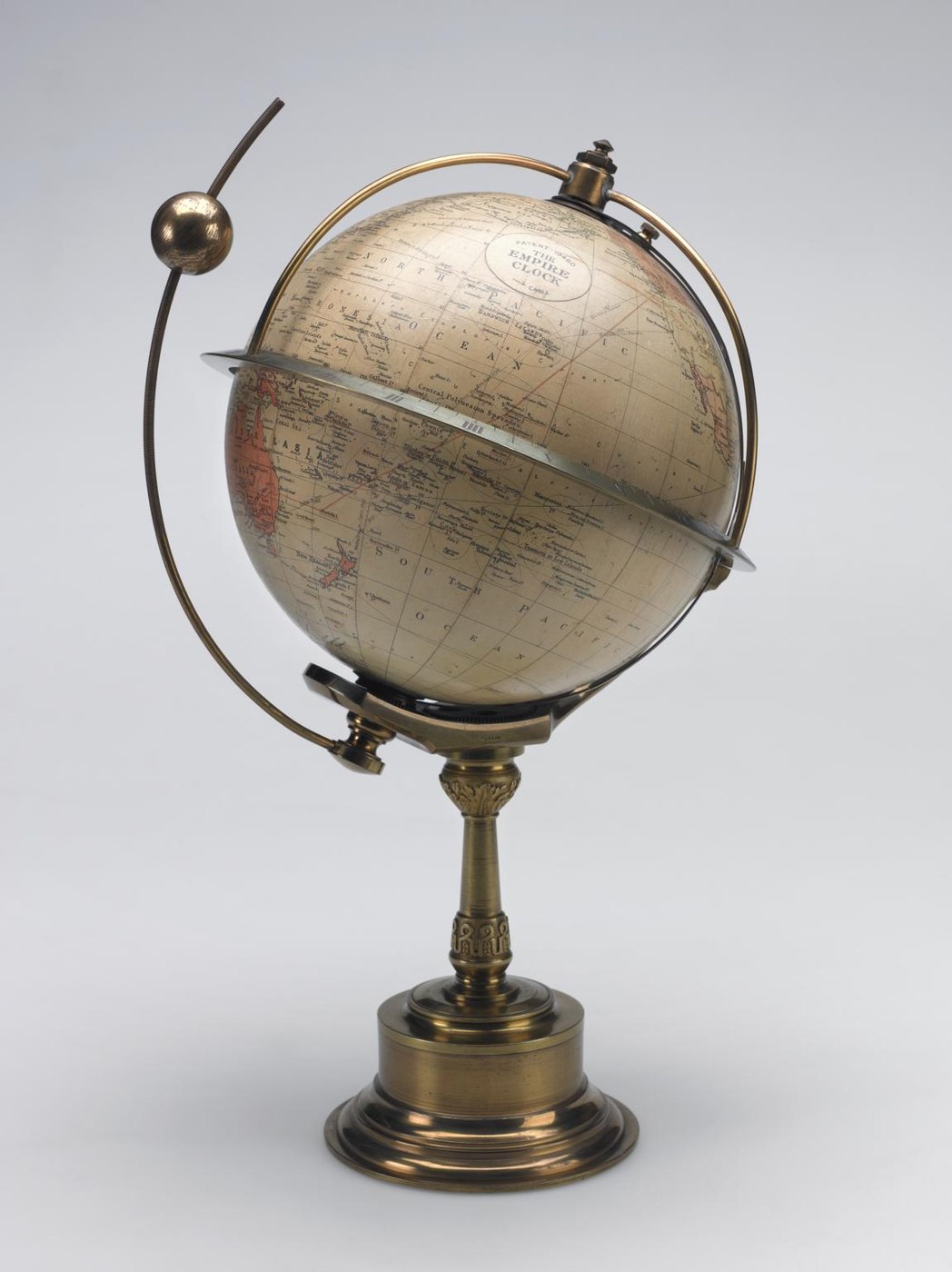
This 'Empire' type world clock is a terrestrial globe designed to indicate time across various longitudes. Produced in France and dated 1909, the mechanism is powered by an internal clockwork motor. The object is constructed to complete a full rotation from west to east once every 24 hours. The terrestrial globe features longitudinal markings that allow the user to determine the time at any specific location by following these lines. An additional brass ball accessory is included, which can be attached to the framework to serve as an indicator for the sun. The naming of this object as an 'Empire' clock originated from its capacity to display time across different countries within the British Empire. The total measurements of the object are 400 mm in height and 200 mm in diameter, with a recorded weight of 2.9 kg.

The Empire type world clock, showing the terrestrial globe, the equatorial ring, and the attached solar indicator arm.
The Empire type world clock, showing the terrestrial globe, the equatorial ring, and the attached solar indicator arm. — Science Museum Group. Rights pending — permission not yet requested. Original source

Catalogue identity

Source
collection.sciencemuseumgroup.org.uk
Category
Clock · Terrestrial globe clock
Maker / attribution
Etienne de Gounevitch; Armand Gustave Couaillett
Reference
Not recorded
Catalogue / lot identifier
1909-199
Source-reported date
1909
Source-reported place
France

Source-reported attribution and specifications are not independent authentication. A listing does not establish present ownership, current display, availability or permission to reproduce.

Object description

Design and Construction

The object is configured as a terrestrial globe measuring 200 mm in diameter and 400 mm in total height. The globe is mounted on a metallic pedestal base that supports the sphere and the associated horological framework. A horizontal metallic ring encircles the equator, facilitating the reading of time in conjunction with the rotating globe.

A separate curved brass arm holds a small brass sphere designed to represent the sun. This component is adjustable relative to the globe. The exterior of the globe surface includes cartographic details and text identifying the device as 'The Empire Clock' and referencing the 1909 patent.

Evidence for this section
  • “This clock is designed in the form of a globe”
  • “A brass ball can be attached to indicate the sun”
  • “overall: 400 mm x 200 mm diameter”

Horological Operation

The timekeeping function relies on an internal clockwork motor which drives the rotation of the terrestrial globe. The globe completes one full revolution every 24 hours, moving from west to east. This rotational motion allows for the tracking of time across various geographical longitudes.

Users determine the time at different locations by aligning the longitudinal lines on the globe surface. The device was intended to provide a visual representation of time differences throughout the British Empire, allowing for quick reference.

Evidence for this section
  • “driven by a clockwork motor to make a full rotation from west to east every 24 hours”
  • “By following longitudinal lines, it is possible to tell the time at any given point on the globe”
  • “It was called an Empire clock because it enabled the time in all the countries of the British Empire to be checked at a glance”

Patents and Provenance

The design is recorded as a patented invention by Etienne de Gounevitch and Armand Gustave Couaillett. The invention is associated with British patent number 23,449 issued in 1909. The object was acquired by the collection from J. MacMichael.

The records identify the origin as French and the date of manufacture as 1909, consistent with the year of the patent application. The object is catalogued under the accession number 1909-199.

Evidence for this section
  • “Patented by Etienne de Gounevitch and Armand Gustave Couailett (British patent No. 23, 449, 1909)”
  • “Credit: Purchased from J. MacMichael”
  • “French, 1909”

Open research questions

  • What is the specific mechanical escapement or drive mechanism utilized within the globe?
  • Are there surviving instructions for the calibration of the brass sun indicator?

Source evidence

Recorded claims and source quotations for Empire Type World Clock
FieldSource-reported valueSource quotation
Accession number1909-199“1909-199”
Country of originFrance“French, 1909”
PatenteesEtienne de Gounevitch and Armand Gustave Couailett“Patented by Etienne de Gounevitch and Armand Gustave Couailett”
Patent numberBritish patent No. 23, 449, 1909“British patent No. 23, 449, 1909”
Weight2.9 kg“2.9 kg”
FunctionGlobe clock with solar indicator“driven by a clockwork motor to make a full rotation from west to east every 24 hours”

Visible details

  • The globe features printed labels including 'PATENT 1909' and 'THE EMPIRE CLOCK'.
  • A curved brass arm supports a small spherical object representing the sun.
  • The base is circular and constructed of metallic material, supporting a central stem.
  • A horizontal metal ring surrounds the globe at the equator.

Research qualifications

  • The source lists 'Unknown maker' alongside specific names, creating ambiguity regarding the primary manufacturing entity.
  • The functionality of the internal clockwork motor is not confirmed as currently operational.

Photograph identity and source facts were screened before import; rights clearance remains pending.

Consulted source

Empire type world clock for indicating time around the globe

Reviewed 2026-10-26 · Record ed989c8cb1

Terms in this record

Glossary explanations for terms named in this object’s record.