
Skip to content
The Encyclopedia of Horology

Clock · Mantel clock

Empire Sienna Marble Mantel Clock

Partially verified

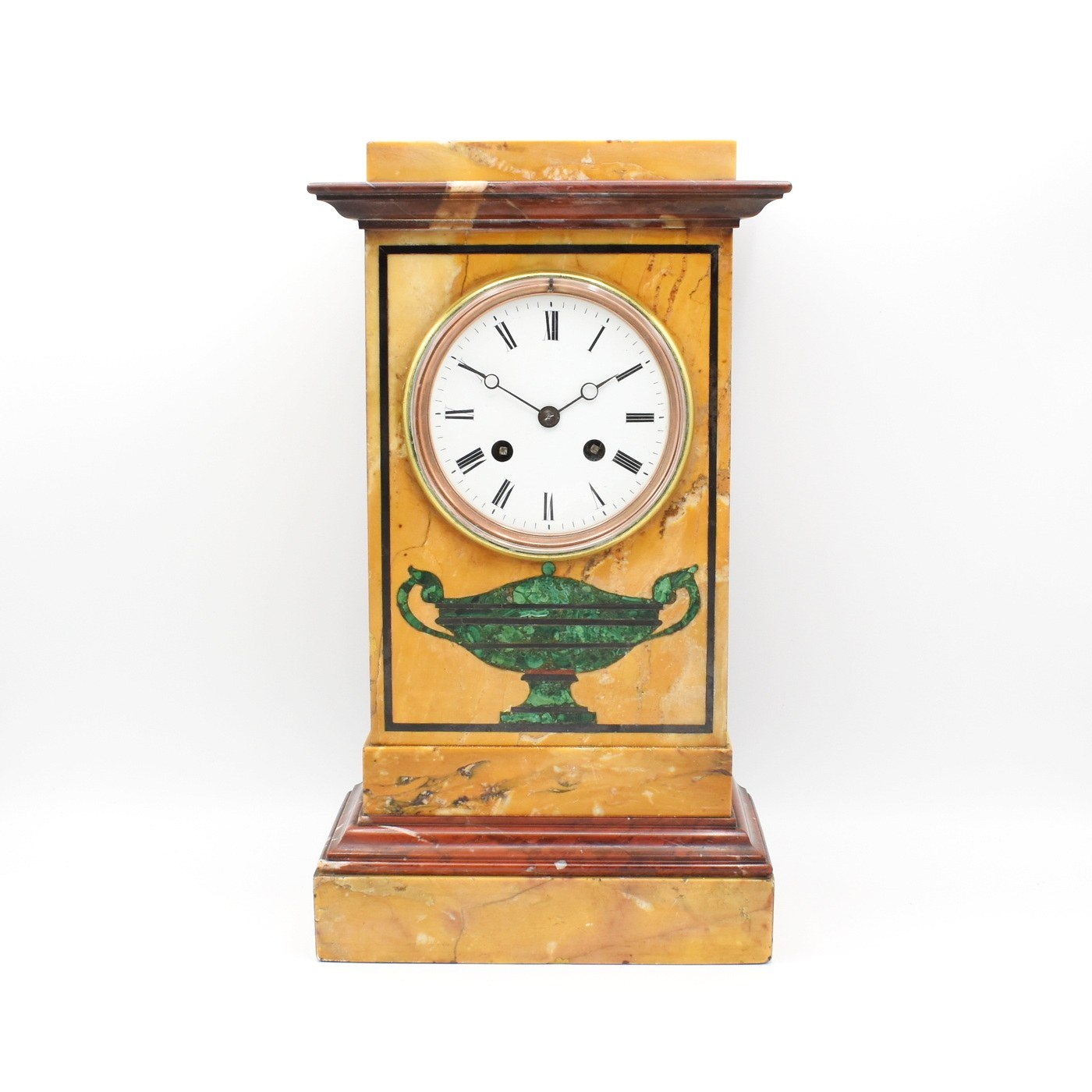
This mantle clock originates from France and is dated to circa 1870. The object is constructed primarily from Sienna marble, featuring a narrow vertical form designed for mantel placement. The front panel displays an inlay of a vase motif crafted from malachite, set within a dark grey marble frame. Additional sections of the casing are composed of red-toned Griotte marble. The clock features a circular dial of white vitreous enamel fitted with moon-style hands. Mechanically, the clock operates with an 8-day movement that strikes on a bell on the hour and half-hour, with a facility to silence the striking mechanism. The source notes that the movement is reported as undisturbed.

Front view of the French Sienna and Griotte marble mantel clock showing the malachite vase inlay and white enamel dial.
Front view of the French Sienna and Griotte marble mantel clock showing the malachite vase inlay and white enamel dial. — The Clock & Watch Shop. Rights pending — permission not yet requested. Original source

Catalogue identity

Source
zamanito.com
Category
Clock · Mantel clock
Maker / attribution
Not established
Reference
Not recorded
Catalogue / lot identifier
Source URL identifies the listing
Source-reported date
circa 1870
Source-reported place
France

Source-reported attribution and specifications are not independent authentication. A listing does not establish present ownership, current display, availability or permission to reproduce.

Object description

Case and Dial

The clock housing is constructed from Sienna marble, providing a yellow-toned base for the decorative elements. The front face is embellished with a central inlay of a vase, executed in green malachite and framed by dark grey marble borders. The lower section of the case and secondary accents are fashioned from reddish Griotte marble, a material noted for its coloration.

The dial is round, featuring white vitreous enamel. It is mounted with moon-style hands, which remain intact according to the source. The combination of varied decorative stone inlays and enamel dial surfaces is consistent with mid-to-late nineteenth-century French clock production for domestic display.

Evidence for this section
  • “ساختار اصلی آن از سنگ مرمر کمیاب سینا (Sienna marble) تراشیده شده است”
  • “تزیینات اینلی به شکل یک گلدان مرصع با سنگ مالاکیت”
  • “صفحه ساعت از نوع لعاب شیشه‌ای سفید (vitreous enamel) و به فرم گرد است”

Movement and Function

The timepiece is equipped with a mechanical movement designed for an 8-day duration. It features an integrated striking system that chimes a bell on both the hour and the half-hour. The movement architecture includes a user-operable silence mechanism, allowing for the suppression of the striking function as desired.

The source reports that the technical operation of the clock is functional, and the components within the movement are noted as being in an original or undisturbed state. The power reserve is specified at eight days, requiring manual winding to maintain consistent timekeeping.

Evidence for this section
  • “موتوری با کارکرد ۸ روزه است”
  • “قابلیت نواختن زنگ روی ناقوس در ساعت‌ها و نیم‌ساعت‌ها را دارد”
  • “در ساختار موتور امکانی تعبیه شده است که در صورت تمایل می‌توان نواختن زنگ را بی‌صدا کرد”

Historical Context

The object is identified as a French mantel clock dating to circa 1870. During this period, the use of ornamental marbles, such as the Sienna and Griotte varieties featured here, was prevalent in the creation of clocks intended for interior decoration.

The construction follows the Empire style, emphasizing the use of natural stone as a decorative medium. The selection of specific marbles for contrast and the use of kiln-fired enamel dials are documented as common practices in the production of these luxury timepieces during the nineteenth century in France.

Evidence for this section
  • “ساعت‌های رومیزی مرمرین سده نوزدهم فرانسه از شاخص‌ترین عناصر تزیینی در فضاهای داخلی اشرافی به شمار می‌رفتند”
  • “بهره‌گیری از ترکیب رنگی سنگ‌های زینتی طبیعی مانند مرمرهای منطقه‌ای و صفحات لعاب حرارت‌دیده امری رایج بوده است”

Open research questions

  • Can the maker be identified through examination of the movement plate marks?
  • What is the accurate scale of the clock given the erroneous dimensions provided in the source documentation?

Source evidence

Recorded claims and source quotations for Empire Sienna Marble Mantel Clock
FieldSource-reported valueSource quotation
Datecirca 1870“حدود ۱۸۷۰”
CountryFrance“ساعت رومیزی فرانسوی”
Movement8-day movement with strike“موتوری با کارکرد ۸ روزه است که قابلیت نواختن زنگ روی ناقوس در ساعت‌ها و نیم‌ساعت‌ها را دارد”
DialWhite vitreous enamel“صفحه ساعت از نوع لعاب شیشه‌ای سفید (vitreous enamel)”
StyleEmpire“متعلق به سبک امپراتوری بوده”

Visible details

  • Front inlay features a malachite vase motif
  • Casing incorporates Sienna and Griotte marbles
  • White vitreous enamel dial with Roman numerals
  • Moon-style hour and minute hands

Research qualifications

  • The source-provided dimensions of 34 x 11 x 19 mm are physically improbable for this clock type
  • Actual manufacturer and specific workshop of origin are unconfirmed

Photograph identity and source facts were screened before import; rights clearance remains pending.

Consulted source

Empire Sienna Marble Mantel Clock

Reviewed 2026-11-02 · Record e5b388a76d

Terms in this record

Glossary explanations for terms named in this object’s record.