
Skip to content
The Encyclopedia of Horology

Component · Watchcase replica

Electrotype reproduction of a watchcase

Partially verified

This object is a 19th-century electrotype reproduction of a 16th-century watchcase. Produced by Elkington & Co. and acquired by the Museum in 1888, the object was created using the electroforming process, which involved taking moulds from a type pattern of the original, which resides in the Louvre. As an electrotype, this object is an impression of the external surfaces of the watchcase rather than a functional horological device.

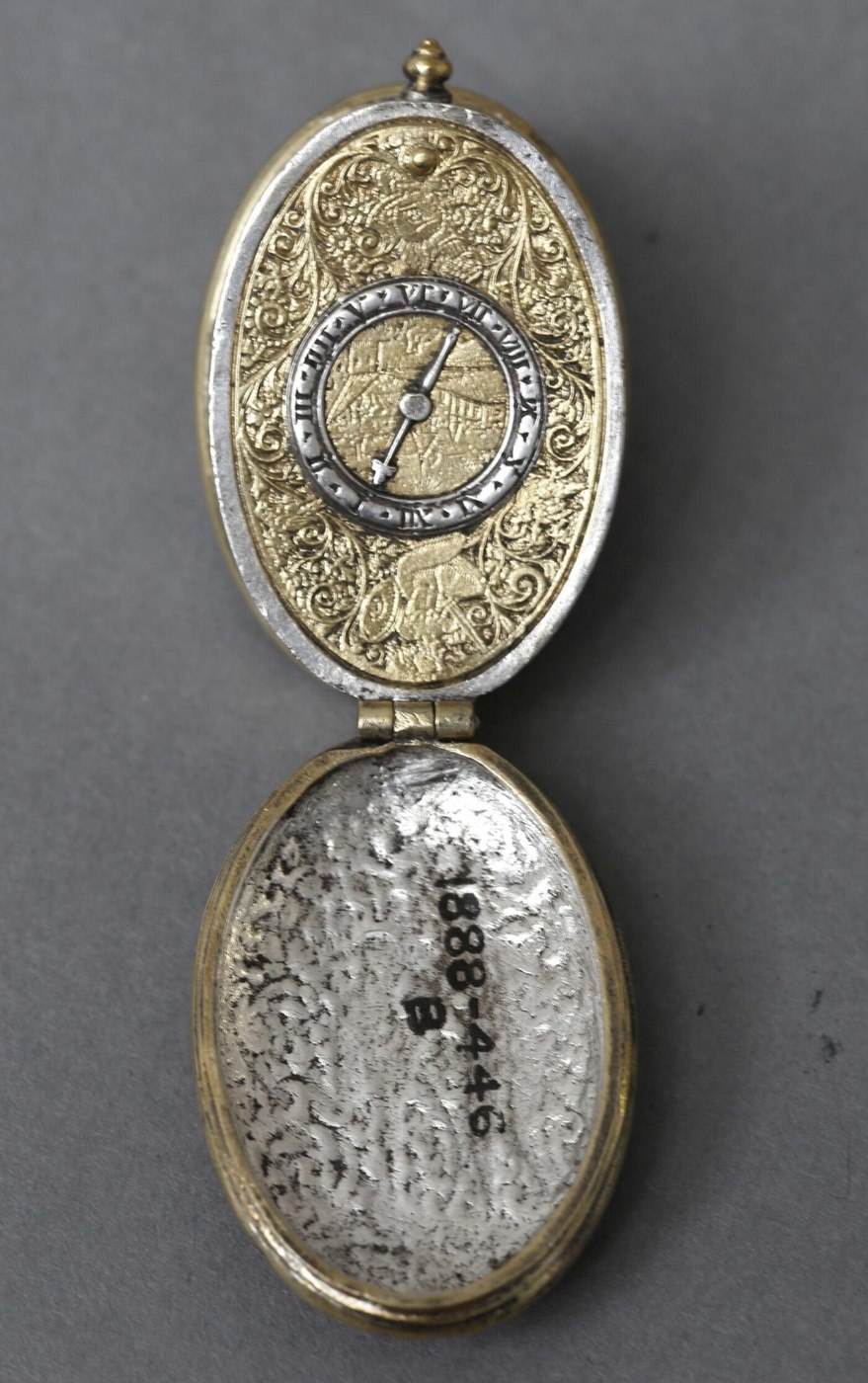
Detailed view of the interior dial plate and the electrotype casing
Detailed view of the interior dial plate and the electrotype casing — Victoria and Albert Museum. Rights pending — permission not yet requested. Original source

Catalogue identity

Source
collections.vam.ac.uk
Category
Component · Watchcase replica
Maker / attribution
Elkington & Co.
Reference
Not recorded
Catalogue / lot identifier
REPRO.1888A-446
Source-reported date
1888
Source-reported place
United Kingdom

Source-reported attribution and specifications are not independent authentication. A listing does not establish present ownership, current display, availability or permission to reproduce.

Object description

Manufacturing and Construction

This object is a 19th-century electrotype, produced by the firm Elkington & Co. through the process of electroforming. The creation of this replica involved taking moulds from a 'type pattern', which was itself an impression of a 16th-century watchcase currently held in the Louvre. The mould was lined with graphite or plumbago to ensure conductivity before being immersed in plating vats, where copper was deposited to replicate the fine details of the original design.

Following the electroforming phase, the copper shell was electroplated and electrogilded to emulate the appearance of the silver and gilt original.

Evidence for this section
  • “The original was in the Louvre.”
  • “The copper electrotype was then electroplated and electrogilded to look like the original.”
  • “In these, copper impressions were electroformed. These became 'type patterns'.”

Educational Purpose and Provenance

The watchcase was acquired by the Museum in 1888 as part of a larger initiative to educate artisans, designers, and the public. The replicas served a similar function to plaster casts, providing students with the opportunity to analyze historic ornament and design quality directly.

The collection of such reproductions was central to the Museum's early mission, aimed at improving the quality of British manufactured goods. The internal components, such as movement and escapement, are not present, as the piece was designed strictly as a non-functional educational model rather than a working watch.

Evidence for this section
  • “The Museum bought electrotypes as part of its growing collection of reproductions.”
  • “Electrotype copies were used as design aids for artists, artisans and students in the government schools of design”
  • “The aim of the Museum was to present a lesson in world ornament.”

Design and Ornamentation

The exterior of the watchcase features chased ornamentation, specifically depicting the scene of Adam and Eve in the Garden of Eden. The design reflects 16th-century aesthetic preferences in horological decoration, incorporating chased patterns across the exterior surfaces. The final product functions as a three-dimensional impression of the exterior surfaces.

Internally, the dial-plate shows detailed engraving and chasing. Although the piece is a non-functioning reproduction, it maintains the layout of a 16th-century timepiece, complete with a dial-plate that includes hour markers. The level of detail achieved by the electrotyping process is significant, as the technique was noted for its ability to copy even the finest lines of the original source material.

Evidence for this section
  • “engraved with Adam and Eve in the garden of Eden; and the Fall of Eve.”
  • “The dial-plate is engraved and chased with ornament.”
  • “the finest lines, the most minute dots are as faithfully copied as the boldest objections.”

Open research questions

  • What specific 16th-century model in the Louvre served as the primary for this reproduction?
  • Are there remaining archival records at Elkington & Co. confirming the quantity of this specific watchcase produced for sale to the public?

Source evidence

Recorded claims and source quotations for Electrotype reproduction of a watchcase
FieldSource-reported valueSource quotation
MakerElkington & Co.“Elkington & Co. (maker)”
Acquisition Date1888“bought by the Museum in 1888”
Method of manufactureElectrotype“Electrotype. From the C19th Register”
Original LocationLouvre“The orginal, of silver with gilt rims, in the Louvre”
Accession numberREPRO.1888A-446“REPRO.1888A-446”
Historical Context16th century“16th century”
DimensionsHeight: 5.1 cm; Width: 2.8 cm; Length: 7.4 cm; Depth: 2 cm“Height: 5.1 cm; Width: 2.8 cm; Length: 7.4 cm; Depth: 2 cm”

Visible details

  • Accession number 1888-446 marked on the inner lid
  • Gilt rims and silver-toned casing
  • Depiction of Adam and Eve on the exterior surface
  • Clock face layout with hour markers on the interior dial plate

Research qualifications

  • The internal mechanism is absent; the object is an empty case
  • The source notes the original is in the Louvre but provides no confirmation of its specific provenance

Photograph identity and source facts were screened before import; rights clearance remains pending.

Consulted source

Watch

Reviewed 2026-10-26 · Record 1cea7c181b

Terms in this record

Glossary explanations for terms named in this object’s record.