
Skip to content
The Encyclopedia of Horology

Clock · Mystery clock

Electric mystery clock by Smiths English Clocks

Partially verified

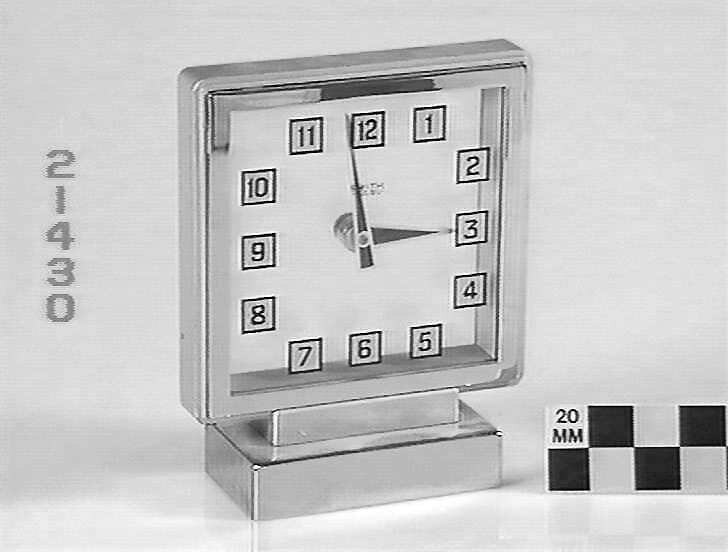
This electric mystery clock was produced by Smiths English Clocks Ltd, based in Cricklewood, England, circa 1938. The design consists of two squares of glass housed within a metal frame, which is mounted upon a rectangular metal base. The dial features numerals transferred into the inside surface of the front glass pane. The clock is powered by an electric synchronous movement contained within the base. To operate the hands, the motor oscillates an internal piece of glass that engages a ratchet mechanism, which subsequently turns the minute hand. The underside of the base contains manufacturer inscriptions regarding patent information and operating instructions, noting that the clock starts automatically when connected to an electrical current. This item was acquired by the museum through a loan and subsequent bequest from Mr. John Askew in September 1940.

Side view of the Smiths English Clocks mystery clock showing the metal base, glass frame, and numerals on the inner glass surface.
Side view of the Smiths English Clocks mystery clock showing the metal base, glass frame, and numerals on the inner glass surface. — Museums Victoria. Rights pending — permission not yet requested. Original source

Catalogue identity

Source
collections.museumsvictoria.com.au
Category
Clock · Mystery clock
Maker / attribution
Smiths English Clocks Ltd
Reference
Not recorded
Catalogue / lot identifier
ST 21430
Source-reported date
circa 1938
Source-reported place
England

Source-reported attribution and specifications are not independent authentication. A listing does not establish present ownership, current display, availability or permission to reproduce.

Object description

Case and Dial Construction

The mystery clock utilizes a minimalist construction style comprising two primary squares of glass held within a simple metal frame. This housing is supported by a solid rectangular metal base that conceals the electrical components necessary for the timepiece to function.

The dial layout deviates from conventional designs by displaying individual numerals within squares. These numerals are transferred onto the internal surface of the front glass pane, creating an impression of suspension for the hands.

Evidence for this section
  • “Mystery clock, comprising two squares of glass in a metal frame on a rectangular metal base.”
  • “Dial numerals are in squares transferred into the inside of the front sheet of glass.”

Movement and Operation

The clock operates using an electric synchronous movement integrated into the base. This motor provides the necessary power to oscillate an internal piece of glass.

The oscillation of the internal glass serves a specific mechanical purpose: it operates a ratchet system that effectively advances the minute hand. The base also features instructional text regarding the automatic starting sequence upon connection to a power current.

Evidence for this section
  • “Synchronous motor in base oscillates an internal piece of glass which operates ratchet that turns minute hand.”
  • “Clock starts automatically with current”

Provenance and Documentation

The clock is associated with the manufacturer Smiths English Clocks Ltd, based in Cricklewood, England. The object carries registration number ST 21430 and is documented with several patent references inscribed on the base.

The object entered the museum collection following a loan and subsequent bequest from Mr. John Askew, which was finalized on September 9, 1940.

Evidence for this section
  • “Registration number: ST 21430”
  • “Loan & Subsequent Bequest from Mr John Askew, 09 Sep 1940”
  • “Underside of base is marked 'Made under one or more Eng. Pats. 374713, 366710, 11058/34'”

Open research questions

  • How does the internal glass oscillation specifically trigger the ratchet for the minute hand?
  • Which specific English patents 374713, 366710, or 11058/34 relate to the mystery clock mystery motion?

Source evidence

Recorded claims and source quotations for Electric mystery clock by Smiths English Clocks
FieldSource-reported valueSource quotation
MakerSmiths English Clocks Ltd“Manufacturer, name: Smiths English Clocks Ltd”
Datecirca 1938“circa 1938”
Registration NumberST 21430“Registration number: ST 21430”
MechanismElectric synchronous movement“Electric synchronous movement.”
Patent InformationMade under English patents 374713, 366710, 11058/34“Underside of base is marked 'Made under one or more Eng. Pats. 374713, 366710, 11058/34'”
Dimensions16 cm x 7 cm x 20 cm“16 cm (Length), 7 cm (Width), 20 cm (Height)”
ProvenanceAcquired via Mr John Askew“Loan & Subsequent Bequest from Mr John Askew, 09 Sep 1940”

Visible details

  • Rectangular metal base supports a square glass-cased clock head
  • Numerals 1 through 12 displayed in individual squares on glass
  • Central hand assembly appears to hold hour and minute hands
  • Overall dimensions are 16 cm length, 7 cm width, and 20 cm height

Research qualifications

  • Specific patent model identification beyond the listed numbers
  • Functional status or electrical safety as of current date

Photograph identity and source facts were screened before import; rights clearance remains pending.

Consulted source

Electric Clock - Smiths English Clocks, circa 1938

Reviewed 2026-10-26 · Record dd97f644fa

Terms in this record

Glossary explanations for terms named in this object’s record.