
Skip to content
The Encyclopedia of Horology

Clock · Cartel clock

Édouard Jeanneret Neuchâteloise Cartel Clock

Partially verified

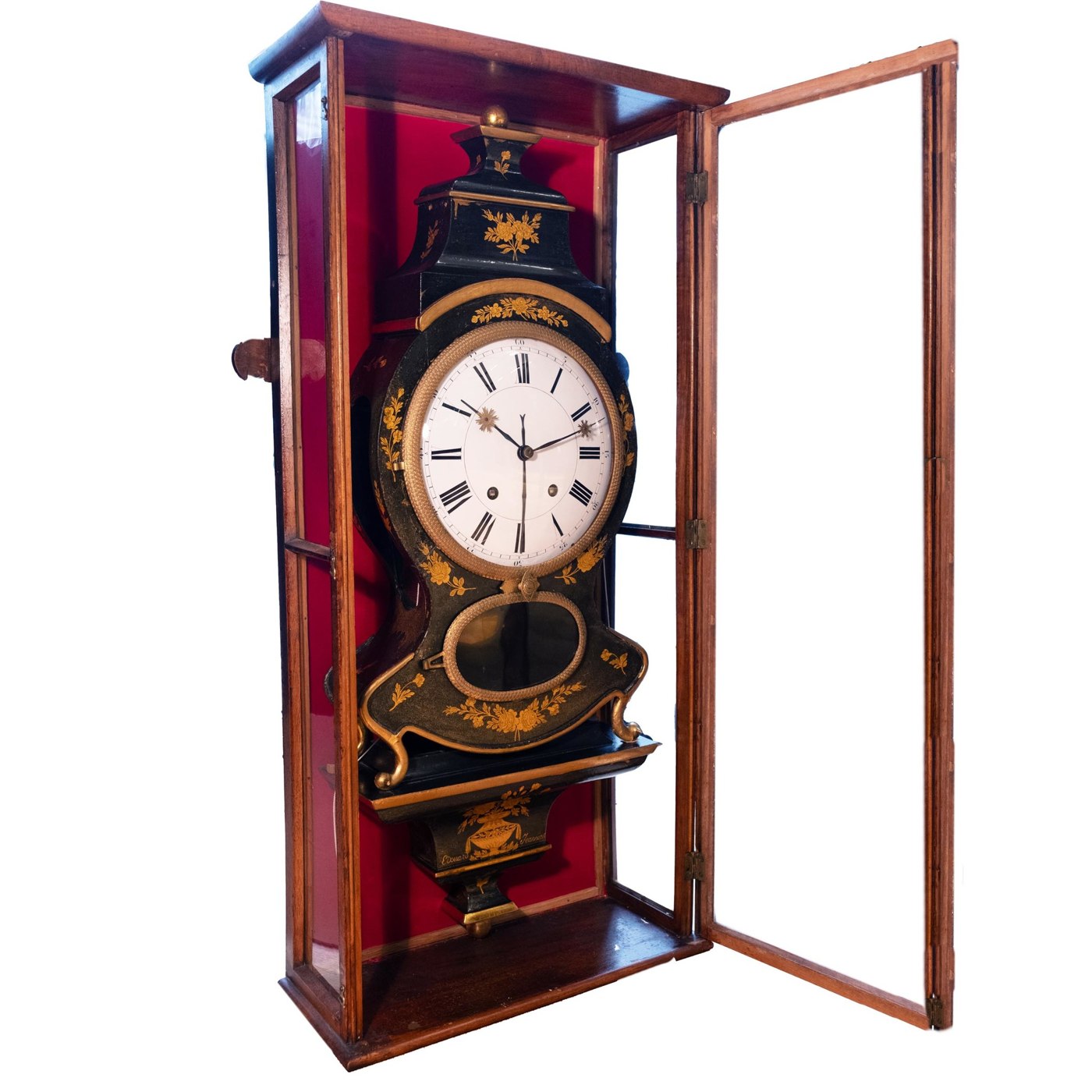
This cartel clock is a Neuchâteloise model attributed to maker Édouard Jeanneret, dating from circa 1840. The clock features a wood case finished in black lacquer and decorated with painted floral motifs. Its design includes a rounded gilt top, glazed curved side panels, and a molded bracket base displaying a painted flower vase. A glazed oval opening in the lower front allows for a view of the pendulum action. The movement provides an eight-day power reserve and incorporates a grande et petite sonnerie striking mechanism with an integrated alarm function. The white enamel dial features Roman numerals for the hours and an outer track for minutes. Time is indicated by blued steel hands finished with floral-shaped tips set with diamond pastes.

Édouard Jeanneret Neuchâteloise cartel clock housed in its original glazed lanterne display case.
Édouard Jeanneret Neuchâteloise cartel clock housed in its original glazed lanterne display case. — Antiquorum. Rights pending — permission not yet requested. Original source

Catalogue identity

Source
catalog.antiquorum.swiss
Category
Clock · Cartel clock
Maker / attribution
Édouard Jeanneret
Reference
Not recorded
Catalogue / lot identifier
287
Source-reported date
Circa 1840
Source-reported place
Switzerland

Source-reported attribution and specifications are not independent authentication. A listing does not establish present ownership, current display, availability or permission to reproduce.

Object description

Case and Exterior Design

The clock is encased in a wood structure finished with black lacquer and adorned with painted floral decorations. It features a rounded gilt top and curved glazed side panels that provide visibility into the movement housing. The case architecture includes curved feet and a hinged back door for mechanical access. A central glazed oval opening in the front section provides a visual reference for the pendulum motion, framed by a hinged brass bezel.

The clock is supported by a molded wall bracket that echoes the decorative program, featuring a painted flower vase. A detachable molded top piece, also finished in black and gold, is topped by a walnut-shaped gilt finial. The entire clock is housed within its original display case, referred to as a 'lanterne', which includes glass panels and a full-height hinged access door.

Evidence for this section
  • “Lacquered in black, painted with flowers, rounded gilt top, glazed curved sides”
  • “front with glazed oval brass framed opening for viewing the action of the pendulum”
  • “molded bracket painted with a flower vase”
  • “Original Lanterne (Showcase of Neuchâtel clocks)”

Dial and Timekeeping

The timepiece features a white enamel dial with Roman numeral hour markers. The perimeter of the dial includes outer minute divisions. Winding points for the eight-day movement are located at the 5 and 7 o'clock positions. The hands are manufactured from blued steel, with the tips featuring gilt floral elements embedded with diamond pastes, according to the auction description.

The internal mechanism provides an eight-day going duration. It includes a grande et petite sonnerie striking train and an integrated alarm function. The auction description notes that the movement is in 'Good' condition but recommends a professional overhaul for future operation.

Evidence for this section
  • “White enamel dial, radial Roman numerals, outer minute divisions, winding apertures at 5 and 7 o'clock”
  • “Blued steel hands with gilt flower tips set with diamond pastes”
  • “EIGHT DAY GOING GRANDE ET PETITE SONNERIE STRIKING WITH ALARM”
  • “Movement: 3* Good Overhaul recommended”

Condition and Attribution

The auction description attributes the clock to Édouard Jeanneret, dating it to circa 1840. The object is graded as 'AA' or 'Very good' overall. Specific condition reports indicate the case displays slight oxidation and minor scratching, consistent with age.

The dial is described as being in good condition. The hands are identified as original to the piece.

Evidence for this section
  • “Brand Édouard Jeanneret”
  • “Year Circa 1840”
  • “Case: 3-6-8 Good Slightly oxidized Slightly scratched”
  • “HANDS Original”

Open research questions

  • What is the specific mechanical arrangement of the grande et petite sonnerie train in this Jeanneret model?
  • Are there known archival records matching this serial number or specific floral painting style to Édouard Jeanneret's workshop?

Source evidence

Recorded claims and source quotations for Édouard Jeanneret Neuchâteloise Cartel Clock
FieldSource-reported valueSource quotation
MakerÉdouard Jeanneret“ÉDOUARD JEANNERET”
DateCirca 1840“Circa 1840”
Striking MechanismGrande et petite sonnerie“GRANDE ET PETITE SONNERIE STRIKING”
Dial FeaturesEnamel with Roman numerals“White enamel dial, radial Roman numerals”
HandsBlued steel with pastes“Blued steel hands with gilt flower tips set with diamond pastes”
Case FinishBlack lacquer with painting“Lacquered in black, painted with flowers”
Dimensions900 mm height“Height 900”

Visible details

  • Black lacquered case with painted gold-toned floral ornamentation
  • Pendulum viewing aperture framed in brass
  • Matching molded wall bracket with vase motif
  • Hands decorated with floral motifs and paste stones

Research qualifications

  • Movement requires an overhaul as reported by the auction description
  • Case exhibits slight oxidation and scratching

Photograph identity and source facts were screened before import; rights clearance remains pending.

Terms in this record

Glossary explanations for terms named in this object’s record.