
Skip to content
The Encyclopedia of Horology

Clock · 1-second pendulum clock

Ecole de Cluses Motor Rewound Pendulum Clock

Partially verified

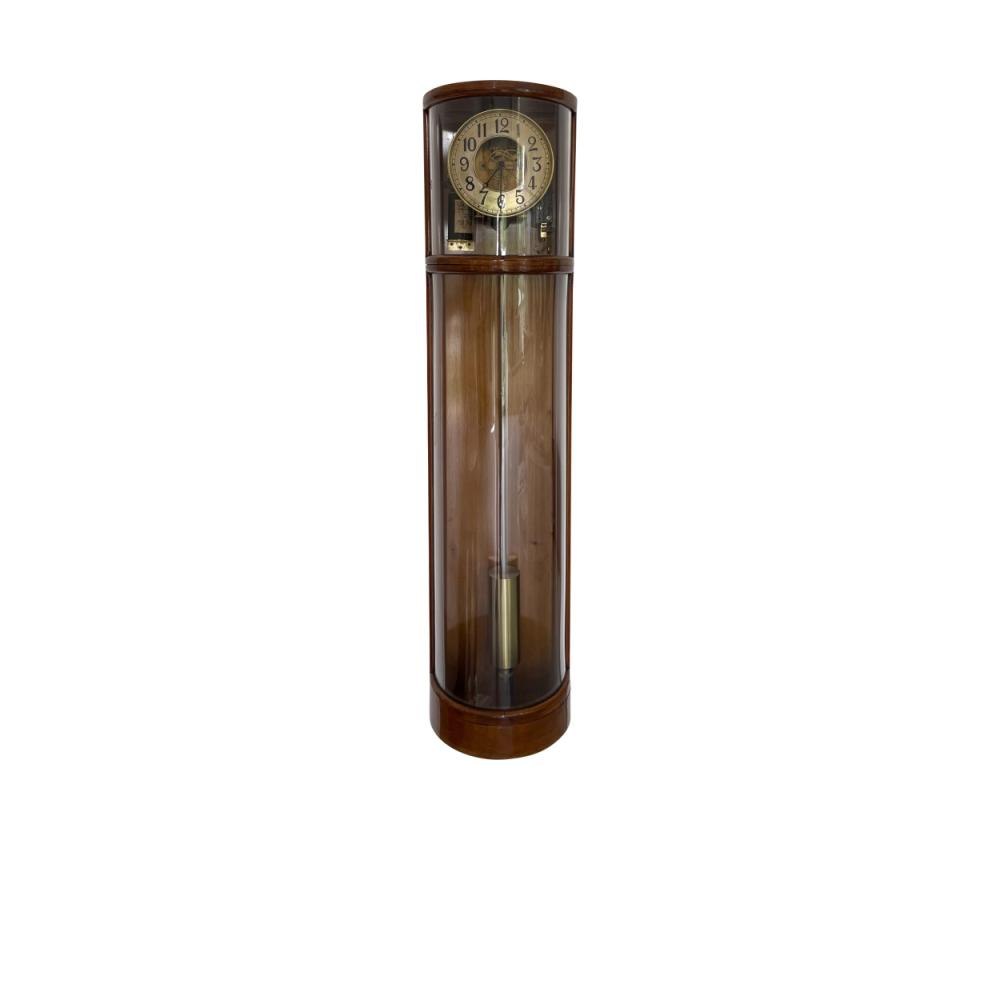
This one-second pendulum clock was produced at the Ecole Nationale d'Horlogerie in Cluses, Haute-Savoie, France, estimated to date to circa 1925. The piece is classified as an apprentice work, as the school did not manufacture clocks for commercial sale. It features a mahogany case with a curved front glass panel. The silvered dial includes applied Arabic numerals and a skeletonized center, paired with blued hands. The movement is constructed with a solid trapezoid brass frame and incorporates an electrical winding system featuring a magnet coil. The mechanical timekeeping is regulated by a steel pendulum with a cylindrical bob. The winding mechanism utilizes an electric motor of the type described as O'Keenan. The development of these electrical clocks at the school occurred under the influence of director Charles Poncet, who integrated electrical technology into the curriculum between 1905 and 1934.

Full view of the motor-rewound pendulum clock showing the mahogany case, curved glass, and the internal brass movement.
Full view of the motor-rewound pendulum clock showing the mahogany case, curved glass, and the internal brass movement. — Auktionen Dr. Crott (via Invaluable). Rights pending — permission not yet requested. Original source

Catalogue identity

Source
www.invaluable.com
Category
Clock · 1-second pendulum clock
Maker / attribution
Ecole Nationale d'Horlogerie Cluses
Reference
Not recorded
Catalogue / lot identifier
70
Source-reported date
circa 1925
Source-reported place
France

Source-reported attribution and specifications are not independent authentication. A listing does not establish present ownership, current display, availability or permission to reproduce.

Object description

Case and Dial Construction

The clock is housed in a mahogany case featuring a prominent curved front glass. The aesthetic design incorporates a silvered dial mounted within the upper section of the case, behind the glazed aperture. This dial is configured with applied Arabic numerals and a skeletonized central area that allows visibility of the underlying movement components. The time is indicated by blued steel hands.

The case dimensions are 1350 mm in height, 320 mm in width, and 250 mm in depth.

Evidence for this section
  • “Case: Mahogani, curved front glass.”
  • “Silver dial with applied Arabic numerals, skeletonised centre, blued hands.”
  • “Dimensions 1350 x 320 x 250 mm”

Movement and Electrical System

The internal mechanism is built upon a solid trapezoid brass frame. The clock operates as a mechanical 1-second pendulum system which is energized through an electric winding apparatus. This motor is identified as being of the "OK" type, sharing features found in O’Keenan clocks. The regulation of the clock is managed by a steel pendulum rod terminating in a cylindrical bob.

The integration of electrical systems into the clockwork was a core component of the curriculum established by Charles Poncet. The movement includes a magnet coil to facilitate the electric winding function, reflecting the school's instructional emphasis on electro-mechanical horology.

Evidence for this section
  • “Solid solid trapezoid brass movement, magnet coil, electrical winding system, steel pendulum with cylindrical bob.”
  • “mechanical clock rewound by an electric motor of the "OK" type found in O’Keenan clocks.”

Provenance and Historical Context

This clock originates from the Ecole Nationale d'Horlogerie in Cluses, France. It is categorized as an apprentice piece, consistent with the school's policy of not producing clocks for commercial trade. Known examples of these motor-rewound clocks were produced by students or faculty during the period between 1924 and 1944.

The auction description reports that the movement is in very good condition and remains capable of running, although professional cleaning is suggested to maintain performance. The dial shows slight oxidation, consistent with its age.

Evidence for this section
  • “made at the Ecole Nationale d'Horlogerie Cluses Haute-Savoie”
  • “the Ecole de Cluses clocks are all "apprentice pieces" made by the students or made by staff.”
  • “Movm.: very good, capable of running, cleaning recommended.”

Open research questions

  • Does the lack of a specific name plaque on the dial indicate a student project rather than a staff-created piece?
  • How does the specific wiring of the O'Keenan motor on this example differ from standard industrial versions of the same motor?

Source evidence

Recorded claims and source quotations for Ecole de Cluses Motor Rewound Pendulum Clock
FieldSource-reported valueSource quotation
Dimensions1350 x 320 x 250 mm“1350 x 320 x 250 mm”
Case MaterialMahogany“Case: Mahogani”
Winding SystemElectric motor“a mechanical clock rewound by an electric motor of the "OK" type found in O’Keenan clocks”
Dial FeaturesSilvered with Arabic numerals“Silver dial with applied Arabic numerals, skeletonised centre, blued hands”
School OriginEcole Nationale d'Horlogerie Cluses“made at the Ecole Nationale d'Horlogerie Cluses Haute-Savoie”
ClassificationApprentice piece“the Ecole de Cluses clocks are all "apprentice pieces" made by the students or made by staff”
Condition ReportVery good“Case: very good. Dial: very good, slightly oxydized. Movm.: very good”

Visible details

  • Mahogany case with curved glass door
  • Silvered dial with skeletonized center
  • Solid trapezoid brass movement plates
  • Cylindrical steel pendulum bob

Research qualifications

  • Exact date of manufacture within the 1924-1944 period is unverified
  • Specific identity of the student or staff member who made the piece is unrecorded

Photograph identity and source facts were screened before import; rights clearance remains pending.

Consulted source

Ecole de Cluses - Ecole Nationale d'Horlogerie

Reviewed 2026-10-26 · Record 11cbe7c3ff

Terms in this record

Glossary explanations for terms named in this object’s record.