
Skip to content
The Encyclopedia of Horology

Component · Enamel pocket watch dial

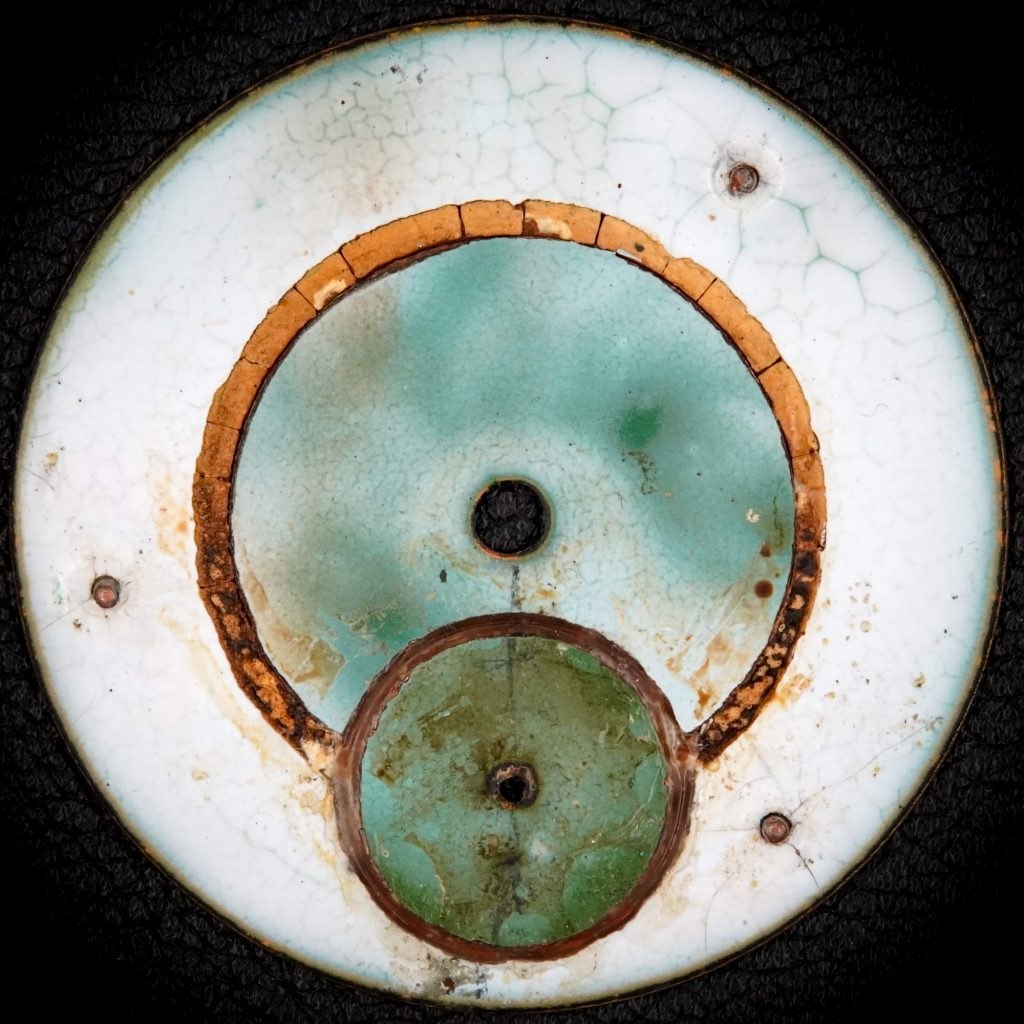
Early Double-Sunk “Elgin Nat’l Watch Co.” Dial, c.1874 (Back View)

Partially verified

This component is the reverse side of an early double-sunk enamel pocket watch dial dating to circa 1874, attributed to the Elgin National Watch Company. According to horological historian Nathan Moore, following the firm's reorganization from the National Watch Company in October 1874, surplus inventory dials were modified to bear the new name. The factory cut out the original center sunk insert to a slightly smaller diameter and installed a replacement marked 'Elgin Nat’l Watch Co.', creating a characteristic circular seam crack over time. The reverse displays charred regions, which the author notes may indicate that the dial was rebaked after the replacement disc was inserted.

Reverse of an early double-sunk Elgin enamel dial showing construction seams, counter-enamel, and charred areas
Reverse of an early double-sunk Elgin enamel dial showing construction seams, counter-enamel, and charred areas — Nathan Moore / Pocket Watch Database. Rights pending — permission not yet requested. Original source

Catalogue identity

Source
blog.pocketwatchdatabase.com
Category
Component · Enamel pocket watch dial
Maker / attribution
Elgin National Watch Company
Reference
Not recorded
Catalogue / lot identifier
Source URL identifies the listing
Source-reported date
c. 1874
Country
United States

Source-reported attribution and specifications are not independent authentication. A listing does not establish present ownership, current display, availability or permission to reproduce.

Object description

Object Identity and Corporate Context

This object is the reverse side of an early double-sunk enamel pocket watch dial, dated to circa 1874 and identified in the source as an Elgin National Watch Company component. It illustrates a factory modification tied to a specific organizational change. In October 1874, leadership at the National Watch Company reorganized the firm as the Elgin National Watch Company to capitalize on the Elgin name.

According to Nathan Moore's study, dials remaining in inventory from before the reorganization were altered rather than discarded. To avoid wasting stock, the factory modified double-sunk dials to bear the new name "Elgin Nat’l Watch Co.", which later resulted in a characteristic circular crack around the center sink on surviving examples.

Evidence for this section
  • “Pictured: Back of Early Double-Sunk “Elgin Nat’l Watch Co.” Dial, c.1874”
  • “In October 1874, the leadership at the National Watch Company agreed to reorganize under the name “Elgin National Watch Company,” strategically leveraging the strong reputation gained by the “Elgin” name.”
  • “The most likely explanation for the cracked dials is that when the company reorganized under the name “Elgin National Watch Company,” double-sunk dials remaining in inventory were modified to reflect the new name.”

Observed Construction and Modification Traces

Visual examination of the reverse shows three copper dial feet positioned near the outer perimeter, a greenish-blue counter-enamel ground, an arbor hole, and an overlapping circular sub-seconds inset bordered by a copper rim. A concentric segmented brownish-copper border marks the seam where the center sunk blank was inserted.

The source explains that the factory removed the original center sink by cutting out a slightly smaller diameter, then installed a replacement enamel blank marked "Elgin Nat’l Watch Co." Darkened charred regions and crazing across the counter-enamel are interpreted by the author as potential evidence that the dial was rebaked after the replacement center was fitted.

Evidence for this section
  • “Reverse face of a circular enamel pocket watch dial showing three copper dial feet near the outer margin.”
  • “Concentric segmented brownish-copper border defining the seam where the center sunk blank was installed.”
  • “The center sink was removed, using a similar method as used when provisioning the original sunk layer , only cutting a slightly smaller diameter. This area was then replaced with another enamel blank and marked “Elgin Nat’l Watch Co.””
  • “Note the charred portions that may indicate the dial was baked again after the original center sunk portion was installed.”

Analytical Limits and Evidence Constraints

The provided documentation for this record depicts only the reverse face of the dial; the front enamel surface and any associated watch movement or case are not included in this entry. Although the source notes that the diameter of the replacement center piece on the back corresponds to the circular crack on the front of such dials, the specific movement caliber, size, and serial number for this individual dial are not recorded in the source text.

Additionally, the rebaking of the dial is explicitly presented by the source author as an explanatory hypothesis based on physical charred areas, rather than a proven factory procedure documented in surviving company archives.

Evidence for this section
  • “Measurements taken on the back of one of the circular-cracked dials supports this theory.”
  • “The diameter of the center enamel piece is exactly the same diameter as the cracked center on the front of the dial, indicating the small outer portion remained from a previous installation.”
  • “Note the charred portions that may indicate the dial was baked again after the original center sunk portion was installed.”

Open research questions

  • What movement size (e.g., 18-size) does the dial-foot spacing and arbor layout correspond to?
  • Does this specific back view belong to the same dial shown from the front in the accompanying blog article, or is it an unassociated specimen?
  • Can chemical analysis determine whether the charred areas result from kiln refiring during center-sink modification or from later heat-related repair?

Source evidence

Recorded claims and source quotations for Early Double-Sunk “Elgin Nat’l Watch Co.” Dial, c.1874 (Back View)
FieldSource-reported valueSource quotation
Item DescriptionBack of Early Double-Sunk “Elgin Nat’l Watch Co.” Dial, c.1874“Pictured: Back of Early Double-Sunk “Elgin Nat’l Watch Co.” Dial, c.1874”
Corporate ReorganizationReorganization under Elgin National Watch Company in October 1874 prompted modifications“In October 1874, the leadership at the National Watch Company agreed to reorganize under the name “Elgin National Watch Company,” strategically leveraging the strong reputation gained by the “Elgin” name.”
Baking EvidenceCharred portions suggest rebaking after modification“Note the charred portions that may indicate the dial was baked again after the original center sunk portion was installed.”
Original Sunk Dial Crack AbsenceEarly double-sunk dials marked 'National Watch Co.' do not show the distinctive circular crack“A study of early double-sunk dials marked “National Watch Co.” fails to reveal any specimens with the distinctive circular crack .”
Front Flaw PrevalenceWatches sold around 1874 with 'Elgin Nat’l Watch Co.' double-sunk dials almost always display the circular seam crack“However, watches likely sold around 1874 fitted with a double-sunk dial marked “Elgin Nat’l Watch Co.” almost always exhibit the flaw .”

Visible details

  • Reverse face of a circular enamel pocket watch dial showing three copper dial feet near the outer margin.
  • Central counter-enamel field with greenish-blue coloration and a central arbor hole.
  • Overlapping circular sub-seconds inset bordered by a copper rim.
  • Concentric segmented brownish-copper border defining the seam where the center sunk blank was installed.
  • Charred, darkened patches and crazing visible across the reverse counter-enamel surface.

Research qualifications

  • Depicts only the reverse of the dial; the front face is not shown in this photograph.
  • The rebaking of the dial is presented as an explanatory hypothesis by the source author based on physical charred areas.

Photograph identity and source facts were screened before import; rights clearance remains pending.

Terms in this record

Glossary explanations for terms named in this object’s record.