
Skip to content
The Encyclopedia of Horology

Component · Astrolabe rete

Early 10th-century astrolabe rete

Partially verified

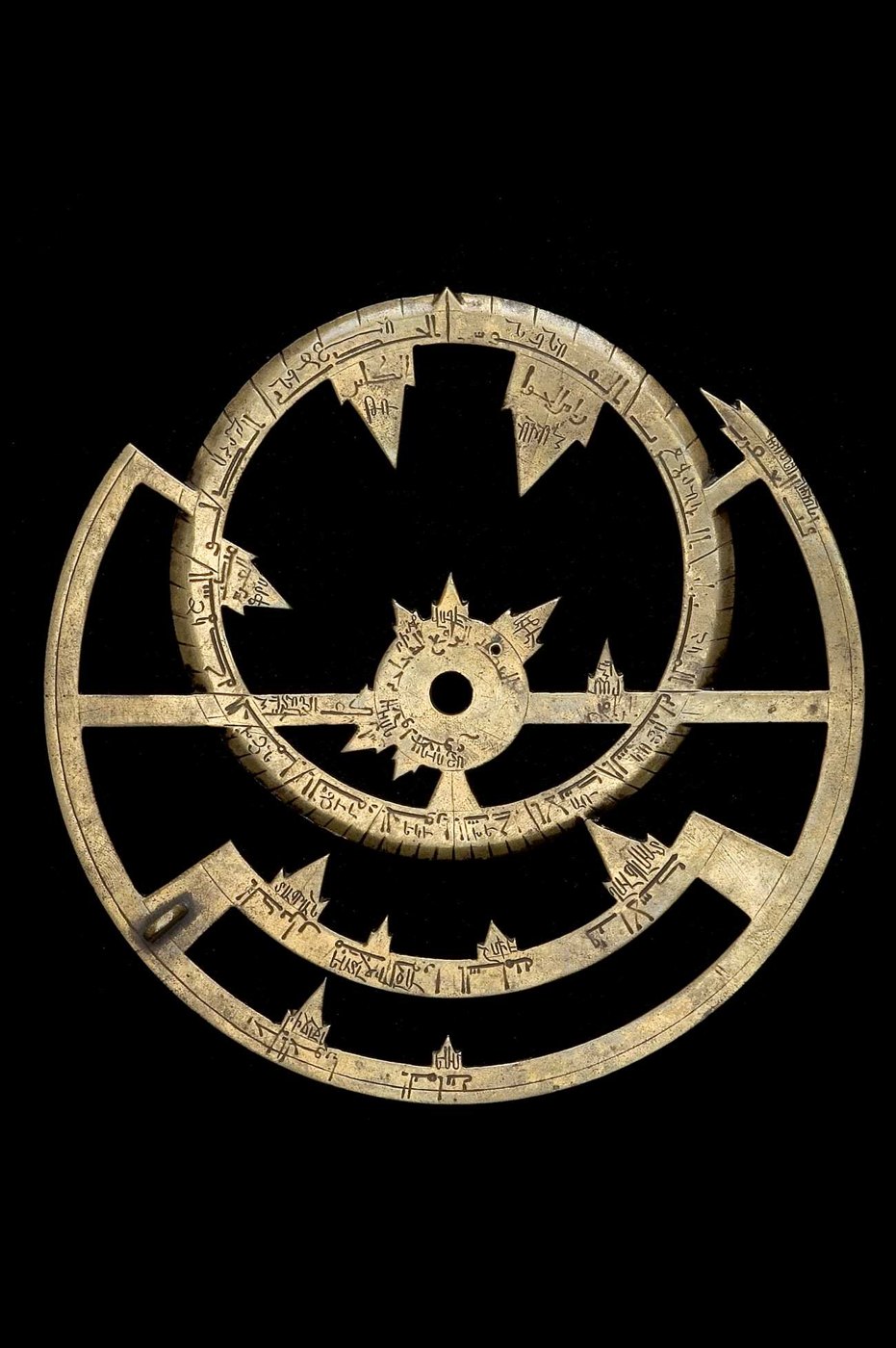
This object is a standalone astrolabe rete, the rotating star map component of an astrolabe, dating from the early 10th century and attributed to Syria. It survives without the remainder of the original instrument. The rete is of the indicator-line simple type and features a single tab for rotation. It includes seventeen star pointers, all designed in a dagger shape. The zodiacal signs and star names are inscribed in an early Kufic script. The piece was presented to the History of Science Museum, Oxford, by J. A. Billmeir in 1957. It shares design similarities with another rete in the collection, inventory number 47632.

The rete component showing the arrangement of star pointers and zodiacal inscriptions in Kufic script with secondary Armenian annotations.
The rete component showing the arrangement of star pointers and zodiacal inscriptions in Kufic script with secondary Armenian annotations. — History of Science Museum, University of Oxford. Rights pending — permission not yet requested. Original source

Catalogue identity

Source
www.mhs.ox.ac.uk
Category
Component · Astrolabe rete
Maker / attribution
Not established
Reference
Not recorded
Catalogue / lot identifier
48470
Source-reported date
early 10th century
Source-reported place
Syria (?)

Source-reported attribution and specifications are not independent authentication. A listing does not establish present ownership, current display, availability or permission to reproduce.

Object description

Construction and Design

The rete is categorized as an indicator-line or simple type, characterized by its functionality as a rotating star map. It is constructed with a single tab used for manual rotation when mounted on an astrolabe plate.

The primary design features seventeen individual star pointers, all rendered in a distinct dagger shape. These pointers identify specific celestial bodies, including stars such as Aldebaran, Sirius, and Vega, which are positioned according to their mediation and declination values.

Evidence for this section
  • “The rete is of the indicator-line (simple) type.”
  • “There are 17 stars on the rete marked with dagger pointers.”

Inscriptions and Linguistic Alteration

The original inscriptions on the rete, including the names of the twelve zodiacal signs and the seventeen stars, are executed in an early Kufic script. This script style is associated with the early Islamic world of the period.

At a later stage, an owner translated the Arabic labels into Armenian. These secondary inscriptions are written above the original Arabic words, documenting a linguistic transition that occurred during the instrument's use.

Evidence for this section
  • “first, the script used to label the stars and the zodiacal signs is an early Kufic script common in the early Islamic world”
  • “a subsequent owner (presumably of the entire astrolabe) who was more familiar with Armenian than with Arabic has translated or had translated all the Arabic words into Armenian.”

Provenance and Acquisition

The rete entered the collection of the History of Science Museum in Oxford in 1957, having been presented by J. A. Billmeir. Records indicate that Billmeir had acquired the object during the two-year period between 1955 and 1957.

The object is held under the accession number 1957-84/156. It is currently catalogued independently as it lacks the remainder of the original astrolabe instrument.

Evidence for this section
  • “Presented by J. A. Billmeir in 1957”
  • “Billmeir bought it during the period 1955-57.”
  • “survives without the remainder of the instrument.”

Open research questions

  • What instrument components originally accompanied this rete?
  • Can the specific context of the Armenian translation be linked to a known geographic region or community?

Source evidence

Recorded claims and source quotations for Early 10th-century astrolabe rete
FieldSource-reported valueSource quotation
Inventory number48470“Inventory no. 48470”
Dateearly 10th century“early 10th century”
Place of originSyria (?)“Place Syria (?)”
Star count17“There are 17 stars on the rete”
Accession1957-84/156“Accession 1957-84/156”
AcquisitionPresented by J. A. Billmeir in 1957“Presented by J. A. Billmeir in 1957”
Rete typeIndicator-line (simple)“The rete is of the indicator-line (simple) type.”

Visible details

  • Seventeen distinct dagger-shaped star pointers
  • Engraved Kufic script for zodiacal signs and star names
  • Secondary Armenian inscriptions added above Arabic text
  • Single rotation tab located on the outer ring

Research qualifications

  • Origin tentatively attributed to Syria
  • Current state is a detached component without the main astrolabe body

Photograph identity and source facts were screened before import; rights clearance remains pending.

Consulted source

Astrolabe, inventory 48470 (Syria (?), early 10th century)

Reviewed 2026-10-26 · Record dd8fc2535a

Terms in this record

Glossary explanations for terms named in this object’s record.